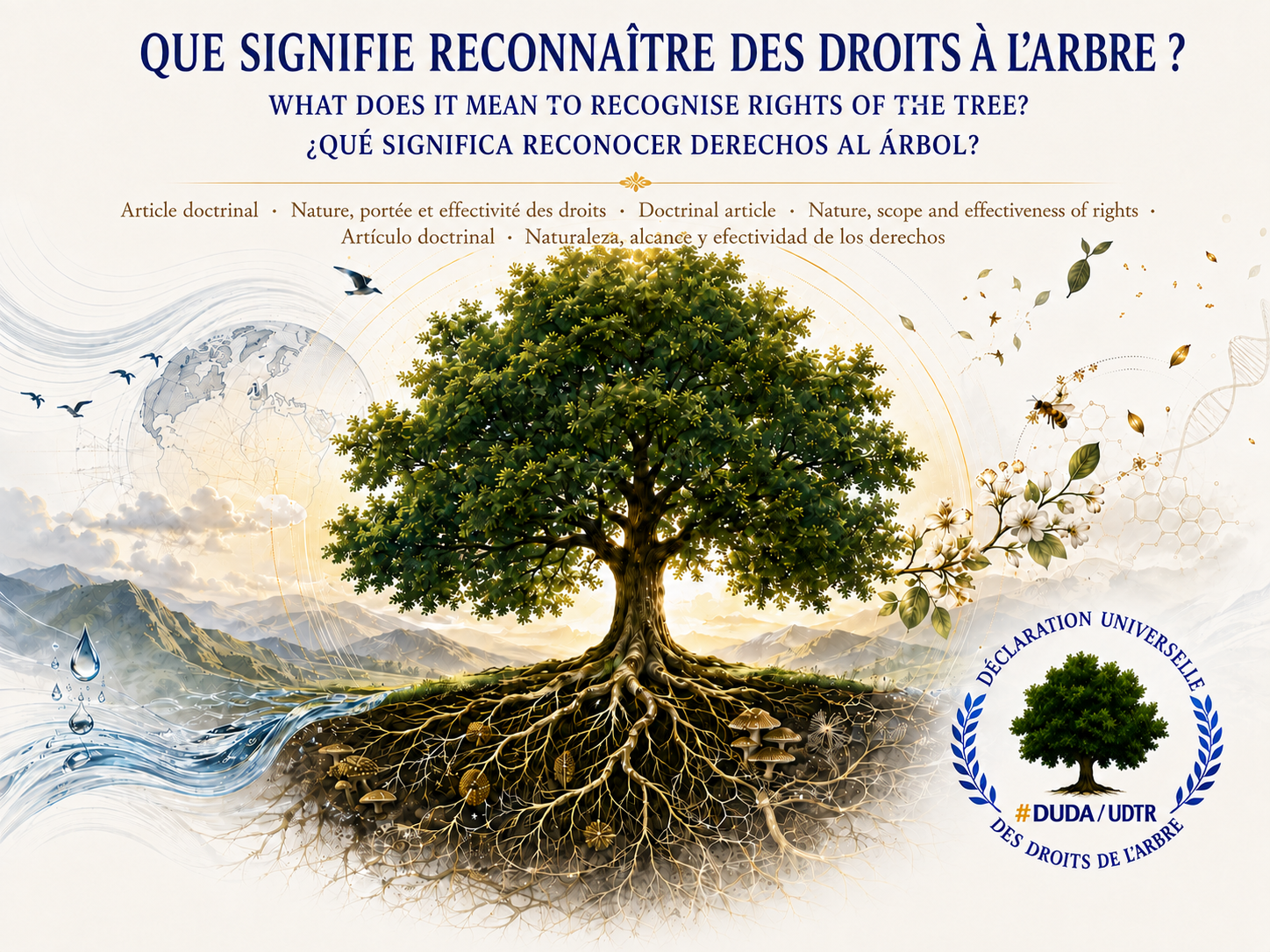
Nature, portée et effectivité des droits dans la Déclaration universelle des droits de l’Arbre
EN — What does it mean to recognise rights of the Tree? — Nature, scope and effectiveness of rights in the Universal Declaration of Tree Rights
ES — ¿Qué significa reconocer derechos al Árbol? — Naturaleza, alcance y efectividad de los derechos en la Declaración Universal de los Derechos del Árbol
IT — Che cosa significa riconoscere diritti all’Albero? — Natura, portata ed effettività dei diritti nella Dichiarazione universale dei diritti dell’Albero
La Déclaration universelle des droits de l’Arbre parle de « droits ». Pourtant, ses trois articles ne se présentent pas comme un catalogue classique de prérogatives formulées selon le modèle « tout arbre a droit à… ». Où se trouvent alors ces droits, quelle est leur nature et comment peuvent-ils devenir effectifs ?
La réponse exige de distinguer plusieurs plans que le débat public confond souvent : le principe et le droit, la reconnaissance et l’obligation, le droit et la personnalité juridique, la protection et l’opposabilité, la qualité pour agir et la justiciabilité. La Déclaration ne résout pas toutes ces questions par une technique juridique unique. Elle établit un socle universel à partir duquel elles peuvent être organisées par les ordres juridiques compétents.
Sa logique est progressive. L’article I qualifie l’Arbre dans sa réalité propre. L’article II justifie l’importance de cette reconnaissance par l’interdépendance entre l’existence de l’Arbre et la Vie. L’article III oblige l’être humain à tirer une conséquence de cette réalité en agissant avec l’Arbre dans un esprit de fraternité et de solidarité. De cette architecture peuvent procéder des droits, protections, obligations, procédures et politiques publiques, sans que ces concrétisations soient confondues avec le texte fondateur lui-même.
Le présent article expose la doctrine positive des droits de l’Arbre dans le cadre propre de la Déclaration. Il ne crée aucun catalogue supplémentaire, n’attribue pas automatiquement la personnalité juridique à l’Arbre et ne transforme pas, par simple affirmation, un principe universel en droit subjectif immédiatement justiciable dans tous les systèmes juridiques.
Publication : 16 août 2026 · Doctrine juridique · Droits de l’Arbre · Version 1.1 · Édition française · Mise à jour institutionnelle : 2 septembre 2026.
Les références juridiques, institutionnelles et doctrinales sont mobilisées afin de rendre les distinctions vérifiables. Leur citation ne signifie pas qu’un mécanisme national ou international particulier constitue, à lui seul, le modèle imposé par la Déclaration universelle des droits de l’Arbre.
I. Pourquoi parler de « droits de l’Arbre » ?
Le droit protège déjà les arbres pour de multiples raisons. Il peut protéger un arbre parce qu’il appartient à une personne, parce qu’il contribue à un paysage, parce qu’il constitue un habitat, parce qu’il assure une fonction écologique, parce qu’il présente une valeur patrimoniale ou parce que sa présence sert un intérêt collectif. Ces motifs sont importants, mais ils ne répondent pas entièrement à la question posée par le titre même de la Déclaration.
Parler de « droits de l’Arbre » introduit une idée supplémentaire : l’Arbre peut être juridiquement pris en considération non seulement pour ce que d’autres possèdent, retirent ou attendent de lui, mais aussi en raison d’intérêts attachés à sa propre existence de vivant. L’existence, l’intégrité, le développement, le milieu vital ou la capacité de régénération peuvent ainsi devenir des objets directs de protection normative.
Ce déplacement ne signifie pas que l’Arbre acquiert automatiquement, dans tous les systèmes, la qualité technique de « sujet de droit ». La Déclaration opère en amont de cette question. Elle refuse d’épuiser la réalité de l’Arbre dans les catégories de bien, de ressource, de propriété, de décor ou de service écosystémique. Elle lui reconnaît une valeur normative propre, susceptible d’être traduite juridiquement de plusieurs manières.
Question fondamentale
Protège-t-on seulement quelque chose pour l’être humain, ou reconnaît-on également quelque chose à l’Arbre lui-même ?
C’est ce second mouvement qui donne sa cohérence à l’expression « droits de l’Arbre ». Il ne supprime pas les protections fondées sur les intérêts humains ; il empêche simplement qu’elles soient les seules catégories juridiquement pensables.
II. Les trois articles ne constituent pas un catalogue fermé de droits
Une déclaration de droits humains formule souvent des prérogatives individualisées : droit à la vie, à la liberté, à la sûreté, à l’expression, à la propriété ou à un recours. La Déclaration universelle des droits de l’Arbre ne reproduit pas mécaniquement cette architecture. Elle ne transpose pas à l’Arbre un catalogue conçu pour l’être humain.
Ce choix est cohérent avec la nature de son objet. L’Arbre n’est pas un être humain auquel il suffirait d’attribuer, par analogie, les mêmes catégories. Sa réalité est biologique, relationnelle, territoriale et temporelle. Les droits qui peuvent lui être reconnus doivent donc être construits à partir de cette réalité propre.
Qu’est-ce que l’Arbre ?
L’article I lui reconnaît une réalité propre : être vivant sensible, source de Vie et bien commun de l’humanité.
Pourquoi cette reconnaissance importe-t-elle ?
L’article II inscrit l’Arbre dans les conditions de continuité de la Vie sur la planète.
Quelle conséquence l’être humain doit-il en tirer ?
L’article III impose un principe de conduite : agir avec l’Arbre dans un esprit de fraternité et de solidarité.
Concrétisation juridique
Droits · protections · obligations · procédures · politiques publiques
Les ordres juridiques compétents déterminent les mécanismes capables de donner effet à ce socle.
Effectivité
La reconnaissance devient opératoire lorsqu’elle modifie effectivement les décisions, les comportements, les procédures et, selon le droit applicable, les recours.
Formule doctrinale
Les trois articles constituent moins un catalogue fermé qu’une matrice normative permettant la reconnaissance et la concrétisation de droits adaptés à la réalité biologique, écologique et relationnelle de l’Arbre.
Cette architecture évite deux erreurs. La première consisterait à prétendre que seuls les mots littéralement présents dans les trois articles peuvent recevoir une traduction juridique. La seconde consisterait, à l’inverse, à inventer une liste de droits et à la présenter comme si elle appartenait au texte fondateur. La doctrine doit tenir ensemble l’ouverture de la matrice et l’intégrité du texte.
III. Du principe au droit : distinguer les catégories
La précision du vocabulaire est décisive. Un principe peut orienter l’interprétation et la décision sans conférer, à lui seul, une action individuelle devant un juge. Un intérêt peut être juridiquement protégé sans être formulé comme un droit subjectif. Une obligation imposée à une autorité ou à un propriétaire peut protéger l’Arbre sans que celui-ci reçoive nécessairement une capacité juridique autonome.
L’articulation entre qualification juridique, fondement scientifique et conséquence normative est développée dans Les fondements juridiques de la Déclaration universelle des droits de l’Arbre. Cette lecture complète la présente distinction des catégories sans transformer, à elle seule, les trois articles en droits subjectifs immédiatement justiciables.
| Catégorie | Fonction | Application à la doctrine de l’Arbre | Ce qu’il ne faut pas déduire automatiquement |
|---|---|---|---|
| Principe | Norme directrice donnant une orientation à l’interprétation et à l’action. | Reconnaître l’Arbre comme vivant, situer son existence dans la continuité de la Vie et encadrer l’action humaine. | Qu’un recours juridictionnel individuel existe déjà dans tout ordre juridique. |
| Intérêt juridiquement protégé | Intérêt auquel le droit accorde une valeur suffisante pour justifier protection ou prise en considération. | Par exemple, l’intégrité d’un arbre ou la conservation de son milieu vital peuvent être protégées directement. | Que l’Arbre dispose nécessairement d’une personnalité ou d’une capacité procédurale. |
| Droit | Position normative reconnue et protégée par un ordre juridique, dont le contenu et les effets dépendent de cet ordre. | Un ordre juridique peut reconnaître, par exemple, un droit à la vie, à l’intégrité ou à la régénération de l’Arbre selon des modalités qu’il définit. | Que ce droit soit nécessairement absolu, directement opposable à tous ou immédiatement justiciable. |
| Obligation | Comportement exigé d’une autorité, d’un propriétaire, d’un opérateur ou d’un tiers. | Évaluer, éviter, justifier, protéger, restaurer ou respecter certaines conditions d’intervention. | Que l’obligé et le titulaire d’un droit soient la même personne juridique ou que l’Arbre doive être juridiquement personnifié. |
| Garantie | Mécanisme destiné à rendre une protection effective. | Autorisation préalable, expertise contradictoire, représentant, contrôle administratif ou juridictionnel, sanction, restauration. | Qu’une garantie particulière soit exigée universellement par le seul texte des trois articles. |
IV. Droits de l’Arbre et personnalité juridique : deux questions distinctes
La personnalité juridique est une technique par laquelle un ordre juridique reconnaît à une entité une aptitude à être titulaire de droits et d’obligations, avec des effets qui varient selon le système. Elle peut s’accompagner de représentation, de capacité patrimoniale ou de mécanismes procéduraux. Elle n’est toutefois pas la seule manière de protéger juridiquement un intérêt.
Un arbre peut bénéficier d’une protection directe particulièrement forte sans devenir une personne juridique. Une loi ou un règlement peut interdire certaines atteintes, imposer des distances de protection racinaire, conditionner un abattage à une autorisation, exiger la démonstration d’une nécessité, ordonner une restauration ou prévoir des sanctions. Dans toutes ces hypothèses, le droit peut reconnaître des intérêts propres à l’Arbre en agissant sur les conduites humaines.
À l’inverse, certains systèmes peuvent choisir la personnalité juridique pour organiser la représentation d’un élément naturel. Ce choix est juridiquement possible dans certains contextes, mais il ne constitue ni une conséquence automatique des trois articles ni une condition nécessaire à la mise en œuvre de la Déclaration.
Formule essentielle
La Déclaration n’impose pas une technique juridique universelle ; elle établit un socle universel de reconnaissance.
Cette distinction est développée dans l’analyse doctrinale Au-delà de la personnalité juridique : quels droits pour l’Arbre ? et dans la note consacrée à Christopher D. Stone et la Déclaration universelle des droits de l’Arbre.
V. Droit, représentation, qualité pour agir et justiciabilité
Une confusion fréquente consiste à déduire toute la chaîne procédurale du seul mot « droit ». Or plusieurs décisions juridiques distinctes doivent être prises. Reconnaître un droit ou un intérêt protégé n’indique pas nécessairement qui peut le représenter, qui peut saisir un juge, contre qui la norme est opposable, quel contrôle le juge peut exercer ni quelle réparation est disponible.
| Notion | Question juridique | Ce que la Déclaration n’établit pas automatiquement |
|---|---|---|
| Reconnaissance d’un droit | Quel intérêt ou quelle position normative est protégé ? | Sa force obligatoire précise dans chaque ordre juridique. |
| Représentation | Qui est habilité à exprimer ou défendre juridiquement l’intérêt protégé ? | L’existence d’un représentant universel obligatoire de l’Arbre. |
| Qualité pour agir | Quelle personne ou institution peut saisir une juridiction ? | Un standing général reconnu à toute personne au nom de tout arbre. |
| Opposabilité | À quels destinataires une norme peut-elle être juridiquement invoquée ? | Une opposabilité générale et immédiate par la seule publication de la Déclaration. |
| Justiciabilité | Un juge peut-il contrôler le respect de la norme et avec quelle intensité ? | Un contrôle juridictionnel identique dans tous les États. |
| Sanction ou réparation | Quelle conséquence attacher à une violation ? | Un régime universel prédéterminé d’amende, d’indemnisation, d’annulation ou de restauration. |
VI. Quels droits peuvent être concrétisés à partir de la Déclaration ?
La réponse doit rester rigoureuse : la Déclaration ne contient pas, après ses trois articles, une seconde liste officielle et implicite qu’il suffirait de révéler. En revanche, son architecture rend possibles des concrétisations juridiques cohérentes avec ce qu’elle reconnaît de l’Arbre.
À partir de la qualification de l’article I, de la justification écologique de l’article II et de l’obligation relationnelle de l’article III, un ordre juridique peut notamment décider de protéger :
- l’existence et la vie de l’Arbre, lorsque le contexte juridique retient ce niveau de protection ;
- son intégrité biologique et structurelle ;
- sa croissance et son développement naturel, compte tenu de son espèce et de son environnement ;
- le respect de ses caractéristiques biologiques et de sa temporalité propre ;
- l’accès aux conditions nécessaires à sa vie, notamment l’eau, l’air, l’espace et un sol compatible avec son maintien ;
- son système racinaire, son sol et son environnement immédiat lorsque leur altération compromet l’organisme ;
- les relations écologiques essentielles qu’il entretient avec d’autres organismes ;
- sa capacité de régénération lorsqu’elle demeure biologiquement possible ;
- la continuité de fonctions écologiques déterminantes dans le contexte considéré ;
- la prévention des atteintes graves ou irréversibles ;
- la restauration lorsqu’elle demeure matériellement et biologiquement possible.
Cette distinction protège l’intégrité du texte fondateur tout en permettant son effectivité. Une déclaration universelle perdrait sa fonction si elle était enfermée dans un mécanisme juridique unique ; elle perdrait aussi sa rigueur si toute proposition ultérieure pouvait être présentée comme faisant déjà partie de son texte.
VIII. Universalité des principes, pluralité des techniques juridiques
Une Déclaration à vocation universelle ne peut supposer que tous les États disposent des mêmes catégories de droit, des mêmes procédures, des mêmes institutions ni de la même organisation territoriale. Les traditions constitutionnelles, les répartitions de compétences, les régimes de propriété, les structures administratives et les mécanismes contentieux diffèrent.
L’universalité doit donc porter sur ce qui peut réellement être universel : la reconnaissance de l’Arbre dans sa réalité vivante, l’importance de son existence pour la Vie et l’obligation humaine d’agir avec lui selon une logique de responsabilité. La technique de mise en œuvre relève ensuite du droit applicable.
Techniques possibles selon les ordres juridiques
- obligation administrative de prise en considération ou de motivation ;
- protection législative ou réglementaire ;
- droit opposable défini par un texte compétent ;
- obligation procédurale avant toute atteinte ;
- régime de représentation ou de gardiennage ;
- protection pénale ou administrative contre certaines atteintes ;
- mécanisme de prévention et d’évitement ;
- régime de restauration ou de réparation ;
- dans certains systèmes, attribution d’une personnalité juridique ou d’un statut comparable.
Principe d’articulation
L’universalité porte sur le principe ; la technique juridique relève de sa mise en œuvre.
Cette pluralité n’affaiblit pas nécessairement la Déclaration. Elle permet au contraire de distinguer ce qui doit demeurer commun de ce qui doit être juridiquement contextualisé. Une technique efficace dans une municipalité canadienne peut ne pas être transposable telle quelle dans un État unitaire, un système fédéral, un droit coutumier ou un ordre constitutionnel différent.
IX. De la reconnaissance à l’effectivité
Le mot « effectivité » ne désigne pas une seule chose. Entre une affirmation éthique et une sanction juridictionnelle existe une série de niveaux qui peuvent se cumuler, apparaître progressivement ou ne pas tous être présents dans un système donné. Les distinguer permet d’éviter le faux dilemme selon lequel un droit serait soit immédiatement justiciable, soit dépourvu de toute portée.
| Niveau | Portée | Question décisive |
|---|---|---|
| Force éthique | Modifie les critères de responsabilité et de légitimité de l’action. | Que devons-nous considérer avant d’agir ? |
| Fondement scientifique | Établit les faits biologiques et écologiques sur lesquels une politique ou une norme peut s’appuyer. | Quels faits sont établis, incertains ou contextuels ? |
| Force politique | Oriente les objectifs, stratégies, programmes et arbitrages publics. | La reconnaissance modifie-t-elle réellement les décisions ? |
| Force normative | Fournit une norme de référence, d’interprétation ou d’orientation. | Quel effet lui reconnaît l’instrument d’adoption ? |
| Force juridique obligatoire | Impose un comportement déterminé en vertu d’une source juridiquement contraignante. | Quelle autorité compétente a créé l’obligation et avec quelle portée ? |
| Opposabilité | Permet d’invoquer la norme à l’encontre de destinataires déterminés. | À qui, dans quelles conditions et avec quel effet ? |
| Justiciabilité | Permet un contrôle par une juridiction selon des règles de recevabilité et de compétence. | Quel juge, quel requérant, quel standard de contrôle ? |
| Sanction ou réparation | Attache une conséquence à la violation : cessation, annulation, restauration, réparation, sanction administrative, civile ou pénale. | Quelle réponse est pertinente et biologiquement utile ? |
Effectivité
Un droit ne devient pas sérieux seulement lorsqu’une sanction est prononcée. Il devient effectif lorsqu’il est capable de modifier en amont les critères, les procédures et les décisions qui affectent l’Arbre.
X. Déclaration, Quinze Engagements et Convention : trois niveaux à ne pas confondre
Le corpus officiel distingue plusieurs instruments qui répondent à des fonctions différentes. Cette distinction est essentielle : ce qui relève d’une feuille de route institutionnelle ou d’un futur instrument international ne doit pas être attribué rétroactivement aux trois articles fondateurs.
| Instrument | Fonction | Statut doctrinal |
|---|---|---|
| La Déclaration | Établit le socle universel de reconnaissance en trois articles. | Texte fondateur. Il ne doit pas être réécrit par les instruments de mise en œuvre. |
| Les Quinze Engagements | Organisent une feuille de route institutionnelle et opérationnelle pour les collectivités qui adoptent la Déclaration. | Dans le cadre officiel actuellement publié, leur adoption accompagne de manière concomitante et intégrale l’adoption institutionnelle de la Déclaration ; leur mise en œuvre est progressive. |
| La Convention internationale | Projet d’instrument international susceptible, s’il aboutit, de préciser des engagements étatiques, obligations et mécanismes de coopération ou de suivi. | Projet : elle n’est pas un traité international en vigueur et ne doit pas être présentée comme tel. |
Comprendre la Déclaration universelle des droits de l’Arbre · Adhésion des collectivités : principes, procédure et portée juridique · Consulter les Quinze Engagements · Projet de Convention internationale des droits de l’Arbre.
XI. Ce que reconnaître des droits à l’Arbre change dans la décision publique
L’une des conséquences les plus importantes de la reconnaissance est méthodologique. Tant que l’Arbre est pensé uniquement comme l’objet d’une compétence humaine, la question juridique peut se réduire à : « Avons-nous juridiquement le pouvoir de faire cette intervention ? » Les droits de l’Arbre ajoutent une seconde série de questions : « Qu’est-ce qui doit être pris en considération avant de décider ? »
Questions de décision
- la suppression ou l’atteinte projetée est-elle réellement nécessaire ?
- existe-t-il une alternative techniquement et juridiquement raisonnable ?
- quel est l’état biologique réel de l’Arbre, au-delà d’une appréciation sommaire ou esthétique ?
- quel rôle joue-t-il dans son écosystème, son paysage, son quartier ou son territoire ?
- quelles conséquences sa disparition ou son altération entraîne-t-elle ?
- son intégrité, son système racinaire et son milieu vital ont-ils été suffisamment pris en considération ?
- la décision intervient-elle assez tôt pour éviter qu’une atteinte irréversible ne rende le contrôle ultérieur inutile ?
Le changement est donc moins spectaculaire qu’une fiction juridique et, potentiellement, plus profond dans la pratique : la décision doit intégrer l’Arbre avant qu’il ne devienne seulement l’objet d’une autorisation, d’un dommage ou d’une indemnisation.
Principe d’effectivité
Le droit de l’Arbre doit pouvoir intervenir avant le dommage, et pas seulement après lui.
XII. La prévention comme conséquence des droits de l’Arbre
La temporalité du vivant donne une importance particulière à la prévention. Une procédure exclusivement réparatrice intervient souvent trop tard. Lorsqu’un arbre ancien est détruit, une compensation financière ou même une replantation peut produire des effets utiles ; elle ne recrée pas instantanément l’organisme perdu.
Elle ne restitue pas son âge, son architecture, son volume racinaire, ses cavités, ses microhabitats, ses réserves, son insertion dans le sol, les relations biologiques qu’il entretenait ni le temps nécessaire à la constitution de ces caractéristiques. Le droit doit donc tenir compte de cette asymétrie fondamentale : une atteinte peut être instantanée ; la reconstitution du vivant peut demander des décennies, voire ne jamais être équivalente.
La prévention ne signifie pas qu’aucune atteinte ne puisse jamais être autorisée. Elle signifie que l’irréversibilité doit compter dans la décision et que l’évitement ne doit pas être traité comme une formalité secondaire lorsque l’Arbre peut encore être conservé.
XIII. Les droits de l’Arbre ne s’opposent pas aux droits humains
Reconnaître des intérêts propres à l’Arbre ne suppose pas de retirer des droits à l’être humain pour les transférer à l’Arbre. La Déclaration ne construit pas une compétition abstraite entre deux titulaires auxquels le droit devrait attribuer un vainqueur. Elle cherche à modifier la manière dont les intérêts sont identifiés et conciliés.
Les droits humains — sécurité, santé, logement, propriété, activité économique, mobilité, culture ou autres libertés protégées — continuent d’exister selon les ordres juridiques compétents. La reconnaissance de l’Arbre ajoute l’exigence de ne pas faire disparaître sa réalité vivante du raisonnement. Il faut alors organiser des rapports de coexistence, de nécessité, de responsabilité et de proportionnalité.
L’article III fournit ici le principe relationnel : « agir avec l’Arbre ». La fraternité et la solidarité ne demandent pas l’abolition de toute décision humaine ; elles demandent que la décision ne soit plus construite comme si l’Arbre était juridiquement absent de la relation.
XIV. Reconnaître des droits ne signifie pas interdire toute intervention
Un droit n’est pas nécessairement absolu. La protection de l’Arbre doit pouvoir tenir compte des situations concrètes : soin, taille raisonnée, gestion d’un verger ou d’une forêt, intervention sanitaire, risque structurel avéré, sécurité des personnes, restauration écologique, contrôle d’une espèce envahissante ou transformation décidée dans un cadre légal d’intérêt général.
L’existence de ces situations ne vide pas les droits de leur contenu. Elle déplace la question vers la justification de l’intervention. Une atteinte ne devrait pas être réputée légitime du seul fait qu’elle est matériellement possible ou économiquement commode. Elle doit pouvoir être examinée au regard de critères adaptés.
| Critère | Question | Finalité |
|---|---|---|
| Nécessité | L’intervention répond-elle à un besoin réel et établi ? | Écarter les atteintes gratuites ou insuffisamment justifiées. |
| État biologique | Le diagnostic distingue-t-il danger, déclin, sénescence et simple contrainte de gestion ? | Fonder la décision sur le réel plutôt que sur une présomption. |
| Alternatives | Une solution moins dommageable existe-t-elle ? | Donner une portée concrète à l’évitement. |
| Proportionnalité | L’intensité de l’atteinte est-elle proportionnée à l’objectif poursuivi ? | Éviter qu’une contrainte limitée justifie une destruction excessive. |
| Conditions d’intervention | Quand, comment et avec quelles précautions intervenir ? | Réduire le dommage biologique évitable. |
| Restauration ou compensation | Que peut-on réellement restaurer, et que ne peut-on pas remplacer ? | Ne pas confondre réparation juridique et équivalence biologique. |
Ainsi comprise, la reconnaissance n’est ni un interdit absolu ni une autorisation de principe. Elle impose une discipline de justification : regarder l’Arbre comme un vivant affecté par la décision et non comme une matière juridiquement neutre.
XV. Une relation juridique nouvelle : de la domination à la responsabilité
La Déclaration ne cherche pas seulement à multiplier les règles relatives aux arbres. Elle propose de déplacer le point de départ du raisonnement. Dans une logique exclusivement instrumentale, la première question est : « Que pouvons-nous faire de cet arbre ? » Dans la logique de la Déclaration, une question préalable apparaît : « Que devons-nous prendre en considération avant d’agir sur lui ? »
Ce déplacement donne tout son sens à l’expression de l’article III : « agir avec l’Arbre ». Le mot « avec » refuse une relation construite uniquement depuis la puissance de décision humaine. Il introduit l’idée d’une relation dans laquelle la réalité propre de l’autre terme — ici l’Arbre — doit compter dans l’élaboration de la décision.
La fraternité et la solidarité ne sont donc pas seulement des images morales. Dans la doctrine de la Déclaration, elles orientent une responsabilité : tenir compte de la vulnérabilité du vivant, de l’interdépendance écologique, de la durée biologique et des conséquences que les décisions humaines imposent à ce qui ne participe pas lui-même aux institutions qui décident.
Déplacement du raisonnement
Le droit de l’Arbre ne commence pas par la fiction qu’il déciderait comme un humain. Il commence par l’obligation pour l’humain de ne plus décider comme si l’Arbre n’existait que pour lui.
XVI. Ce que la Déclaration affirme — et ce qu’elle n’affirme pas
Une doctrine rigoureuse doit être capable de formuler positivement la portée de la Déclaration tout en indiquant clairement les conséquences qui ne peuvent pas lui être attribuées sans texte de mise en œuvre supplémentaire.
| La Déclaration affirme | Elle n’affirme pas automatiquement |
|---|---|
| Une reconnaissance propre de l’Arbre comme être vivant sensible, source de Vie et bien commun de l’humanité. | Que tout arbre possède une personnalité juridique dans tous les ordres juridiques. |
| L’inscription de l’Arbre dans les conditions fondamentales de la Vie sur la planète. | Que tout arbre dispose d’une capacité juridique autonome ou puisse accomplir lui-même des actes juridiques. |
| Une responsabilité humaine envers l’Arbre, formulée par l’obligation d’agir avec lui dans un esprit de fraternité et de solidarité. | Qu’un représentant universel obligatoire lui soit attribué. |
| La possibilité et la nécessité d’une traduction concrète des principes par des protections, obligations et mécanismes appropriés. | Que toute personne dispose automatiquement d’une qualité pour agir en justice au nom de tout arbre. |
| La légitimité d’une prise en considération directe de l’existence, de l’intégrité et des conditions de développement de l’Arbre. | Que toute coupe, taille, gestion ou intervention humaine soit interdite. |
| Une orientation vers la prévention, la responsabilité et l’effectivité. | Qu’un modèle juridique identique doive être imposé à tous les États et à toutes les collectivités. |
| L’articulation possible avec des instruments de mise en œuvre ultérieurs. | Que les règles nationales existantes soient automatiquement remplacées par la Déclaration, les Quinze Engagements ou le projet de Convention. |
Pour les règles institutionnelles de représentation, d’adoption, d’utilisation et d’articulation des différents instruments, consulter le Cadre officiel de la Déclaration universelle des droits de l’Arbre.
XVII. Conclusion — Des principes universels aux droits effectifs
Que signifie donc reconnaître des droits à l’Arbre ? Cela signifie d’abord reconnaître que son existence, son intégrité et les conditions nécessaires à son développement ne doivent plus être considérées exclusivement à travers les intérêts humains qui s’y attachent, mais peuvent constituer en elles-mêmes l’objet d’une protection normative.
La Déclaration fournit le socle de cette reconnaissance. Elle qualifie l’Arbre, justifie l’importance de son existence et formule une obligation humaine de conduite. Elle ne prétend pas, en trois articles, régler chaque question de capacité, de représentation, de procédure, de recours ou de sanction. Ces éléments relèvent de la concrétisation par les collectivités, les législateurs, les administrations, les juridictions et, éventuellement, de futurs instruments internationaux.
La portée universelle de la Déclaration n’est donc pas l’uniformité. Elle réside dans un changement commun de point de départ : l’Arbre ne doit plus être uniquement l’objet sur lequel porte la décision ; il devient une réalité vivante dont la décision doit prendre en considération les intérêts, les conditions d’existence et la vulnérabilité.
Conclusion doctrinale
La Déclaration ne dicte pas un droit unique de l’Arbre. Elle établit les principes universels à partir desquels le droit peut cesser de considérer l’Arbre uniquement comme un objet de décision et commencer à prendre en considération ce qui lui est dû.
Références juridiques, institutionnelles et doctrinales
Corpus officiel de la Déclaration
- Site officiel de la Déclaration universelle des droits de l’Arbre
- Article I — Être vivant sensible, source de Vie et bien commun de l’humanité
- Article II — Fondements scientifiques
- Article III — Agir avec l’Arbre : fraternité et solidarité
- Comprendre la Déclaration universelle des droits de l’Arbre
- Les fondements juridiques de la Déclaration universelle des droits de l’Arbre
- Cadre officiel de la Déclaration universelle des droits de l’Arbre
- L’adhésion des collectivités à la Déclaration universelle des droits de l’Arbre : principes, procédure et portée juridique
- Christopher D. Stone et la Déclaration universelle des droits de l’Arbre
- Au-delà de la personnalité juridique : quels droits pour l’Arbre ?
- Les Quinze Engagements des collectivités locales et régionales
- Projet de Convention internationale des droits de l’Arbre
Transparence doctrinale
Cet article distingue délibérément le texte fondateur de la Déclaration, son interprétation doctrinale et les mécanismes de droit positif qui peuvent lui donner effet. Les exemples de droits, d’obligations, de procédures et de garanties présentés ici sont qualifiés comme concrétisations possibles lorsqu’ils ne figurent pas littéralement dans les trois articles.
Aucune extension interprétative ne doit être présentée comme appartenant au texte original. Inversement, l’absence d’un mécanisme universel de personnalité, de représentation ou de contentieux ne doit pas être utilisée pour nier la portée normative du socle posé par la Déclaration.
Par Ricardo Rey
Auteur et initiateur de la Déclaration universelle des droits de l’Arbre
Président de La Compagnie des Papillons Bleus
Préparé et publié dans le cadre des travaux de La Compagnie des Papillons Bleus, organisation assurant le portage institutionnel officiel de la Déclaration universelle des droits de l’Arbre.
Site officiel : www.declarationuniverselledesdroitsdelarbre.org
Nature, scope and effectiveness of rights in the Universal Declaration of Tree Rights
FR — Que signifie reconnaître des droits à l’Arbre ? — Nature, portée et effectivité des droits dans la Déclaration universelle des droits de l’Arbre
ES — ¿Qué significa reconocer derechos al Árbol? — Naturaleza, alcance y efectividad de los derechos en la Declaración Universal de los Derechos del Árbol
The Universal Declaration of Tree Rights speaks of “rights”. Yet its three Articles do not take the form of a conventional catalogue of entitlements framed as “every Tree has the right to…”. Where, then, are these rights located, what is their legal nature, and how can they become effective?
A proper answer requires several levels that public debate often conflates to be distinguished clearly: principle and right; recognition and obligation; rights and legal personhood; protection and enforceability; standing and justiciability. The Declaration does not resolve all these questions through a single legal technique. It establishes a universal foundation from which they may be organised by the competent legal orders.
Its logic is progressive. Article I characterises the Tree in its own reality. Article II justifies the importance of that recognition through the interdependence between the existence of the Tree and Life. Article III requires human beings to draw a consequence from that reality by acting with the Tree in a spirit of fraternity and solidarity. Rights, protections, obligations, procedures and public policies may flow from this architecture without those forms of implementation being confused with the founding text itself.
This article sets out the positive doctrine of Tree Rights within the Declaration’s own framework. It creates no additional catalogue, does not automatically confer legal personhood upon the Tree, and does not, by mere assertion, transform a universal principle into an immediately justiciable subjective right in every legal system.
Published: 16 August 2026 · Legal doctrine · Tree Rights · Version 1.1 · English edition · Institutional update: 2 September 2026.
Legal, institutional and doctrinal references are used to make the distinctions verifiable. Their citation does not mean that any particular national or international mechanism constitutes, by itself, the model imposed by the Universal Declaration of Tree Rights.
I. Why speak of “Tree Rights”?
Law already protects trees for many reasons. It may protect a tree because it belongs to someone, contributes to a landscape, constitutes habitat, performs an ecological function, has heritage value, or because its presence serves a collective interest. These grounds matter, but they do not fully answer the question posed by the Declaration’s very title.
Speaking of “Tree Rights” introduces a further idea: the Tree may be taken into legal consideration not only for what others own, obtain or expect from it, but also because of interests attached to its own existence as a living being. Existence, integrity, development, living environment and regenerative capacity may therefore become direct objects of normative protection.
This shift does not mean that the Tree automatically acquires, in every system, the technical status of a “subject of law”. The Declaration operates upstream of that question. It refuses to exhaust the reality of the Tree within the categories of asset, resource, property, decoration or ecosystem service. It recognises the Tree as having normative value in its own right, capable of being translated into law in several ways.
Fundamental question
Are we protecting something only for human beings, or are we also recognising something as being due to the Tree itself?
It is this second movement that gives coherence to the expression “Tree Rights”. It does not eliminate protections based on human interests; it simply prevents them from being the only legally conceivable categories.
II. The three Articles do not constitute a closed catalogue of rights
A human-rights declaration often formulates individualised entitlements: rights to life, liberty, security, expression, property or a remedy. The Universal Declaration of Tree Rights does not mechanically reproduce that architecture. It does not transpose to the Tree a catalogue designed for human beings.
This choice is consistent with the nature of its object. The Tree is not a human being to whom the same categories could simply be attributed by analogy. Its reality is biological, relational, territorial and temporal. Rights capable of being recognised for the Tree must therefore be constructed from that reality.
What is the Tree?
Article I recognises it in its own reality: a sentient living being, source of Life and common good of humanity.
Why does this recognition matter?
Article II places the Tree within the conditions for the continuity of Life on Earth.
What consequence must human beings draw?
Article III lays down a principle of conduct: act with the Tree in a spirit of fraternity and solidarity.
Legal concretisation
Rights · protections · obligations · procedures · public policies
Competent legal orders determine the mechanisms capable of giving effect to this foundation.
Effectiveness
Recognition becomes operative when it actually changes decisions, conduct, procedures and, depending on applicable law, remedies.
Doctrinal formula
The three Articles constitute less a closed catalogue than a normative matrix enabling the recognition and concretisation of rights adapted to the Tree’s biological, ecological and relational reality.
This architecture avoids two errors. The first would be to claim that only the words literally appearing in the three Articles can receive a legal translation. The second would, conversely, be to invent a list of rights and present it as though it belonged to the founding text. Doctrine must preserve both the openness of the matrix and the integrity of the text.
III. From principle to right: distinguishing the categories
Precision of vocabulary is decisive. A principle may guide interpretation and decision-making without, by itself, conferring an individual cause of action before a court. An interest may be legally protected without being formulated as a subjective right. An obligation imposed upon an authority or owner may protect the Tree without the Tree necessarily receiving autonomous legal capacity.
The articulation between legal characterisation, scientific foundation and normative consequence is developed in The legal foundations of the Universal Declaration of Tree Rights. That analysis complements the present distinction between categories without, by itself, transforming the three Articles into immediately justiciable subjective rights.
| Category | Function | Application to Tree Rights doctrine | What must not be inferred automatically |
|---|---|---|---|
| Principle | A guiding norm orienting interpretation and action. | Recognise the Tree as living, situate its existence within the continuity of Life, and frame human action. | That an individual judicial remedy already exists in every legal order. |
| Legally protected interest | An interest to which law accords sufficient value to justify protection or consideration. | For example, a Tree’s integrity or the conservation of its living environment may be directly protected. | That the Tree necessarily has legal personhood or procedural capacity. |
| Right | A normative position recognised and protected by a legal order, whose content and effects depend on that order. | A legal order may, for example, recognise a right of the Tree to life, integrity or regeneration under terms it defines. | That the right is necessarily absolute, directly enforceable against everyone or immediately justiciable. |
| Obligation | Conduct required of an authority, owner, operator or third party. | Assess, avoid, justify, protect, restore, or comply with specified conditions of intervention. | That the duty-bearer and the holder of a right must be the same legal person, or that the Tree must be legally personified. |
| Safeguard | A mechanism intended to make protection effective. | Prior authorisation, adversarial expert assessment, representative, administrative or judicial review, sanction, restoration. | That any particular safeguard is universally required by the three Articles alone. |
IV. Tree Rights and legal personhood: two distinct questions
Legal personhood is a technique by which a legal order recognises an entity as capable of holding rights and obligations, with effects that vary from one system to another. It may be accompanied by representation, patrimonial capacity or procedural mechanisms. It is not, however, the only way to protect an interest in law.
A Tree may benefit from particularly strong direct protection without becoming a legal person. Legislation or regulation may prohibit certain harms, impose root-protection distances, make felling subject to authorisation, require proof of necessity, order restoration or provide sanctions. In each of these situations, law may recognise interests proper to the Tree by regulating human conduct.
Conversely, some systems may choose legal personhood to organise the representation of a natural entity. That choice may be legally available in certain contexts, but it is neither an automatic consequence of the three Articles nor a necessary condition for implementing the Declaration.
Essential formula
The Declaration does not impose a universal legal technique; it establishes a universal foundation of recognition.
This distinction is developed in the doctrinal analysis Beyond legal personhood: what rights for the Tree? and in the note on Christopher D. Stone and the Universal Declaration of Tree Rights.
V. Right, representation, standing and justiciability
A frequent confusion is to infer the entire procedural chain from the word “right” alone. Yet several separate legal decisions are required. Recognising a right or protected interest does not necessarily determine who may represent it, who may bring proceedings, against whom the norm is enforceable, what review a court may undertake, or what remedy is available.
| Concept | Legal question | What the Declaration does not establish automatically |
|---|---|---|
| Recognition of a right | What interest or normative position is protected? | Its precise binding force in each legal order. |
| Representation | Who is authorised to express or legally defend the protected interest? | A mandatory universal representative of the Tree. |
| Standing | Which person or institution may bring proceedings before a court? | General standing for any person in the name of any Tree. |
| Enforceability | Against which addressees may the norm be legally invoked? | General and immediate enforceability solely by publication of the Declaration. |
| Justiciability | May a court review compliance with the norm, and with what intensity? | Identical judicial review in every State. |
| Sanction or remedy | What consequence attaches to a violation? | A predetermined universal regime of fines, damages, annulment or restoration. |
VI. What rights may be concretised from the Declaration?
The answer must remain rigorous: after its three Articles, the Declaration does not contain a second official and implicit list simply waiting to be revealed. Its architecture does, however, make possible legal concretisations that are consistent with what it recognises about the Tree.
From the characterisation in Article I, the ecological justification in Article II and the relational obligation in Article III, a legal order may in particular decide to protect:
- the existence and life of the Tree, where the relevant legal context adopts that level of protection;
- its biological and structural integrity;
- its natural growth and development, taking account of its species and environment;
- respect for its biological characteristics and its own temporality;
- access to the conditions necessary for its life, including water, air, space and soil compatible with its continued existence;
- its root system, soil and immediate environment where their alteration compromises the organism;
- the essential ecological relationships it maintains with other organisms;
- its capacity for regeneration where biologically possible;
- the continuity of decisive ecological functions in the relevant context;
- prevention of serious or irreversible harm;
- restoration where materially and biologically possible.
VIII. Universality of principles, plurality of legal techniques
A declaration with universal ambition cannot assume that all States possess the same legal categories, procedures, institutions or territorial organisation. Constitutional traditions, allocations of powers, property regimes, administrative structures and litigation mechanisms differ.
Universality must therefore concern what can genuinely be universal: recognition of the Tree in its living reality, the importance of its existence for Life, and the human obligation to act with it according to a logic of responsibility. The technique of implementation then belongs to applicable law.
Principle of articulation
Universality concerns the principle; the legal technique belongs to implementation.
This plurality does not necessarily weaken the Declaration. On the contrary, it distinguishes what should remain common from what must be legally contextualised. A technique effective in a Canadian municipality may not be transferable unchanged to a unitary State, a federal system, customary law or a different constitutional order.
IX. From recognition to effectiveness
“Effectiveness” does not denote a single thing. Between an ethical statement and a judicial sanction lies a series of levels that may be cumulative, may emerge progressively, or may not all be present in a given system. Distinguishing them avoids the false dilemma according to which a right is either immediately justiciable or entirely devoid of effect.
| Level | Scope | Decisive question |
|---|---|---|
| Ethical force | Changes the criteria of responsibility and legitimacy of action. | What must we consider before acting? |
| Scientific foundation | Establishes the biological and ecological facts upon which policy or a norm may rely. | Which facts are established, uncertain or context-dependent? |
| Political force | Orients public objectives, strategies, programmes and trade-offs. | Does recognition actually change decisions? |
| Normative force | Provides a reference norm for interpretation or orientation. | What effect does the adopting instrument give it? |
| Legally binding force | Requires specified conduct by virtue of a legally binding source. | Which competent authority created the obligation, and with what scope? |
| Enforceability | Allows the norm to be invoked against specified addressees. | Against whom, under what conditions, and with what effect? |
| Justiciability | Allows review by a court under rules of admissibility and jurisdiction. | Which court, which claimant, which standard of review? |
| Sanction or remedy | Attaches a consequence to breach: cessation, annulment, restoration, reparation, administrative, civil or criminal sanction. | What response is relevant and biologically useful? |
Effectiveness
A right does not become serious only when a sanction is imposed. It becomes effective when it is capable of changing, upstream, the criteria, procedures and decisions that affect the Tree.
X. Declaration, Fifteen Commitments and Convention: three levels not to be confused
The official corpus distinguishes several instruments serving different functions. This distinction is essential: what belongs to an institutional roadmap or a future international instrument must not be retroactively attributed to the three founding Articles.
| Instrument | Function | Doctrinal status |
|---|---|---|
| The Declaration | Establishes the universal foundation of recognition in three Articles. | Founding text. It must not be rewritten by implementation instruments. |
| The Fifteen Commitments | Organise an institutional and operational roadmap for local and regional authorities adopting the Declaration. | Under the currently published official framework, their adoption accompanies institutional adoption of the Declaration simultaneously and in full; implementation is progressive. |
| The International Convention | A proposed international instrument that, if brought to fruition, could specify State commitments, obligations and mechanisms for cooperation or follow-up. | Draft project: it is not an international treaty currently in force and must not be presented as such. |
XI. What recognising Tree Rights changes in public decision-making
One of the most important consequences of recognition is methodological. So long as the Tree is conceived solely as the object of human power, the legal question may be reduced to: “Do we legally have the power to carry out this intervention?” Tree Rights add a second set of questions: “What must be taken into consideration before deciding?”
The change is therefore less spectacular than a legal fiction and potentially deeper in practice: the decision must integrate the Tree before it becomes merely the object of an authorisation, damage assessment or compensation.
Principle of effectiveness
Tree Rights must be capable of operating before harm occurs, not only after it.
XII. Prevention as a consequence of Tree Rights
The temporality of living systems gives prevention particular importance. A purely remedial procedure often intervenes too late. When an old Tree is destroyed, financial compensation or even replanting may produce useful effects; it does not instantly recreate the lost organism.
It does not restore its age, architecture, root volume, cavities, microhabitats, reserves, integration within the soil, the biological relationships it maintained, or the time required for those characteristics to form. Law must therefore take account of a fundamental asymmetry: harm may be instantaneous; reconstruction of living systems may require decades, or may never be biologically equivalent.
Prevention does not mean that no harm can ever be authorised. It means that irreversibility must count in the decision and that avoidance must not be treated as a secondary formality while the Tree can still be conserved.
XIII. Tree Rights do not oppose human rights
Recognising interests proper to the Tree does not require taking rights away from human beings in order to transfer them to the Tree. The Declaration does not construct an abstract competition between two rights-holders in which law must choose a winner. It seeks to change how interests are identified and reconciled.
Human rights — safety, health, housing, property, economic activity, mobility, culture and other protected freedoms — continue to exist under the competent legal orders. Recognition of the Tree adds the requirement that its living reality not disappear from the reasoning. Relationships of coexistence, necessity, responsibility and proportionality must then be organised.
Article III supplies the relational principle here: “act with the Tree”. Fraternity and solidarity do not demand abolition of all human decision-making; they require that decisions no longer be constructed as though the Tree were legally absent from the relationship.
XIV. Recognising rights does not mean prohibiting every intervention
A right is not necessarily absolute. Protection of the Tree must be capable of taking concrete situations into account: care, reasoned pruning, orchard or forest management, plant-health intervention, proven structural risk, public safety, ecological restoration, control of an invasive species, or a transformation decided within a lawful framework of public interest.
The existence of such situations does not empty rights of their content. It shifts the question towards justification of the intervention. Harm should not be treated as legitimate merely because it is materially possible or economically convenient. It must be capable of examination against appropriate criteria.
| Criterion | Question | Purpose |
|---|---|---|
| Necessity | Does the intervention respond to a real and established need? | Exclude gratuitous or insufficiently justified harm. |
| Biological condition | Does the diagnosis distinguish danger, decline, senescence and a mere management constraint? | Ground the decision in reality rather than presumption. |
| Alternatives | Is there a less damaging solution? | Give concrete effect to avoidance. |
| Proportionality | Is the intensity of the harm proportionate to the objective pursued? | Prevent a limited constraint from justifying excessive destruction. |
| Conditions of intervention | When, how and with what precautions should intervention occur? | Reduce avoidable biological damage. |
| Restoration or compensation | What can actually be restored, and what cannot be replaced? | Do not confuse legal reparation with biological equivalence. |
Understood in this way, recognition is neither an absolute prohibition nor a presumption of authorisation. It imposes a discipline of justification: view the Tree as a living being affected by the decision, not as legally neutral matter.
XV. A new legal relationship: from domination to responsibility
The Declaration does not merely seek to multiply rules concerning trees. It proposes a shift in the starting point of legal reasoning. In an exclusively instrumental logic, the first question is: “What can we do with this Tree?” Under the Declaration’s logic, a prior question arises: “What must we take into consideration before acting upon it?”
This shift gives full meaning to Article III’s expression: “act with the Tree”. The word “with” rejects a relationship constructed solely from human decision-making power. It introduces a relationship in which the reality of the other entity — here, the Tree — must count in shaping the decision.
Fraternity and solidarity are therefore not merely moral images. Within the Declaration’s doctrine, they give normative direction to responsibility: taking account of the vulnerability of living systems, ecological interdependence, biological duration, and the consequences human decisions impose upon what does not itself participate in the institutions that decide.
Shift in reasoning
Tree Rights do not begin with the fiction that the Tree decides like a human being. They begin with the obligation upon human beings no longer to decide as though the Tree existed only for them.
XVI. What the Declaration states — and what it does not state
Rigorous doctrine must be able to state the Declaration’s scope positively while clearly identifying consequences that cannot be attributed to it without an additional implementing text.
| The Declaration states | It does not automatically state |
|---|---|
| Recognition of the Tree in its own right as a sentient living being, source of Life and common good of humanity. | That every Tree has legal personhood in every legal order. |
| The place of the Tree within the fundamental conditions of Life on Earth. | That every Tree has autonomous legal capacity or may itself perform legal acts. |
| Human responsibility towards the Tree, formulated through the obligation to act with it in a spirit of fraternity and solidarity. | That a mandatory universal representative is assigned to it. |
| The possibility and necessity of concretely translating the principles through appropriate protections, obligations and mechanisms. | That every person automatically has standing to bring proceedings in the name of any Tree. |
| The legitimacy of directly considering the Tree’s existence, integrity and conditions of development. | That all felling, pruning, management or human intervention is prohibited. |
| An orientation towards prevention, responsibility and effectiveness. | That an identical legal model must be imposed upon all States and local authorities. |
| Possible articulation with later implementation instruments. | That existing national rules are automatically replaced by the Declaration, the Fifteen Commitments or the proposed Convention. |
XVII. Conclusion — From universal principles to effective rights
What, then, does it mean to recognise Tree Rights? It means, first, recognising that the Tree’s existence, integrity and the conditions necessary for its development should no longer be considered exclusively through the human interests attached to them, but may themselves constitute the object of normative protection.
The Declaration provides the foundation for this recognition. It characterises the Tree, justifies the importance of its existence and formulates a human obligation of conduct. In three Articles, it does not claim to settle every question of capacity, representation, procedure, remedy or sanction. Those matters belong to concretisation by local and regional authorities, legislatures, administrations, courts and, potentially, future international instruments.
The Declaration’s universal scope is therefore not uniformity. It lies in a shared change of starting point: the Tree must no longer be solely the object upon which the decision bears; it becomes a living reality whose interests, conditions of existence and vulnerability the decision must take into consideration.
Doctrinal conclusion
The Declaration does not prescribe a single, uniform legal model for Tree Rights. It establishes universal principles from which law can cease to regard the Tree solely as an object of decision and begin to take into consideration what is owed to it.
Legal, institutional and doctrinal references
Official Declaration corpus
- Official website of the Universal Declaration of Tree Rights
- The Three Founding Articles — official English text
- Article II — Scientific foundations
- Article III — Acting with the Tree: fraternity and solidarity
- Understanding the Universal Declaration of Tree Rights
- Legal foundations of the Universal Declaration of Tree Rights
- Official Framework of the Universal Declaration of Tree Rights
- Local Authorities and the Universal Declaration of Tree Rights: principles, procedure and legal scope
- Christopher D. Stone and the Universal Declaration of Tree Rights
- Beyond legal personhood: what rights for the Tree?
- The Fifteen Commitments of Local and Regional Authorities — official English text
- Proposed International Convention on Tree Rights
Doctrinal transparency
This article deliberately distinguishes the Declaration’s founding text, its doctrinal interpretation and the mechanisms of positive law that may give it effect. Examples of rights, obligations, procedures and safeguards presented here are described as possible concretisations where they do not appear literally in the three Articles.
No interpretive extension should be presented as belonging to the original text. Conversely, the absence of a universal mechanism of personhood, representation or litigation should not be used to deny the normative scope of the foundation established by the Declaration.
By Ricardo Rey
Author and initiator of the Universal Declaration of Tree Rights
President of La Compagnie des Papillons Bleus
Prepared and published within the work of La Compagnie des Papillons Bleus, the organisation responsible for the official institutional stewardship of the Universal Declaration of Tree Rights.
Official website: www.declarationuniverselledesdroitsdelarbre.org
Naturaleza, alcance y efectividad de los derechos en la Declaración Universal de los Derechos del Árbol
FR — Que signifie reconnaître des droits à l’Arbre ? — Nature, portée et effectivité des droits dans la Déclaration universelle des droits de l’Arbre
EN — What does it mean to recognise rights of the Tree? — Nature, scope and effectiveness of rights in the Universal Declaration of Tree Rights
IT — Che cosa significa riconoscere diritti all’Albero? — Natura, portata ed effettività dei diritti nella Dichiarazione universale dei diritti dell’Albero
La Declaración Universal de los Derechos del Árbol habla de «derechos». Sin embargo, sus tres artículos no se presentan como un catálogo clásico de prerrogativas formuladas según el modelo «todo Árbol tiene derecho a…». ¿Dónde se encuentran entonces esos derechos, cuál es su naturaleza jurídica y cómo pueden adquirir efectividad?
Responder exige distinguir varios planos que el debate público suele confundir: principio y derecho; reconocimiento y obligación; derechos y personalidad jurídica; protección y oponibilidad; legitimación activa y justiciabilidad. La Declaración no resuelve todas estas cuestiones mediante una técnica jurídica única. Establece un fundamento universal a partir del cual pueden ser organizadas por los ordenamientos jurídicos competentes.
Su lógica es progresiva. El artículo I califica al Árbol en su realidad propia. El artículo II justifica la importancia de ese reconocimiento mediante la interdependencia entre la existencia del Árbol y la Vida. El artículo III obliga al ser humano a extraer una consecuencia de esa realidad actuando con el Árbol en un espíritu de fraternidad y solidaridad. De esta arquitectura pueden derivarse derechos, protecciones, obligaciones, procedimientos y políticas públicas, sin confundir esas concreciones con el propio texto fundacional.
El presente artículo expone la doctrina positiva de los Derechos del Árbol dentro del marco propio de la Declaración. No crea ningún catálogo adicional, no atribuye automáticamente personalidad jurídica al Árbol y no transforma, por mera afirmación, un principio universal en un derecho subjetivo inmediatamente justiciable en todos los sistemas jurídicos.
Publicación: 16 de agosto de 2026 · Doctrina jurídica · Derechos del Árbol · Versión 1.1 · Edición española · Actualización institucional: 2 de septiembre de 2026.
Las referencias jurídicas, institucionales y doctrinales se utilizan para que las distinciones sean verificables. Su cita no significa que un mecanismo nacional o internacional determinado constituya, por sí solo, el modelo impuesto por la Declaración Universal de los Derechos del Árbol.
I. ¿Por qué hablar de «Derechos del Árbol»?
El Derecho ya protege los árboles por múltiples razones. Puede proteger un árbol porque pertenece a una persona, porque contribuye a un paisaje, porque constituye un hábitat, porque desempeña una función ecológica, porque presenta un valor patrimonial o porque su presencia sirve a un interés colectivo. Estos fundamentos son importantes, pero no responden por completo a la cuestión planteada por el propio título de la Declaración.
Hablar de «Derechos del Árbol» introduce una idea adicional: el Árbol puede ser tomado jurídicamente en consideración no solo por lo que otros poseen, obtienen o esperan de él, sino también por los intereses vinculados a su propia existencia como ser vivo. La existencia, la integridad, el desarrollo, el entorno vital o la capacidad de regeneración pueden convertirse así en objetos directos de protección normativa.
Este desplazamiento no significa que el Árbol adquiera automáticamente, en todos los sistemas, la condición técnica de «sujeto de derecho». La Declaración se sitúa antes de esa cuestión. Se niega a agotar la realidad del Árbol en las categorías de bien, recurso, propiedad, ornamento o servicio ecosistémico. Le reconoce un valor normativo propio, susceptible de traducción jurídica mediante distintas técnicas.
Cuestión fundamental
¿Protegemos algo únicamente para el ser humano, o reconocemos también algo que corresponde al propio Árbol?
Este segundo movimiento es el que da coherencia a la expresión «Derechos del Árbol». No elimina las protecciones fundadas en intereses humanos; simplemente impide que sean las únicas categorías jurídicamente concebibles.
II. Los tres artículos no constituyen un catálogo cerrado de derechos
Una declaración de derechos humanos formula a menudo prerrogativas individualizadas: derecho a la vida, a la libertad, a la seguridad, a la expresión, a la propiedad o a un recurso. La Declaración Universal de los Derechos del Árbol no reproduce mecánicamente esta arquitectura. No traslada al Árbol un catálogo concebido para el ser humano.
Esta elección es coherente con la naturaleza de su objeto. El Árbol no es un ser humano al que bastaría atribuir, por analogía, las mismas categorías. Su realidad es biológica, relacional, territorial y temporal. Los derechos que pueden serle reconocidos deben, por tanto, construirse a partir de esa realidad propia.
¿Qué es el Árbol?
El artículo I le reconoce una realidad propia: ser vivo sensible, fuente de Vida y bien común de la humanidad.
¿Por qué importa este reconocimiento?
El artículo II inscribe al Árbol en las condiciones de continuidad de la Vida en el planeta.
¿Qué consecuencia debe extraer el ser humano?
El artículo III establece un principio de conducta: actuar con el Árbol en un espíritu de fraternidad y solidaridad.
Concreción jurídica
Derechos · protecciones · obligaciones · procedimientos · políticas públicas
Los ordenamientos jurídicos competentes determinan los mecanismos capaces de dar efecto a este fundamento.
Efectividad
El reconocimiento se vuelve operativo cuando modifica efectivamente las decisiones, las conductas, los procedimientos y, según el Derecho aplicable, los recursos.
Fórmula doctrinal
Los tres artículos constituyen menos un catálogo cerrado que una matriz normativa que permite el reconocimiento y la concreción de derechos adaptados a la realidad biológica, ecológica y relacional del Árbol.
Esta arquitectura evita dos errores. El primero consistiría en afirmar que solo las palabras literalmente presentes en los tres artículos pueden recibir una traducción jurídica. El segundo consistiría, a la inversa, en inventar una lista de derechos y presentarla como si perteneciera al texto fundacional. La doctrina debe preservar simultáneamente la apertura de la matriz y la integridad del texto.
III. Del principio al derecho: distinguir las categorías
La precisión del vocabulario es decisiva. Un principio puede orientar la interpretación y la decisión sin conferir, por sí solo, una acción individual ante un juez. Un interés puede estar jurídicamente protegido sin estar formulado como derecho subjetivo. Una obligación impuesta a una autoridad o a un propietario puede proteger al Árbol sin que este reciba necesariamente capacidad jurídica autónoma.
La articulación entre calificación jurídica, fundamento científico y consecuencia normativa se desarrolla en Los fundamentos jurídicos de la Declaración Universal de los Derechos del Árbol. Esa lectura completa la presente distinción entre categorías sin transformar, por sí sola, los tres artículos en derechos subjetivos inmediatamente justiciables.
| Categoría | Función | Aplicación a la doctrina de los Derechos del Árbol | Lo que no debe deducirse automáticamente |
|---|---|---|---|
| Principio | Norma directriz que orienta la interpretación y la acción. | Reconocer al Árbol como ser vivo, situar su existencia en la continuidad de la Vida y encuadrar la acción humana. | Que exista ya un recurso jurisdiccional individual en todo ordenamiento jurídico. |
| Interés jurídicamente protegido | Interés al que el Derecho atribuye valor suficiente para justificar protección o toma en consideración. | Por ejemplo, la integridad de un Árbol o la conservación de su entorno vital pueden ser protegidas directamente. | Que el Árbol disponga necesariamente de personalidad jurídica o capacidad procesal. |
| Derecho | Posición normativa reconocida y protegida por un ordenamiento jurídico, cuyo contenido y efectos dependen de ese ordenamiento. | Un ordenamiento puede reconocer, por ejemplo, un derecho del Árbol a la vida, a la integridad o a la regeneración conforme a las modalidades que defina. | Que ese derecho sea necesariamente absoluto, directamente oponible a todos o inmediatamente justiciable. |
| Obligación | Conducta exigida a una autoridad, un propietario, un operador o un tercero. | Evaluar, evitar, justificar, proteger, restaurar o respetar determinadas condiciones de intervención. | Que el obligado y el titular de un derecho deban ser la misma persona jurídica o que el Árbol deba ser personificado jurídicamente. |
| Garantía | Mecanismo destinado a hacer efectiva una protección. | Autorización previa, peritaje contradictorio, representante, control administrativo o jurisdiccional, sanción, restauración. | Que una garantía determinada sea exigida universalmente por el solo texto de los tres artículos. |
IV. Derechos del Árbol y personalidad jurídica: dos cuestiones distintas
La personalidad jurídica es una técnica mediante la cual un ordenamiento reconoce a una entidad aptitud para ser titular de derechos y obligaciones, con efectos variables según el sistema. Puede ir acompañada de representación, capacidad patrimonial o mecanismos procesales. Sin embargo, no es la única forma de proteger jurídicamente un interés.
Un Árbol puede beneficiarse de una protección directa especialmente intensa sin convertirse en persona jurídica. Una ley o un reglamento puede prohibir determinadas afecciones, imponer distancias de protección radicular, someter la tala a autorización, exigir la demostración de una necesidad, ordenar una restauración o establecer sanciones. En todas estas hipótesis, el Derecho puede reconocer intereses propios del Árbol regulando las conductas humanas.
A la inversa, algunos sistemas pueden optar por la personalidad jurídica para organizar la representación de un elemento natural. Esa opción puede ser jurídicamente posible en determinados contextos, pero no constituye ni una consecuencia automática de los tres artículos ni una condición necesaria para aplicar la Declaración.
Fórmula esencial
La Declaración no impone una técnica jurídica universal; establece un fundamento universal de reconocimiento.
Esta distinción se desarrolla en el análisis doctrinal Más allá de la personalidad jurídica: ¿qué derechos para el Árbol? y en la nota dedicada a Christopher D. Stone y la Declaración Universal de los Derechos del Árbol.
V. Derecho, representación, legitimación activa y justiciabilidad
Una confusión frecuente consiste en deducir toda la cadena procesal del solo término «derecho». Sin embargo, deben adoptarse varias decisiones jurídicas distintas. Reconocer un derecho o un interés protegido no indica necesariamente quién puede representarlo, quién puede acudir a un juez, frente a quién es oponible la norma, qué control puede ejercer el juez ni qué reparación está disponible.
| Noción | Cuestión jurídica | Lo que la Declaración no establece automáticamente |
|---|---|---|
| Reconocimiento de un derecho | ¿Qué interés o posición normativa se protege? | Su fuerza obligatoria exacta en cada ordenamiento jurídico. |
| Representación | ¿Quién está habilitado para expresar o defender jurídicamente el interés protegido? | La existencia de un representante universal obligatorio del Árbol. |
| Legitimación para actuar | ¿Qué persona o institución puede acudir a una jurisdicción? | Una legitimación general reconocida a toda persona en nombre de cualquier Árbol. |
| Oponibilidad | ¿Frente a qué destinatarios puede invocarse jurídicamente una norma? | Una oponibilidad general e inmediata por la sola publicación de la Declaración. |
| Justiciabilidad | ¿Puede un juez controlar el respeto de la norma y con qué intensidad? | Un control jurisdiccional idéntico en todos los Estados. |
| Sanción o reparación | ¿Qué consecuencia debe atribuirse a una vulneración? | Un régimen universal predeterminado de multa, indemnización, anulación o restauración. |
VI. ¿Qué derechos pueden concretarse a partir de la Declaración?
La respuesta debe seguir siendo rigurosa: la Declaración no contiene, después de sus tres artículos, una segunda lista oficial e implícita que bastaría con revelar. Su arquitectura sí permite, en cambio, concreciones jurídicas coherentes con lo que reconoce del Árbol.
A partir de la calificación del artículo I, de la justificación ecológica del artículo II y de la obligación relacional del artículo III, un ordenamiento jurídico puede decidir, entre otras posibilidades, proteger:
- la existencia y la vida del Árbol, cuando el contexto jurídico correspondiente adopte ese nivel de protección;
- su integridad biológica y estructural;
- su crecimiento y desarrollo naturales, teniendo en cuenta su especie y su entorno;
- el respeto de sus características biológicas y de su temporalidad propia;
- el acceso a las condiciones necesarias para su vida, en particular agua, aire, espacio y un suelo compatible con su mantenimiento;
- su sistema radicular, su suelo y su entorno inmediato cuando su alteración comprometa al organismo;
- las relaciones ecológicas esenciales que mantiene con otros organismos;
- su capacidad de regeneración cuando siga siendo biológicamente posible;
- la continuidad de funciones ecológicas determinantes en el contexto considerado;
- la prevención de daños graves o irreversibles;
- la restauración cuando siga siendo material y biológicamente posible.
VIII. Universalidad de los principios, pluralidad de las técnicas jurídicas
Una Declaración con vocación universal no puede presuponer que todos los Estados disponen de las mismas categorías jurídicas, los mismos procedimientos, las mismas instituciones o la misma organización territorial. Las tradiciones constitucionales, las distribuciones competenciales, los regímenes de propiedad, las estructuras administrativas y los mecanismos contenciosos difieren.
La universalidad debe recaer, por tanto, sobre lo que puede ser realmente universal: el reconocimiento del Árbol en su realidad viva, la importancia de su existencia para la Vida y la obligación humana de actuar con él según una lógica de responsabilidad. La técnica de aplicación corresponde después al Derecho aplicable.
Principio de articulación
La universalidad recae sobre el principio; la técnica jurídica corresponde a su aplicación.
Esta pluralidad no debilita necesariamente la Declaración. Al contrario, permite distinguir lo que debe permanecer común de aquello que debe contextualizarse jurídicamente. Una técnica eficaz en un municipio canadiense puede no ser trasladable sin modificaciones a un Estado unitario, un sistema federal, un Derecho consuetudinario o un orden constitucional diferente.
IX. Del reconocimiento a la efectividad
El término «efectividad» no designa una sola realidad. Entre una afirmación ética y una sanción jurisdiccional existe una serie de niveles que pueden acumularse, aparecer progresivamente o no estar todos presentes en un sistema determinado. Distinguirlos evita el falso dilema según el cual un derecho sería o inmediatamente justiciable o completamente carente de alcance.
| Nivel | Alcance | Cuestión decisiva |
|---|---|---|
| Fuerza ética | Modifica los criterios de responsabilidad y legitimidad de la acción. | ¿Qué debemos considerar antes de actuar? |
| Fundamento científico | Establece los hechos biológicos y ecológicos en los que una política o una norma puede apoyarse. | ¿Qué hechos están establecidos, son inciertos o dependen del contexto? |
| Fuerza política | Orienta objetivos, estrategias, programas y ponderaciones públicas. | ¿El reconocimiento modifica realmente las decisiones? |
| Fuerza normativa | Proporciona una norma de referencia, interpretación u orientación. | ¿Qué efecto le reconoce el instrumento de adopción? |
| Fuerza jurídica obligatoria | Impone una conducta determinada en virtud de una fuente jurídicamente vinculante. | ¿Qué autoridad competente creó la obligación y con qué alcance? |
| Oponibilidad | Permite invocar la norma frente a destinatarios determinados. | ¿Frente a quién, en qué condiciones y con qué efecto? |
| Justiciabilidad | Permite el control por una jurisdicción conforme a reglas de admisibilidad y competencia. | ¿Qué juez, qué demandante, qué estándar de control? |
| Sanción o reparación | Vincula una consecuencia a la vulneración: cese, anulación, restauración, reparación, sanción administrativa, civil o penal. | ¿Qué respuesta es pertinente y biológicamente útil? |
Efectividad
Un derecho no se vuelve serio únicamente cuando se impone una sanción. Se vuelve efectivo cuando es capaz de modificar, desde antes del daño, los criterios, los procedimientos y las decisiones que afectan al Árbol.
X. Declaración, Quince Compromisos y Convención: tres niveles que no deben confundirse
El corpus oficial distingue varios instrumentos que cumplen funciones diferentes. Esta distinción es esencial: lo que corresponde a una hoja de ruta institucional o a un futuro instrumento internacional no debe atribuirse retroactivamente a los tres artículos fundacionales.
| Instrumento | Función | Estatuto doctrinal |
|---|---|---|
| La Declaración | Establece el fundamento universal de reconocimiento en tres artículos. | Texto fundacional. No debe ser reescrito por los instrumentos de aplicación. |
| Los Quince Compromisos | Organizan una hoja de ruta institucional y operativa para las autoridades locales y regionales que adoptan la Declaración. | En el marco oficial actualmente publicado, su adopción acompaña de manera simultánea e íntegra la adopción institucional de la Declaración; su aplicación es progresiva. |
| La Convención Internacional | Proyecto de instrumento internacional susceptible, si llega a culminarse, de precisar compromisos estatales, obligaciones y mecanismos de cooperación o seguimiento. | Proyecto: no es un tratado internacional actualmente en vigor y no debe presentarse como tal. |
XI. Lo que el reconocimiento de Derechos al Árbol cambia en la decisión pública
Una de las consecuencias más importantes del reconocimiento es metodológica. Mientras el Árbol sea concebido únicamente como objeto de una competencia humana, la cuestión jurídica puede reducirse a: «¿Tenemos jurídicamente la potestad de realizar esta intervención?». Los Derechos del Árbol añaden una segunda serie de preguntas: «¿Qué debe tomarse en consideración antes de decidir?».
El cambio es, por tanto, menos espectacular que una ficción jurídica y, potencialmente, más profundo en la práctica: la decisión debe integrar al Árbol antes de que se convierta únicamente en objeto de una autorización, de un daño o de una indemnización.
Principio de efectividad
Los Derechos del Árbol deben poder operar antes del daño, y no solamente después.
XII. La prevención como consecuencia de los Derechos del Árbol
La temporalidad de lo vivo confiere una importancia particular a la prevención. Un procedimiento exclusivamente reparador interviene a menudo demasiado tarde. Cuando se destruye un Árbol antiguo, una compensación económica o incluso una replantación pueden producir efectos útiles; no recrean instantáneamente el organismo perdido.
No restituyen su edad, su arquitectura, su volumen radicular, sus cavidades, sus microhábitats, sus reservas, su inserción en el suelo, las relaciones biológicas que mantenía ni el tiempo necesario para la constitución de esas características. El Derecho debe, por tanto, tener en cuenta una asimetría fundamental: el daño puede ser instantáneo; la reconstrucción de lo vivo puede exigir décadas o no llegar nunca a ser biológicamente equivalente.
La prevención no significa que jamás pueda autorizarse afección alguna. Significa que la irreversibilidad debe pesar en la decisión y que la evitación no debe tratarse como una formalidad secundaria mientras el Árbol todavía puede conservarse.
XIII. Los Derechos del Árbol no se oponen a los derechos humanos
Reconocer intereses propios del Árbol no supone retirar derechos al ser humano para transferírselos al Árbol. La Declaración no construye una competencia abstracta entre dos titulares en la que el Derecho deba designar un vencedor. Busca modificar la manera en que los intereses son identificados y conciliados.
Los derechos humanos — seguridad, salud, vivienda, propiedad, actividad económica, movilidad, cultura u otras libertades protegidas — siguen existiendo conforme a los ordenamientos jurídicos competentes. El reconocimiento del Árbol añade la exigencia de no hacer desaparecer su realidad viva del razonamiento. Deben organizarse entonces relaciones de coexistencia, necesidad, responsabilidad y proporcionalidad.
El artículo III aporta aquí el principio relacional: «actuar con el Árbol». La fraternidad y la solidaridad no exigen abolir toda decisión humana; exigen que la decisión deje de construirse como si el Árbol estuviera jurídicamente ausente de la relación.
XIV. Reconocer derechos no significa prohibir toda intervención
Un derecho no es necesariamente absoluto. La protección del Árbol debe poder tener en cuenta situaciones concretas: cuidado, poda razonada, gestión de un huerto o de un bosque, intervención fitosanitaria, riesgo estructural acreditado, seguridad de las personas, restauración ecológica, control de una especie invasora o transformación decidida dentro de un marco legal de interés general.
La existencia de estas situaciones no vacía los derechos de su contenido. Desplaza la cuestión hacia la justificación de la intervención. Una afección no debería considerarse legítima por el solo hecho de ser materialmente posible o económicamente conveniente. Debe poder examinarse conforme a criterios adecuados.
| Criterio | Pregunta | Finalidad |
|---|---|---|
| Necesidad | ¿La intervención responde a una necesidad real y acreditada? | Excluir daños gratuitos o insuficientemente justificados. |
| Estado biológico | ¿El diagnóstico distingue peligro, declive, senescencia y simple restricción de gestión? | Fundar la decisión en la realidad y no en una presunción. |
| Alternativas | ¿Existe una solución menos perjudicial? | Dar alcance concreto a la evitación. |
| Proporcionalidad | ¿La intensidad de la afección es proporcional al objetivo perseguido? | Evitar que una limitación reducida justifique una destrucción excesiva. |
| Condiciones de intervención | ¿Cuándo, cómo y con qué precauciones intervenir? | Reducir el daño biológico evitable. |
| Restauración o compensación | ¿Qué puede restaurarse realmente y qué no puede sustituirse? | No confundir reparación jurídica con equivalencia biológica. |
Entendido así, el reconocimiento no constituye ni una prohibición absoluta ni una autorización de principio. Impone una disciplina de justificación: considerar al Árbol como un ser vivo afectado por la decisión, y no como una materia jurídicamente neutra.
XV. Una nueva relación jurídica: de la dominación a la responsabilidad
La Declaración no pretende únicamente multiplicar las reglas relativas a los árboles. Propone desplazar el punto de partida del razonamiento. En una lógica exclusivamente instrumental, la primera pregunta es: «¿Qué podemos hacer con este Árbol?». En la lógica de la Declaración aparece una pregunta previa: «¿Qué debemos tomar en consideración antes de actuar sobre él?».
Este desplazamiento otorga todo su sentido a la expresión del artículo III: «actuar con el Árbol». La palabra «con» rechaza una relación construida únicamente desde el poder humano de decisión. Introduce la idea de una relación en la que la realidad propia del otro término — aquí, el Árbol — debe contar en la elaboración de la decisión.
La fraternidad y la solidaridad no son, por tanto, meras imágenes morales. En la doctrina de la Declaración orientan una responsabilidad: tener en cuenta la vulnerabilidad de lo vivo, la interdependencia ecológica, la duración biológica y las consecuencias que las decisiones humanas imponen a aquello que no participa por sí mismo en las instituciones que deciden.
Desplazamiento del razonamiento
Los Derechos del Árbol no comienzan con la ficción de que el Árbol decidiría como un ser humano. Comienzan con la obligación del ser humano de dejar de decidir como si el Árbol existiera únicamente para él.
XVI. Lo que afirma la Declaración — y lo que no afirma
Una doctrina rigurosa debe poder formular positivamente el alcance de la Declaración e indicar con claridad las consecuencias que no pueden atribuírsele sin un texto adicional de aplicación.
| La Declaración afirma | No afirma automáticamente |
|---|---|
| Un reconocimiento propio del Árbol como ser vivo sensible, fuente de Vida y bien común de la humanidad. | Que todo Árbol posea personalidad jurídica en todos los ordenamientos jurídicos. |
| La inscripción del Árbol en las condiciones fundamentales de la Vida en el planeta. | Que todo Árbol disponga de capacidad jurídica autónoma o pueda realizar por sí mismo actos jurídicos. |
| Una responsabilidad humana hacia el Árbol, formulada mediante la obligación de actuar con él en un espíritu de fraternidad y solidaridad. | Que se le atribuya un representante universal obligatorio. |
| La posibilidad y la necesidad de traducir concretamente los principios mediante protecciones, obligaciones y mecanismos adecuados. | Que toda persona disponga automáticamente de legitimación activa en justicia en nombre de cualquier Árbol. |
| La legitimidad de tomar directamente en consideración la existencia, la integridad y las condiciones de desarrollo del Árbol. | Que estén prohibidas toda tala, poda, gestión o intervención humana. |
| Una orientación hacia la prevención, la responsabilidad y la efectividad. | Que deba imponerse un modelo jurídico idéntico a todos los Estados y autoridades locales. |
| La posible articulación con instrumentos posteriores de aplicación. | Que las normas nacionales existentes sean sustituidas automáticamente por la Declaración, los Quince Compromisos o el proyecto de Convención. |
XVII. Conclusión — De los principios universales a los derechos efectivos
¿Qué significa, entonces, reconocer Derechos al Árbol? Significa, en primer lugar, reconocer que su existencia, su integridad y las condiciones necesarias para su desarrollo ya no deben considerarse exclusivamente a través de los intereses humanos vinculados a ellas, sino que pueden constituir por sí mismas el objeto de una protección normativa.
La Declaración proporciona el fundamento de este reconocimiento. Califica al Árbol, justifica la importancia de su existencia y formula una obligación humana de conducta. No pretende resolver, en tres artículos, cada cuestión de capacidad, representación, procedimiento, recurso o sanción. Esos elementos corresponden a la concreción por las autoridades locales y regionales, los legisladores, las administraciones, los órganos jurisdiccionales y, eventualmente, futuros instrumentos internacionales.
El alcance universal de la Declaración no es, por tanto, la uniformidad. Reside en un cambio común del punto de partida: el Árbol ya no debe ser únicamente el objeto sobre el que recae la decisión; pasa a ser una realidad viva cuyos intereses, condiciones de existencia y vulnerabilidad deben ser tomados en consideración por la decisión.
Conclusión doctrinal
La Declaración no impone un modelo jurídico único de Derechos del Árbol. Establece los principios universales a partir de los cuales el Derecho puede dejar de considerar al Árbol únicamente como objeto de decisión y comenzar a tomar en consideración aquello que se le debe.
Referencias jurídicas, institucionales y doctrinales
Corpus oficial de la Declaración
- Sitio oficial de la Declaración Universal de los Derechos del Árbol
- Artículo I — Ser vivo sensible, fuente de Vida y bien común de la humanidad
- Artículo II — Fundamentos científicos
- Artículo III — Actuar con el Árbol: fraternidad y solidaridad
- Comprender la Declaración Universal de los Derechos del Árbol
- Fundamentos jurídicos de la Declaración Universal de los Derechos del Árbol
- Marco Oficial de la Declaración Universal de los Derechos del Árbol
- Adopción por autoridades locales de la Declaración Universal de los Derechos del Árbol: principios, procedimiento y alcance jurídico
- Christopher D. Stone y la Declaración Universal de los Derechos del Árbol
- Más allá de la personalidad jurídica: ¿qué derechos para el Árbol?
- Los Quince Compromisos de las autoridades locales y regionales — texto oficial en español
- Proyecto de Convención Internacional sobre los Derechos del Árbol
Transparencia doctrinal
Este artículo distingue deliberadamente el texto fundacional de la Declaración, su interpretación doctrinal y los mecanismos de Derecho positivo que pueden darle efecto. Los ejemplos de derechos, obligaciones, procedimientos y garantías presentados aquí se califican como posibles concreciones cuando no figuran literalmente en los tres artículos.
Ninguna extensión interpretativa debe presentarse como perteneciente al texto original. A la inversa, la ausencia de un mecanismo universal de personalidad, representación o litigio no debe utilizarse para negar el alcance normativo del fundamento establecido por la Declaración.
Por Ricardo Rey
Autor e impulsor de la Declaración Universal de los Derechos del Árbol
Presidente de La Compagnie des Papillons Bleus
Preparado y publicado en el marco de los trabajos de La Compagnie des Papillons Bleus, organización responsable de la custodia institucional oficial de la Declaración Universal de los Derechos del Árbol.
Sitio oficial: www.declarationuniverselledesdroitsdelarbre.org
Natura, portata ed effettività dei diritti nella Dichiarazione universale dei diritti dell’Albero
FR — Que signifie reconnaître des droits à l’Arbre ? — Nature, portée et effectivité des droits dans la Déclaration universelle des droits de l’Arbre
EN — What does it mean to recognise rights of the Tree? — Nature, scope and effectiveness of rights in the Universal Declaration of Tree Rights
ES — ¿Qué significa reconocer derechos al Árbol? — Naturaleza, alcance y efectividad de los derechos en la Declaración Universal de los Derechos del Árbol
La Dichiarazione universale dei diritti dell’Albero parla di «diritti». Eppure, i suoi tre articoli non si presentano come un catalogo classico di prerogative formulate secondo il modello «ogni Albero ha diritto a…». Dove si collocano allora questi diritti, qual è la loro natura giuridica e in che modo possono divenire effettivi?
La risposta richiede di distinguere diversi piani che il dibattito pubblico tende spesso a confondere: principio e diritto, riconoscimento e obbligo, diritto e personalità giuridica, protezione e opponibilità, legittimazione ad agire e giustiziabilità. La Dichiarazione non risolve tutte queste questioni attraverso un’unica tecnica giuridica. Stabilisce un fondamento universale a partire dal quale esse possono essere organizzate dagli ordinamenti giuridici competenti.
La sua logica è progressiva. L’articolo I qualifica l’Albero nella sua realtà propria. L’articolo II giustifica l’importanza di tale riconoscimento attraverso l’interdipendenza tra l’esistenza dell’Albero e la Vita. L’articolo III obbliga l’essere umano a trarre una conseguenza da questa realtà, agendo con l’Albero in uno spirito di fraternità e solidarietà. Da questa architettura possono derivare diritti, protezioni, obblighi, procedure e politiche pubbliche, senza che tali concretizzazioni siano confuse con il testo fondatore stesso.
Il presente articolo espone la dottrina positiva dei diritti dell’Albero nel quadro proprio della Dichiarazione. Non crea alcun catalogo supplementare, non attribuisce automaticamente personalità giuridica all’Albero e non trasforma, mediante una semplice affermazione, un principio universale in un diritto soggettivo immediatamente giustiziabile in tutti gli ordinamenti giuridici.
Pubblicazione: 16 agosto 2026 · Dottrina giuridica · Diritti dell’Albero · Versione 1.1 · Edizione italiana · Aggiornamento istituzionale: 2 settembre 2026.
I riferimenti giuridici, istituzionali e dottrinali sono utilizzati per rendere verificabili le distinzioni. La loro citazione non significa che un particolare meccanismo nazionale o internazionale costituisca, di per sé, il modello imposto dalla Dichiarazione universale dei diritti dell’Albero.
I. Perché parlare di «diritti dell’Albero»?
Il diritto protegge già gli alberi per molteplici ragioni. Può proteggere un albero perché appartiene a una persona, perché contribuisce a un paesaggio, perché costituisce un habitat, perché svolge una funzione ecologica, perché presenta un valore patrimoniale o perché la sua presenza serve un interesse collettivo. Queste ragioni sono importanti, ma non rispondono integralmente alla questione posta dal titolo stesso della Dichiarazione.
Parlare di «diritti dell’Albero» introduce un’idea ulteriore: l’Albero può essere preso giuridicamente in considerazione non soltanto per ciò che altri possiedono, ricavano o si attendono da esso, ma anche in ragione degli interessi connessi alla sua propria esistenza di essere vivente. L’esistenza, l’integrità, lo sviluppo, l’ambiente vitale o la capacità di rigenerazione possono così diventare oggetti diretti di protezione normativa.
Questo spostamento non significa che l’Albero acquisisca automaticamente, in tutti gli ordinamenti, la qualifica tecnica di «soggetto di diritto». La Dichiarazione si colloca a monte di tale questione. Rifiuta di esaurire la realtà dell’Albero nelle categorie di bene, risorsa, proprietà, elemento decorativo o servizio ecosistemico. Gli riconosce un valore normativo proprio, suscettibile di essere tradotto giuridicamente in modi diversi.
È questo secondo movimento a dare coerenza all’espressione «diritti dell’Albero». Esso non elimina le protezioni fondate sugli interessi umani; impedisce semplicemente che siano le sole categorie giuridicamente concepibili.
II. I tre articoli non costituiscono un catalogo chiuso di diritti
Una dichiarazione dei diritti umani formula spesso prerogative individualizzate: diritto alla vita, alla libertà, alla sicurezza, all’espressione, alla proprietà o a un ricorso. La Dichiarazione universale dei diritti dell’Albero non riproduce meccanicamente questa architettura. Non trasferisce all’Albero un catalogo concepito per l’essere umano.
Questa scelta è coerente con la natura del suo oggetto. L’Albero non è un essere umano al quale sarebbe sufficiente attribuire, per analogia, le medesime categorie. La sua realtà è biologica, relazionale, territoriale e temporale. I diritti che possono essergli riconosciuti devono quindi essere costruiti a partire da questa realtà propria.
Che cos’è l’Albero?
L’articolo I gli riconosce una realtà propria: essere vivente sensibile, fonte di Vita e bene comune dell’umanità.
Perché questo riconoscimento è importante?
L’articolo II colloca l’Albero tra le condizioni della continuità della Vita sul pianeta.
Quale conseguenza deve trarne l’essere umano?
L’articolo III stabilisce un principio di condotta: agire con l’Albero in uno spirito di fraternità e solidarietà.
Concretizzazione giuridica
Diritti · protezioni · obblighi · procedure · politiche pubbliche
Gli ordinamenti giuridici competenti determinano i meccanismi capaci di dare effetto a questo fondamento.
Effettività
Il riconoscimento diventa operativo quando modifica concretamente le decisioni, i comportamenti, le procedure e, secondo il diritto applicabile, i rimedi.
Questa architettura evita due errori. Il primo consisterebbe nell’affermare che soltanto le parole letteralmente presenti nei tre articoli possano ricevere una traduzione giuridica. Il secondo consisterebbe, all’opposto, nell’inventare un elenco di diritti e nel presentarlo come se appartenesse al testo fondatore. La dottrina deve preservare insieme l’apertura della matrice e l’integrità del testo.
III. Dal principio al diritto: distinguere le categorie
La precisione del vocabolario è decisiva. Un principio può orientare l’interpretazione e la decisione senza conferire, di per sé, un’azione individuale davanti a un giudice. Un interesse può essere giuridicamente protetto senza essere formulato come diritto soggettivo. Un obbligo imposto a un’autorità o a un proprietario può proteggere l’Albero senza che quest’ultimo riceva necessariamente una capacità giuridica autonoma.
L’articolazione tra qualificazione giuridica, fondamento scientifico e conseguenza normativa è sviluppata in I fondamenti giuridici della Dichiarazione universale dei diritti dell’Albero. Questa lettura completa la presente distinzione tra categorie senza trasformare, di per sé, i tre articoli in diritti soggettivi immediatamente giustiziabili.
| Categoria | Funzione | Applicazione alla dottrina dei diritti dell’Albero | Ciò che non deve essere dedotto automaticamente |
|---|---|---|---|
| Principio | Norma direttiva che orienta l’interpretazione e l’azione. | Riconoscere l’Albero come essere vivente, collocare la sua esistenza nella continuità della Vita e orientare l’azione umana. | Che esista già, in ogni ordinamento, un rimedio giurisdizionale individuale. |
| Interesse giuridicamente protetto | Interesse al quale il diritto attribuisce un valore sufficiente a giustificarne la protezione o la presa in considerazione. | Per esempio, l’integrità di un Albero o la conservazione del suo ambiente vitale possono essere protette direttamente. | Che l’Albero disponga necessariamente di personalità giuridica o capacità processuale. |
| Diritto | Posizione normativa riconosciuta e protetta da un ordinamento giuridico, il cui contenuto e i cui effetti dipendono da tale ordinamento. | Un ordinamento può riconoscere, per esempio, un diritto dell’Albero alla vita, all’integrità o alla rigenerazione secondo modalità da esso definite. | Che tale diritto sia necessariamente assoluto, direttamente opponibile a tutti o immediatamente giustiziabile. |
| Obbligo | Comportamento imposto a un’autorità, a un proprietario, a un operatore o a un terzo. | Valutare, evitare, giustificare, proteggere, ripristinare o rispettare determinate condizioni d’intervento. | Che il soggetto obbligato e il titolare del diritto debbano coincidere o che l’Albero debba essere personificato giuridicamente. |
| Garanzia | Meccanismo destinato a rendere effettiva una protezione. | Autorizzazione preventiva, perizia in contraddittorio, rappresentante, controllo amministrativo o giurisdizionale, sanzione, ripristino. | Che una particolare garanzia sia universalmente imposta dal solo testo dei tre articoli. |
IV. Diritti dell’Albero e personalità giuridica: due questioni distinte
La personalità giuridica è una tecnica mediante la quale un ordinamento riconosce a un’entità l’idoneità a essere titolare di diritti e obblighi, con effetti che variano a seconda del sistema. Può accompagnarsi a rappresentanza, capacità patrimoniale o meccanismi processuali. Non è tuttavia l’unico modo di proteggere giuridicamente un interesse.
Un Albero può beneficiare di una protezione diretta particolarmente intensa senza diventare una persona giuridica. Una legge o un regolamento possono vietare determinate lesioni, imporre distanze di protezione dell’apparato radicale, subordinare un abbattimento a un’autorizzazione, esigere la dimostrazione della necessità, ordinare un ripristino o prevedere sanzioni. In tutte queste ipotesi, il diritto può riconoscere interessi propri dell’Albero regolando le condotte umane.
All’opposto, alcuni ordinamenti possono scegliere la personalità giuridica per organizzare la rappresentanza di un’entità naturale. Tale scelta può essere giuridicamente possibile in determinati contesti, ma non costituisce né una conseguenza automatica dei tre articoli né una condizione necessaria per l’attuazione della Dichiarazione.
Questa distinzione è sviluppata nell’analisi dottrinale Oltre la personalità giuridica: quali diritti per l’Albero? e nella nota dedicata a Christopher D. Stone e la Dichiarazione universale dei diritti dell’Albero.
V. Diritto, rappresentanza, legittimazione ad agire e giustiziabilità
Una confusione frequente consiste nel dedurre l’intera catena processuale dalla sola parola «diritto». Occorre invece assumere diverse decisioni giuridiche distinte. Riconoscere un diritto o un interesse protetto non indica necessariamente chi possa rappresentarlo, chi possa adire un giudice, nei confronti di chi la norma sia opponibile, quale controllo il giudice possa esercitare né quale rimedio sia disponibile.
| Nozione | Questione giuridica | Ciò che la Dichiarazione non stabilisce automaticamente |
|---|---|---|
| Riconoscimento di un diritto | Quale interesse o posizione normativa è protetto? | La sua precisa forza vincolante in ciascun ordinamento giuridico. |
| Rappresentanza | Chi è abilitato a esprimere o difendere giuridicamente l’interesse protetto? | L’esistenza di un rappresentante universale obbligatorio dell’Albero. |
| Legittimazione ad agire | Quale persona o istituzione può adire una giurisdizione? | Una legittimazione generale riconosciuta a chiunque in nome di qualsiasi Albero. |
| Opponibilità | Nei confronti di quali destinatari una norma può essere giuridicamente invocata? | Un’opponibilità generale e immediata derivante dalla sola pubblicazione della Dichiarazione. |
| Giustiziabilità | Un giudice può controllare il rispetto della norma e con quale intensità? | Un controllo giurisdizionale identico in tutti gli Stati. |
| Sanzione o rimedio | Quale conseguenza collegare a una violazione? | Un regime universale predeterminato di ammenda, risarcimento, annullamento o ripristino. |
VI. Quali diritti possono essere concretizzati a partire dalla Dichiarazione?
La risposta deve restare rigorosa: dopo i suoi tre articoli, la Dichiarazione non contiene un secondo elenco ufficiale e implicito che basterebbe semplicemente rivelare. La sua architettura rende tuttavia possibili concretizzazioni giuridiche coerenti con ciò che essa riconosce dell’Albero.
A partire dalla qualificazione dell’articolo I, dalla giustificazione ecologica dell’articolo II e dall’obbligo relazionale dell’articolo III, un ordinamento giuridico può, in particolare, decidere di proteggere:
- l’esistenza e la vita dell’Albero, quando il contesto giuridico accolga tale livello di protezione;
- la sua integrità biologica e strutturale;
- la sua crescita e il suo sviluppo naturale, tenendo conto della specie e dell’ambiente;
- il rispetto delle sue caratteristiche biologiche e della sua temporalità propria;
- l’accesso alle condizioni necessarie alla sua vita, in particolare acqua, aria, spazio e un suolo compatibile con la sua permanenza;
- il suo apparato radicale, il suolo e l’ambiente immediato quando la loro alterazione comprometta l’organismo;
- le relazioni ecologiche essenziali che mantiene con altri organismi;
- la sua capacità di rigenerazione quando rimanga biologicamente possibile;
- la continuità di funzioni ecologiche determinanti nel contesto considerato;
- la prevenzione delle lesioni gravi o irreversibili;
- il ripristino quando rimanga materialmente e biologicamente possibile.
Questa distinzione protegge l’integrità del testo fondatore consentendone al tempo stesso l’effettività. Una dichiarazione universale perderebbe la propria funzione se fosse rinchiusa in un unico meccanismo giuridico; perderebbe anche rigore se ogni proposta successiva potesse essere presentata come già appartenente al suo testo.
VIII. Universalità dei principi, pluralità delle tecniche giuridiche
Una Dichiarazione a vocazione universale non può presupporre che tutti gli Stati dispongano delle medesime categorie giuridiche, delle stesse procedure, delle stesse istituzioni o della stessa organizzazione territoriale. Le tradizioni costituzionali, le ripartizioni delle competenze, i regimi di proprietà, le strutture amministrative e i meccanismi contenziosi differiscono.
L’universalità deve dunque riguardare ciò che può essere realmente universale: il riconoscimento dell’Albero nella sua realtà vivente, l’importanza della sua esistenza per la Vita e l’obbligo umano di agire con esso secondo una logica di responsabilità. La tecnica di attuazione appartiene poi al diritto applicabile.
Questa pluralità non indebolisce necessariamente la Dichiarazione. Al contrario, consente di distinguere ciò che deve rimanere comune da ciò che deve essere giuridicamente contestualizzato. Una tecnica efficace in un Comune canadese può non essere trasponibile senza modifiche in uno Stato unitario, in un sistema federale, in un diritto consuetudinario o in un diverso ordinamento costituzionale.
IX. Dal riconoscimento all’effettività
Il termine «effettività» non designa una sola realtà. Tra un’affermazione etica e una sanzione giurisdizionale esiste una serie di livelli che possono cumularsi, emergere progressivamente o non essere tutti presenti in un determinato sistema. Distinguerli evita il falso dilemma secondo cui un diritto sarebbe o immediatamente giustiziabile oppure completamente privo di portata.
| Livello | Portata | Questione decisiva |
|---|---|---|
| Forza etica | Modifica i criteri di responsabilità e di legittimità dell’azione. | Che cosa dobbiamo prendere in considerazione prima di agire? |
| Fondamento scientifico | Stabilisce i fatti biologici ed ecologici sui quali una politica o una norma può fondarsi. | Quali fatti sono accertati, incerti o dipendenti dal contesto? |
| Forza politica | Orienta obiettivi, strategie, programmi e bilanciamenti pubblici. | Il riconoscimento modifica realmente le decisioni? |
| Forza normativa | Fornisce una norma di riferimento, di interpretazione o di orientamento. | Quale effetto le attribuisce lo strumento di adozione? |
| Forza giuridicamente vincolante | Impone un comportamento determinato in virtù di una fonte giuridicamente vincolante. | Quale autorità competente ha creato l’obbligo e con quale portata? |
| Opponibilità | Consente di invocare la norma nei confronti di destinatari determinati. | Nei confronti di chi, a quali condizioni e con quali effetti? |
| Giustiziabilità | Consente il controllo da parte di una giurisdizione secondo regole di ammissibilità e competenza. | Quale giudice, quale ricorrente, quale parametro e quale intensità del controllo? |
| Sanzione o rimedio | Collega una conseguenza alla violazione: cessazione, annullamento, ripristino, risarcimento, sanzione amministrativa, civile o penale. | Quale risposta è pertinente e biologicamente utile? |
X. Dichiarazione, Quindici Impegni e Convenzione: tre livelli da non confondere
Il corpus ufficiale distingue diversi strumenti che svolgono funzioni differenti. Questa distinzione è essenziale: ciò che appartiene a una tabella di marcia istituzionale o a un futuro strumento internazionale non deve essere attribuito retroattivamente ai tre articoli fondatori.
| Strumento | Funzione | Status dottrinale |
|---|---|---|
| La Dichiarazione | Stabilisce il fondamento universale del riconoscimento in tre articoli. | Testo fondatore. Non deve essere riscritto dagli strumenti di attuazione. |
| I Quindici Impegni | Organizzano una tabella di marcia istituzionale e operativa per gli enti locali e regionali che adottano la Dichiarazione. | Nel quadro ufficiale attualmente pubblicato, la loro adozione accompagna in modo simultaneo e integrale l’adozione istituzionale della Dichiarazione; l’attuazione è progressiva. |
| La Convenzione internazionale | Progetto di strumento internazionale che, qualora giungesse a compimento, potrebbe precisare impegni statali, obblighi e meccanismi di cooperazione o monitoraggio. | Progetto: non è un trattato internazionale attualmente in vigore e non deve essere presentata come tale. |
XI. Cosa cambia, nella decisione pubblica, il riconoscimento dei diritti dell’Albero
Una delle conseguenze più importanti del riconoscimento è metodologica. Finché l’Albero è concepito unicamente come oggetto di un potere umano, la questione giuridica può ridursi a: «Abbiamo giuridicamente il potere di effettuare questo intervento?» I diritti dell’Albero aggiungono una seconda serie di domande: «Che cosa deve essere preso in considerazione prima di decidere?»
Il cambiamento è dunque meno spettacolare di una finzione giuridica e, potenzialmente, più profondo nella pratica: la decisione deve integrare l’Albero prima che esso diventi soltanto l’oggetto di un’autorizzazione, di un danno o di un risarcimento.
XII. La prevenzione come conseguenza dei diritti dell’Albero
La temporalità del vivente conferisce alla prevenzione un’importanza particolare. Una procedura esclusivamente riparatoria interviene spesso troppo tardi. Quando un Albero antico viene distrutto, una compensazione economica o perfino una nuova piantumazione possono produrre effetti utili; non ricreano istantaneamente l’organismo perduto.
Non restituiscono la sua età, la sua architettura, il volume radicale, le cavità, i microhabitat, le riserve, l’integrazione nel suolo, le relazioni biologiche che intratteneva né il tempo necessario alla formazione di tali caratteristiche. Il diritto deve quindi tenere conto di questa asimmetria fondamentale: la lesione può essere istantanea; la ricostituzione del vivente può richiedere decenni, oppure non raggiungere mai un’equivalenza biologica.
La prevenzione non significa che nessuna lesione possa mai essere autorizzata. Significa che l’irreversibilità deve avere un peso nella decisione e che l’evitamento non deve essere trattato come una formalità secondaria quando l’Albero può ancora essere conservato.
XIII. I diritti dell’Albero non si oppongono ai diritti umani
Riconoscere interessi propri dell’Albero non presuppone di sottrarre diritti all’essere umano per trasferirli all’Albero. La Dichiarazione non costruisce una competizione astratta tra due titolari nella quale il diritto debba designare un vincitore. Mira a modificare il modo in cui gli interessi vengono identificati e conciliati.
I diritti umani — sicurezza, salute, abitazione, proprietà, attività economica, mobilità, cultura o altre libertà protette — continuano a esistere secondo gli ordinamenti giuridici competenti. Il riconoscimento dell’Albero aggiunge l’esigenza di non far scomparire dal ragionamento la sua realtà vivente. Occorre allora organizzare rapporti di coesistenza, necessità, responsabilità e proporzionalità.
L’articolo III fornisce qui il principio relazionale: «agire con l’Albero». La fraternità e la solidarietà non richiedono l’abolizione di ogni decisione umana; richiedono che la decisione non sia più costruita come se l’Albero fosse giuridicamente assente dalla relazione.
XIV. Riconoscere diritti non significa vietare qualsiasi intervento
Un diritto non è necessariamente assoluto. La protezione dell’Albero deve poter tenere conto delle situazioni concrete: cura, potatura corretta e proporzionata, gestione di un frutteto o di un bosco, intervento fitosanitario, rischio strutturale accertato, sicurezza delle persone, ripristino ecologico, controllo di una specie invasiva o trasformazione decisa nell’ambito di un quadro legale di interesse generale.
L’esistenza di tali situazioni non svuota i diritti del loro contenuto. Sposta la questione verso la giustificazione dell’intervento. Una lesione non dovrebbe essere considerata legittima per il solo fatto di essere materialmente possibile o economicamente conveniente. Deve poter essere esaminata alla luce di criteri adeguati.
| Criterio | Domanda | Finalità |
|---|---|---|
| Necessità | L’intervento risponde a un’esigenza reale e accertata? | Escludere lesioni gratuite o insufficientemente giustificate. |
| Stato biologico | La diagnosi distingue pericolo, declino, senescenza e semplice vincolo gestionale? | Fondare la decisione sulla realtà anziché su una presunzione. |
| Alternative | Esiste una soluzione meno dannosa? | Dare portata concreta all’evitamento. |
| Proporzionalità | L’intensità della lesione è proporzionata all’obiettivo perseguito? | Evitare che un vincolo limitato giustifichi una distruzione eccessiva. |
| Condizioni d’intervento | Quando, come e con quali precauzioni intervenire? | Ridurre il danno biologico evitabile. |
| Ripristino o compensazione | Che cosa può essere realmente ripristinato e che cosa non può essere sostituito? | Non confondere la riparazione giuridica con l’equivalenza biologica. |
Così inteso, il riconoscimento non costituisce né un divieto assoluto né una presunzione di autorizzazione. Impone una disciplina della giustificazione: considerare l’Albero come un essere vivente inciso dalla decisione, e non come materia giuridicamente neutra.
XV. Una nuova relazione giuridica: dal dominio alla responsabilità
La Dichiarazione non mira soltanto a moltiplicare le regole relative agli alberi. Propone di spostare il punto di partenza del ragionamento. In una logica esclusivamente strumentale, la prima domanda è: «Che cosa possiamo fare di questo Albero?» Nella logica della Dichiarazione emerge una domanda preliminare: «Che cosa dobbiamo prendere in considerazione prima di agire su di esso?»
Questo spostamento conferisce pieno significato all’espressione dell’articolo III: «agire con l’Albero». La parola «con» rifiuta una relazione costruita unicamente a partire dal potere decisionale umano. Introduce l’idea di una relazione nella quale la realtà propria dell’altro termine — qui l’Albero — deve contare nell’elaborazione della decisione.
La fraternità e la solidarietà non sono quindi semplici immagini morali. Nella dottrina della Dichiarazione orientano una responsabilità: tenere conto della vulnerabilità del vivente, dell’interdipendenza ecologica, della durata biologica e delle conseguenze che le decisioni umane impongono a ciò che non partecipa direttamente alle istituzioni che decidono.
XVI. Ciò che la Dichiarazione afferma — e ciò che non afferma
Una dottrina rigorosa deve essere capace di formulare positivamente la portata della Dichiarazione, indicando al tempo stesso con chiarezza le conseguenze che non possono esserle attribuite senza un ulteriore testo di attuazione.
| La Dichiarazione afferma | Non afferma automaticamente |
|---|---|
| Un riconoscimento proprio dell’Albero come essere vivente sensibile, fonte di Vita e bene comune dell’umanità. | Che ogni Albero possieda personalità giuridica in tutti gli ordinamenti. |
| L’inserimento dell’Albero nelle condizioni fondamentali della Vita sul pianeta. | Che ogni Albero disponga di capacità giuridica autonoma o possa compiere direttamente atti giuridici. |
| Una responsabilità umana verso l’Albero, formulata mediante l’obbligo di agire con esso in uno spirito di fraternità e solidarietà. | Che gli sia attribuito un rappresentante universale obbligatorio. |
| La possibilità e la necessità di tradurre concretamente i principi mediante protezioni, obblighi e meccanismi appropriati. | Che chiunque disponga automaticamente della legittimazione ad agire in giudizio in nome di qualsiasi Albero. |
| La legittimità di prendere direttamente in considerazione l’esistenza, l’integrità e le condizioni di sviluppo dell’Albero. | Che siano vietati ogni abbattimento, potatura, gestione o intervento umano. |
| Un orientamento verso la prevenzione, la responsabilità e l’effettività. | Che un modello giuridico identico debba essere imposto a tutti gli Stati e a tutti gli enti locali. |
| La possibile articolazione con successivi strumenti di attuazione. | Che le norme nazionali esistenti siano automaticamente sostituite dalla Dichiarazione, dai Quindici Impegni o dal progetto di Convenzione. |
XVII. Conclusione — Dai principi universali ai diritti effettivi
Che cosa significa, dunque, riconoscere diritti all’Albero? Significa anzitutto riconoscere che la sua esistenza, la sua integrità e le condizioni necessarie al suo sviluppo non devono più essere considerate esclusivamente attraverso gli interessi umani che vi si collegano, ma possono costituire in sé stesse l’oggetto di una protezione normativa.
La Dichiarazione fornisce il fondamento di questo riconoscimento. Qualifica l’Albero, giustifica l’importanza della sua esistenza e formula un obbligo umano di condotta. Non pretende, in tre articoli, di disciplinare ogni questione di capacità, rappresentanza, procedura, ricorso o sanzione. Tali elementi appartengono alla concretizzazione da parte degli enti locali e regionali, dei legislatori, delle amministrazioni, delle giurisdizioni e, eventualmente, di futuri strumenti internazionali.
La portata universale della Dichiarazione non coincide quindi con l’uniformità. Risiede in un cambiamento comune del punto di partenza: l’Albero non deve più essere soltanto l’oggetto sul quale verte la decisione; diventa una realtà vivente di cui la decisione deve prendere in considerazione gli interessi, le condizioni di esistenza e la vulnerabilità.
Riferimenti giuridici, istituzionali e dottrinali
Corpus ufficiale della Dichiarazione
- Sito ufficiale della Dichiarazione universale dei diritti dell’Albero
- Articolo I — Essere vivente sensibile, fonte di Vita e bene comune dell’umanità
- Articolo II — Fondamenti scientifici
- Articolo III — Agire con l’Albero: fraternità e solidarietà
- Comprendere la Dichiarazione universale dei diritti dell’Albero
- Fondamenti giuridici della Dichiarazione universale dei diritti dell’Albero
- Quadro ufficiale della Dichiarazione universale dei diritti dell’Albero
- Adozione da parte degli enti locali e regionali: principi, procedura e portata giuridica
- Christopher D. Stone e la Dichiarazione universale dei diritti dell’Albero
- Oltre la personalità giuridica: quali diritti per l’Albero?
- I Quindici Impegni degli enti locali e regionali — testo ufficiale in italiano
- Progetto di Convenzione internazionale sui diritti dell’Albero
Trasparenza dottrinale
Questo articolo distingue deliberatamente il testo fondatore della Dichiarazione, la sua interpretazione dottrinale e i meccanismi di diritto positivo che possono darle effetto. Gli esempi di diritti, obblighi, procedure e garanzie qui presentati sono qualificati come possibili concretizzazioni quando non figurano letteralmente nei tre articoli.
Nessuna estensione interpretativa deve essere presentata come appartenente al testo originale. Viceversa, l’assenza di un meccanismo universale di personalità, rappresentanza o contenzioso non deve essere utilizzata per negare la portata normativa del fondamento posto dalla Dichiarazione.
Di Ricardo Rey
Autore e promotore della Dichiarazione universale dei diritti dell’Albero
Presidente di La Compagnie des Papillons Bleus
Preparato e pubblicato nell’ambito dei lavori di La Compagnie des Papillons Bleus, organizzazione responsabile della gestione istituzionale ufficiale della Dichiarazione universale dei diritti dell’Albero.
Sito ufficiale: www.declarationuniverselledesdroitsdelarbre.org