Official doctrinal statement
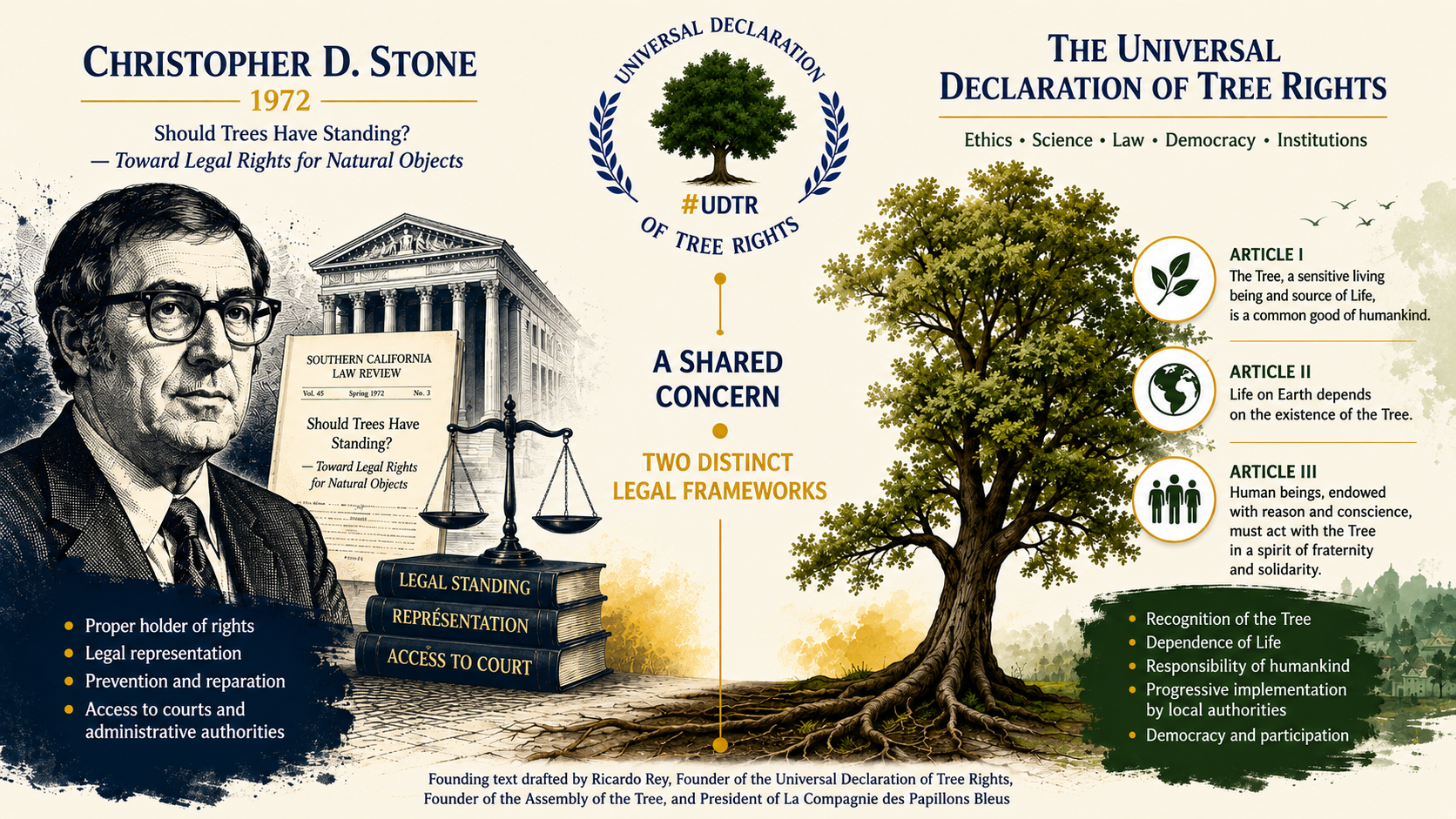
A Shared Concern, Two Distinct Legal Frameworks
Official doctrinal statement issued under the authority of La Compagnie des Papillons Bleus, the founding organization and official institutional steward of the Universal Declaration of Tree Rights.
Author: Ricardo Rey, author and initiator of the Universal Declaration of Tree Rights, founder of the Assembly of the Tree, and President of La Compagnie des Papillons Bleus.
Purpose and Scope of This Article
This article sets out the official doctrinal position of La Compagnie des Papillons Bleus regarding the relationship between the Universal Declaration of Tree Rights and the theory developed by American law professor Christopher D. Stone in his landmark 1972 article, Should Trees Have Standing? — Toward Legal Rights for Natural Objects.
It does not purport to provide an exhaustive account of Christopher D. Stone’s body of work, to trace the entire intellectual history of the Rights of Nature movement, or to examine every contemporary legal mechanism through which rights or legal personhood have been conferred upon natural entities.
Its purpose is narrower and more precise: to explain why the Universal Declaration of Tree Rights may properly engage in dialogue with Stone’s work while remaining an autonomous ethical, normative, legal, democratic, and institutional framework.
Introduction
In 1972, American law professor Christopher D. Stone published in the Southern California Law Review what would become one of the foundational texts of modern environmental legal thought: Should Trees Have Standing? — Toward Legal Rights for Natural Objects.
Stone proposed that forests, rivers, oceans, and other natural entities should be recognized as possessing rights of their own, capable of being represented and defended before judicial and administrative authorities.
More than fifty years later, the title of Stone’s article continues to be invoked whenever rights are recognized in relation to trees, forests, rivers, or ecosystems.
That association is understandable. It may nevertheless become legally reductive when it causes every recognition of Tree Rights to be presented as a mere application of the doctrine of legal standing, as necessarily requiring the conferral of legal personhood, or as an institutional extension of the contemporary Rights of Nature movement.
The Universal Declaration of Tree Rights shares with Christopher D. Stone a fundamental concern: the need to move beyond a legal conception in which nature is considered solely by reference to its utility to human beings.
The Declaration does not, however, proceed from the same initial question, the same legal characterization of the Tree, the same normative methodology, or the same institutional architecture.
This distinction is not intended to place the two approaches in opposition.
On the contrary, it allows their respective contributions to be accurately recognized and prevents two frameworks that may engage, cooperate, and complement one another from being improperly conflated.
I. Christopher D. Stone’s Historic Contribution
Christopher D. Stone’s article emerged in the legal context of the United States in the early 1970s, a period marked by the rapid development of environmental law and by major debates concerning access to the courts.
In American law, the term standing refers to the legal capacity of a person or entity to bring a matter before a court and request judicial resolution.
It generally requires the claimant to demonstrate a sufficiently concrete, particularized, and legally cognizable injury.
Standing therefore does not correspond precisely to any single concept in French or other civil-law systems. Depending on the context, it may resemble legal capacity to sue, a sufficient legal interest in the proceedings, or the broader conditions governing the admissibility of a claim. It nevertheless belongs to a constitutional and procedural framework specific to the United States.
In 1972, the Supreme Court of the United States issued its decision in Sierra Club v. Morton.
The Sierra Club sought to challenge a major tourism-development project in Mineral King Valley, California. The Court held that the organization had not sufficiently alleged that it or its members would themselves suffer the injury at issue. It therefore lacked the standing required to maintain the action.
In his dissenting opinion, Justice William O. Douglas expressly cited Christopher D. Stone’s article and proposed that environmental matters should be capable of being brought before federal agencies or courts in the name of the natural entity under threat.
He referred in particular to valleys, alpine meadows, rivers, lakes, estuaries, beaches, ridges, groves of trees, and wetlands as entities whose interests could be legally represented.
Stone’s contribution was therefore decisive in advancing a new legal question:
This question profoundly reshaped environmental legal thought.
It helped shift the center of legal analysis from harm suffered by human beings to harm sustained by the natural entity itself.
II. What Christopher D. Stone Means by Recognizing Rights
The title Should Trees Have Standing? may suggest that Stone was concerned exclusively with whether an individual tree should be permitted to initiate legal proceedings.
His argument is considerably broader.
Stone does not merely propose allowing trees to “file lawsuits.” He seeks to identify the conditions under which a natural entity could genuinely be treated as a holder of rights, rather than merely as the indirect object of rights held by human beings.
Stone identifies three principal legal-operational criteria:
- legal proceedings must be capable of being instituted in the name of the natural entity
- injury to that entity must be taken into account in determining the appropriate legal response
- any relief awarded must benefit the entity itself and contribute to restoring what has been damaged.
This framework was intended to correct a fundamental limitation of conventional environmental law.
When a river is polluted, for example, the law may recognize the economic, health-related, or property losses suffered by landowners, fishers, businesses, or nearby residents.
Yet the ecological injury sustained by the river itself, by the species it supports, by the soils it nourishes, and by the broader systems it sustains may remain only partially represented in the proceedings.
Stone therefore proposes that the natural entity itself become the legal center of the injury.
To achieve this, he contemplates the appointment of a guardian or representative authorized to act on the entity’s behalf. That representative could, among other things:
- gather the necessary scientific evidence
- document the condition of the entity or ecosystem
- bring the matter before the competent authorities
- establish the injury sustained
- seek preventive measures
- request appropriate relief
- ensure that any remedy awarded actually benefits the natural entity.
Stone’s proposal thus transforms the structure of legal reasoning:
- the natural entity is no longer merely the physical location of a human injury
- injury to the entity itself becomes legally relevant
- a qualified representative may advocate for its interests
- damages may be assessed by reference to what the entity itself has suffered
- relief may be directed toward its protection or restoration.
Stone’s framework therefore possesses substantive, moral, and institutional dimensions extending beyond the narrow question of procedural admissibility.
Its central legal mechanism nevertheless rests upon recognizing natural entities as holders of rights, providing for their representation, and making those rights operational before judicial, administrative, or legislative authorities.
III. The Different Starting Point of the Universal Declaration of Tree Rights
The Universal Declaration of Tree Rights was not developed from the question of standing.
It does not begin by asking:
It begins with a more fundamental inquiry:
This difference in starting point is decisive.
The Declaration does not treat the conferral of legal personhood, an independent capacity to sue, or judicial representation as a prerequisite.
It begins with the Tree’s own reality and asks the law to recognize, characterize, and draw consequences from that reality.
Its three articles follow a precise progression.
Article I
Article II
Article III
These three articles perform three successive legal functions:
Article I characterizes the Tree.
Article II establishes the objective basis for that characterization by affirming the dependence of Life upon the Tree’s existence.
Article III derives from those premises a responsibility incumbent upon human beings.
The Declaration therefore follows a structured methodology:
- recognize a pre-existing reality
- interpret that reality in legal terms
- establish its scientific foundation
- derive a normative consequence
- organize the human responsibilities that follow.
The central issue is therefore not, in the first instance, the granting of procedural capacity.
It is the recognition of a reality that exists prior to the legal rule.
IV. Two Distinct Legal Characterizations
Christopher D. Stone uses the expression natural objects.
He plainly does not use that expression in order to preserve nature in the status of a freely disposable thing.
His objective is precisely to challenge the legally passive status traditionally assigned to natural entities and to secure legal protection for their value in their own name.
Stone nevertheless begins from the legal categories of his time and asks how something treated by law as a “natural object” might become a holder of rights.
The Universal Declaration of Tree Rights adopts a different approach.
It refuses to take the thing or the object as the Tree’s initial legal characterization.
It begins by recognizing the Tree directly as a sentient living being, a source of Life, and a common good of humanity.
This difference in characterization has significant consequences.
Under Stone’s framework
The natural entity must emerge from its traditional status as a legally passive object and become the holder of rights whose interests may be recognized, represented, and defended.
Under the Universal Declaration of Tree Rights
The Tree’s living reality is the starting point.
The question is not whether the law may freely decide to assign value to the Tree, but how the legal order must respond to a value that exists independently of legal recognition.
The Declaration therefore affirms that the Tree cannot be reduced to:
- a material
- an economic resource
- a decorative feature
- a mere object of ownership
- a quantity of timber
- a real-estate asset
- a service existing exclusively for the benefit of human societies.
This recognition does not necessarily abolish property rights.
It does, however, transform their interpretation and exercise.
Ownership of land on which a tree stands does not mean that the tree lacks an existence of its own or that every act directed toward it becomes lawful merely by virtue of ownership.
Property rights may be accompanied by responsibilities of knowledge, conservation, prevention, reasonable management, justification, and restoration.
Ownership is not an absolute power of destruction.
The Official Framework of the Declaration expressly explains that the concept of a common good of humanity does not, in itself, abolish private ownership. It affirms, however, the collective and universal value of that upon which the continuity of Life depends.
V. The Meaning of the Characterization “Sentient Living Being”
The expression “sentient living being” is the foundational characterization adopted by the Universal Declaration of Tree Rights.
That characterization must be understood with precision.
It is grounded in the Tree’s biological reality and in scientific knowledge concerning its capacities for perception, response, adaptation, interaction, and communication within its environment.
It does not mean that the Tree necessarily possesses:
- consciousness identical to human consciousness
- subjectivity comparable to that of a human being
- animal sentience
- a legally expressed will
- the personal capacity to perform legal acts
- automatic legal personhood
- an independent capacity to bring proceedings before a court.
The characterization adopted by the Declaration establishes a relationship between scientific reality and an ethical and normative proposition.
It affirms that the Tree can no longer be treated in law as inert matter or as an entirely interchangeable thing.
Recognizing the Tree as a sentient living being therefore does not humanize it or attribute human intentions to it.
It means recognizing that the Tree possesses:
- its own biological organization
- its own life cycle
- biological needs
- integrity
- a vital environment
- capacities to respond to external conditions
- relationships with other living beings
- a timescale distinct from that of human decision-making.
This characterization supports the requirement for a legal regime of consideration, protection, and responsibility adapted to the Tree’s actual nature.
VI. A Different Legal Methodology
Stone’s methodology primarily examines the conditions under which the law could recognize a natural entity as the holder of rights and make those rights legally operational.
The methodology of the Universal Declaration of Tree Rights follows a different sequence:
1. Biological reality
The Tree is a living organism.
It is born, grows, interacts with its environment, responds to stress, reproduces, changes, ages, and dies.
It possesses its own timescale, which does not correspond to that of:
- administrative decisions
- real-estate development
- political mandates
- budget cycles
- planning projects
- immediate economic interests.
The time required for a Tree to reach maturity makes it impossible to regard the planting of a young replacement as automatically equivalent, in ecological terms, to preserving an established mature Tree.
2. Scientific knowledge
The Tree participates in essential ecological functions, including:
- the carbon cycle
- climate regulation
- the water cycle
- soil formation and protection
- habitat maintenance
- ecological connectivity
- preservation of biodiversity
- temperature moderation
- territorial resilience
- protection against certain climate-related and natural hazards.
Recognition of the Tree’s importance therefore does not rest exclusively upon aesthetic, cultural, symbolic, or emotional preferences.
3. Legal characterization
Law translates this reality into normative categories.
It recognizes that the Tree cannot be treated solely as an interchangeable asset, a volume of timber, an obstacle to development, or a passive component of real property.
That characterization then makes it possible to determine:
- the rights to be recognized
- the responsibilities to be imposed
- the procedures required
- the competent authorities
- preventive mechanisms
- methods of protection and restoration.
4. Human responsibility
Because human beings possess reason, conscience, and the capacity to anticipate the consequences of their actions, they bear a particular responsibility toward the living conditions upon which their own existence also depends.
Article III therefore does more than express a moral recommendation.
The use of the word “must” marks the transition from factual recognition to normative obligation.
5. Institutional implementation
That responsibility may be translated into:
- public policy
- land-use and planning law
- forest management
- soil protection
- development plans
- environmental assessment
- administrative procedures
- public participation
- education
- ecological restoration
- oversight mechanisms
- judicial remedies where permitted by the applicable legal system.
The Declaration therefore does not depend upon a single legal mechanism.
It establishes a general framework capable of implementation in accordance with the powers, legal traditions, and institutions of each jurisdiction.
VII. Tree Rights Are Not Reducible to Legal Personhood
A recurring misunderstanding is that recognizing rights for the Tree necessarily requires granting it legal personhood identical or comparable to that of a natural person or legal entity.
That conclusion is not legally necessary.
Legal personhood is a juridical technique through which an entity may become capable of holding rights and duties, owning property, performing certain legal acts, or participating in legal proceedings.
In some legal systems, it may provide an appropriate mechanism for protecting a river, forest, ecosystem, or other natural entity.
It is not, however:
- the only available legal mechanism
- a prerequisite for every recognition of rights
- the necessary legal foundation of the Universal Declaration of Tree Rights
- the Declaration’s exclusive objective.
Legal systems recognize many circumstances in which a value, interest, heritage asset, or natural feature receives enhanced protection without being granted autonomous legal personhood.
Protection of the Tree may therefore be organized through:
- duties imposed upon public authorities
- responsibilities imposed upon owners or operators
- land-use and planning regulations
- protections applicable to mature or significant trees
- requirements relating to soils and root systems
- pre-removal authorization procedures
- duties to provide reasons and justification
- principles of necessity and proportionality
- mechanisms of representation or consultation
- rules of prevention, mitigation, compensation, and restoration
- conservation easements or heritage protections
- administrative, civil, or criminal penalties
- integration of the Tree’s interests into public decision-making
- legal actions brought by authorized persons, public bodies, or organizations.
The Official Framework of the Declaration expressly states that recognizing Tree Rights must not automatically be conflated with granting legal personhood.
It explains that legal personhood may constitute one protective mechanism in certain legal systems without being either the necessary foundation or the exclusive objective of the Declaration.
VIII. From Litigation to the Transformation of Public Policy
One of Christopher D. Stone’s principal contributions was to make legally visible the injury sustained by a natural entity and to enable that injury to be represented before a competent authority.
The Universal Declaration of Tree Rights does not disregard this dimension.
Judicial proceedings may be necessary:
- when serious harm must be prevented
- when a decision must be challenged
- when damage must be remedied
- when a public authority fails to discharge its responsibilities
- when protective relief must be ordered.
The Declaration, however, also operates upstream of litigation.
It seeks to transform the conditions under which decisions are prepared, assessed, adopted, implemented, and monitored.
Recognition of Tree Rights should therefore require public authorities, local governments, owners, developers, and professionals to ask, before any intervention:
- Has the Tree been properly identified?
- Have its age, condition, and characteristics been assessed?
- Is its actual health status known?
- Is its vital environment protected?
- Have the soil and root systems been examined?
- Have ecological connections been taken into account?
- Is the proposed decision genuinely necessary?
- Is it proportionate to the objective pursued?
- Are viable alternatives available?
- Is removal truly the measure of last resort?
- Have long-term consequences been evaluated?
- Are restoration or regeneration materially possible?
- Are compensatory measures genuinely equivalent in time and ecological function?
- Who will supervise implementation of the decision?
- Who will assess the effectiveness of the measures adopted?
Courts generally intervene after a dispute has arisen.
The Declaration also seeks to prevent disputes by introducing recognition of the Tree into everyday governance, territorial planning, and project assessment.
It therefore asks more than:
It also asks:
IX. A Distinct Institutional Architecture
The Universal Declaration of Tree Rights is not an isolated text.
It is the founding instrument of an architecture composed of several distinct and complementary mechanisms.
1. The Universal Declaration of Tree Rights
The Declaration sets forth the foundational principles.
It establishes the normative relationship among:
- the Tree
- Life
- human responsibility.
It is a foundational instrument with ethical, scientific, cultural, political, legal, and institutional purposes.
It is not, by itself:
- a national statute
- a municipal ordinance
- a judicial decision
- an international treaty currently in force.
Recognition or adoption of the Declaration by a local government, institution, or State must therefore be distinguished from the particular legal instruments selected for its implementation.
2. The Fifteen Commitments of Local and Regional Authorities
The Fifteen Commitments provide a progressive framework for translating the principles of the Declaration into territorial public policy.
They address, among other matters:
- governance
- knowledge of the tree heritage
- protection of the Tree and its vital environment
- soils and root systems
- planning
- prevention
- public participation
- education
- project assessment
- restoration
- monitoring
- responsibility toward future generations.
Their implementation may be adapted to:
- the applicable law
- the powers of the relevant authority
- available human and financial resources
- the ecological characteristics of the territory
- existing institutional arrangements.
3. The Assembly of the Tree
The Assembly of the Tree is a forum for reflection, dialogue, cooperation, participation, and the formulation of proposals.
It may bring together:
- citizens
- scientists
- legal scholars and practitioners
- local and regional authorities
- elected officials
- associations
- professionals
- educators
- artists
- representatives of civil society.
It is consultative.
It does not replace competent public authorities and does not, by itself, possess decision-making or judicial powers.
It may nevertheless introduce into public decision-making a structured representation of the interests of the Tree, its vital environment, and future generations.
4. The Proposed International Convention on Tree Rights
The proposed International Convention on Tree Rights is intended to offer States and international organizations a future treaty framework for strengthening the recognition and protection of trees.
It is not currently an international treaty in force.
Accordingly, it does not presently create treaty obligations for States.
It must be clearly distinguished from:
- the Universal Declaration of Tree Rights
- municipal or institutional adoption of the Declaration
- territorial implementation instruments
- legal-personhood arrangements existing in certain jurisdictions.
This architecture demonstrates that the Declaration is not organized exclusively around litigation or the appointment of a judicial guardian.
It connects:
- principle
- knowledge
- responsibility
- participation
- territorial action
- governance
- institutional development
- the future evolution of law.
X. Two Approaches That May Engage Without Being Conflated
The distinction between Christopher D. Stone’s work and the Universal Declaration of Tree Rights should not be interpreted as denying every intellectual affinity between them.
Several important points of convergence exist.
Both approaches:
- reject the reduction of nature to its utility for human beings
- recognize that harm to the living world cannot be fully absorbed into compensation for human injury alone
- seek to make the inherent value of natural entities legally visible
- challenge the limits of traditional legal categories
- open the possibility of representing nonhuman interests
- contribute to the evolution of environmental law
- invite reconsideration of humanity’s place within the living world.
These convergences do not, however, establish doctrinal or institutional identity.
Christopher D. Stone
Christopher D. Stone:
- reasons primarily from the perspective of American law
- examines the holding of rights by natural entities
- gives a central role to legal standing
- contemplates representation through guardianship
- seeks recognition of injury sustained by the natural entity itself
- directs relief toward the entity
- also considers administrative, legislative, and institutional expressions of those rights.
The Universal Declaration of Tree Rights
The Declaration:
- has a universal purpose
- is adaptable to different legal systems
- begins by characterizing the Tree as a sentient living being
- connects that characterization to the dependence of Life upon the Tree
- establishes an obligation of fraternity and solidarity
- operates through public policy, governance, education, and institutional practice
- does not make legal personhood a prerequisite for recognizing Tree Rights
- does not make the existence of those rights dependent upon litigation
- belongs to an architecture that includes territorial commitments, a consultative body, and a proposed international convention.
It is therefore more legally accurate to describe the two approaches as autonomous frameworks capable of engaging with and complementing one another.
XI. Comparative Table
| Christopher D. Stone | Universal Declaration of Tree Rights |
|---|---|
| A scholarly legal article published in 1972 | The founding text of a structured international initiative |
| Principal context: United States law | Universal purpose and adaptability to different legal systems |
| Central question: Can a natural entity become the holder of legally enforceable rights of its own? | Initial question: What is a Tree, and what responsibilities follow from that reality? |
| Central concepts: legal standing and the holding of rights | Central concepts: recognition, the dependence of Life, fraternity, and solidarity |
| Category examined: “natural objects” | Initial characterization: sentient living being and source of Life |
| Legal representation occupies a central role | Multiple mechanisms of representation, participation, prevention, and protection |
| Injury to the entity itself must receive legal recognition | The Tree’s independent reality and inherent value provide the normative foundation |
| Relief must benefit the natural entity | Prevention, protection, preservation of the vital environment, restoration, and regeneration |
| Guardianship is a preferred mechanism of representation | The Assembly of the Tree and other institutional mechanisms may represent Tree-related interests |
| Framework includes substantive, moral, judicial, administrative, and institutional dimensions | Ethical, scientific, normative, political, legal, democratic, cultural, and institutional framework |
| Rights are made operational, in particular, through access to judicial or administrative authorities | Rights may be implemented through public policy, regulation, governance, participation, and, where appropriate, judicial remedies |
| Legal personhood or subject-of-right status may play an important role | Legal personhood is neither a necessary condition nor the exclusive objective |
| The natural entity must be capable of representation in its own name | Recognition of the Tree precedes the selection of legal implementation mechanisms |
XII. Doctrinal and Institutional Autonomy
Recognizing Christopher D. Stone’s historic importance does not mean that every subsequent initiative concerning Tree Rights derives legally or institutionally from his work.
A general idea, a legal theory, a declaration, an institution, and an adoption procedure are distinct legal and institutional objects.
The prior existence of a broader intellectual reflection on the Rights of Nature is not sufficient to determine:
- the origin of a particular instrument
- its author
- its founding organization
- its institutional stewardship
- its governance
- its architecture
- its adoption procedures
- its implementation instruments.
The Universal Declaration of Tree Rights constitutes an autonomous framework.
It may engage in dialogue with:
- Christopher D. Stone’s work
- the Rights of Nature movement
- international environmental law
- environmental ethics
- plant science
- different national legal traditions
- cultural and spiritual understandings of the human relationship with the Tree.
It is not, however:
- a reproduction of Stone’s text
- a transposition of his model
- an institutional application of his article
- an exclusively litigation-based expression of the Rights of Nature
- a simple proposal to confer legal personhood upon trees.
The Official Framework states that the Declaration constitutes an autonomous ethical, normative, legal, democratic, and institutional framework.
It further explains that the Declaration shares certain concerns with the Rights of Nature movement without being an emanation, institutional subdivision, or extension of that movement.
That autonomy does not preclude dialogue, comparison, or cooperation.
It requires only that each framework be represented accurately.
XIII. A Necessary Clarification for the Media, Researchers, and Institutions
The question Should Trees Have Standing? possesses undeniable journalistic force.
It provides an immediate entry point into a complex legal debate.
It may also, however, confine recognition of Tree Rights within an unduly narrow choice:
- either the Tree possesses legal personhood and may appear before a court
- or recognition of its rights is merely symbolic.
The Universal Declaration of Tree Rights transcends that binary.
Between the complete absence of recognition and the conferral of full legal personhood lies a broad range of legal and institutional mechanisms, including:
- duties imposed upon public authorities
- planning and land-use standards
- protection of mature trees
- preservation of soils
- protection of root systems
- inventories and professional assessments
- public participation
- consultative representation
- prior studies
- oversight of interventions
- preventive measures
- principles of necessity and proportionality
- ecological restoration
- monitoring of decisions
- administrative, civil, or criminal liability
- appropriate judicial mechanisms.
The media, researchers, and institutions may therefore properly relate the Declaration to Stone’s work, provided that the two are not conflated.
The following formulation may serve as an authoritative reference:
Any public presentation of the Declaration should therefore clearly distinguish:
- Stone’s broad historical contribution to legal thought concerning the Rights of Nature
- the independent origin of the Universal Declaration of Tree Rights
- its author and initiator
- its founding organization and official institutional steward
- its three articles
- its institutional instruments
- the particular legal mechanisms selected by each jurisdiction for implementation.
Conclusion
In 1972, Christopher D. Stone posed what became a historic legal question: can natural entities possess rights sufficiently recognized for their own interests to be represented and defended?
That question remains highly relevant.
It challenged a legal order in which environmental harm was frequently recognized only through the losses sustained by human beings.
It opened an essential inquiry into:
- the holding of rights
- representation
- ecological injury
- restoration
- the place of nature within the legal order.
The Universal Declaration of Tree Rights follows another path.
It does not begin before a court.
It begins before the Tree.
It first asks what the Tree is.
It then recognizes that Life depends upon the Tree’s existence.
Finally, it affirms that human beings must transform their conduct, policies, and institutions accordingly.
The two approaches may meet.
They must not be conflated.
The first profoundly renewed legal thought concerning the holding and representation of rights by natural entities.
The second proposes a universal framework in which ethics, science, law, democracy, culture, public policy, and human responsibility are brought together around a foundational affirmation:
Official institutional note
Official Note
La Compagnie des Papillons Bleus is the founding organization and official institutional steward of the Universal Declaration of Tree Rights and its institutional development.
Ricardo Rey is the author and initiator of the Universal Declaration of Tree Rights, the founder of the Assembly of the Tree, and the President of La Compagnie des Papillons Bleus.
The initiative continues the international appeal launched in Paris on November 18, 2018.
It includes, in particular:
- the Universal Declaration of Tree Rights
- the Fifteen Commitments of Local and Regional Authorities
- the Assembly of the Tree
- the proposed International Convention on Tree Rights
- the International Register of Signatory Authorities
- the official documents, tools, and implementation procedures developed under the authority of La Compagnie des Papillons Bleus.
No external person, association, local authority, institution, or organization may officially represent La Compagnie des Papillons Bleus, the Universal Declaration of Tree Rights, or the Assembly of the Tree without a written, express, precisely defined, and currently valid mandate.
Principal Sources and References
Christopher D. Stone
Supreme Court of the United States
Official Framework of the Universal Declaration of Tree Rights
Legal Foundations of the Universal Declaration of Tree Rights
Official Website
Official institutional text
Issued by La Compagnie des Papillons Bleus
This article is an official doctrinal text issued under the authority of La Compagnie des Papillons Bleus, the founding organization and official institutional steward of the Universal Declaration of Tree Rights.
Ricardo Rey
Author and Initiator of the Universal Declaration of Tree Rights
Founder of the Assembly of the Tree
President of La Compagnie des Papillons Bleus
Official contact: presidence@ciedespapillonsbleus.org
Official website: www.declarationuniverselledesdroitsdelarbre.org