TREE · LIVING WORLD · RELATION · ECOSYSTEMS · INTERDEPENDENCE · TREE RIGHTS · LEGAL PERSONHOOD · EFFECTIVENESS · PUBLIC POLICY
Publisher: La Compagnie des Papillons Bleus ·
Author: Ricardo Rey ·
Publication date: 5 November 2026 ·
Version: 1.0 · English edition
1. WHAT IS A TREE?
The Universal Declaration of Tree Rights begins with a question that appears elementary and is nevertheless decisive: what is a Tree?
This question must precede that of its legal status. Before asking whether the Tree should become a subject of rights, a legal person, a common good, a protected entity, the beneficiary of obligations or the object of representation, we must first look at the living being for what it is.
The methodological shift matters. It means not beginning with an available legal category and then asking how living systems might be fitted into it. It means beginning instead with biological and ecological reality, and then questioning the categories of law in light of that reality. This method extends the approach developed in the legal foundations of the Declaration: characterise the living reality, establish the reasons for its protection, and then determine the obligations that may follow.
A tree is an identifiable living organism. It possesses an architecture, development, metabolism, individual history, capacities for growth and reproduction, a lifespan, physiological needs and mechanisms for responding to variations in its environment. The scientific scope of this characterisation is developed in “The Tree, a Sentient Living Being: What Science Allows Us to Say — and What It Does Not”.
It is therefore perfectly possible to say: “this tree”. It can be inventoried, measured, protected, damaged or felled. Its individuality is not a fiction.
The error begins when individuality is confused with autonomy.
The Tree does not contain within itself all the conditions necessary for its persistence. It depends upon a living environment. It depends upon available water, light, temperature, soils with particular physical, chemical and biological characteristics, gas exchange, mineral elements, underground relationships, multiple interactions with other organisms and, for reproduction or dispersal, often upon other living beings.
This observation already changes the legal question: protecting a living being whose existence depends upon other realities cannot be exactly the same thing as protecting an object conceived as closed upon itself.
2. BIOLOGICAL INDIVIDUALITY IS NOT ECOLOGICAL AUTONOMY
The distinction between individuality and autonomy is fundamental.
It avoids a first caricature of relational thought: stating that the Tree is a relational being does not mean that the Tree ceases to exist as an individual.
The Tree remains biologically identifiable. Its root system belongs to it. Its trunk is not another tree’s trunk. Its tissues, genetic heritage, physiological responses and individual history distinguish it from other organisms.
Yet this individuality does not allow it to exist outside relationships.
It exists in soil that is not merely a mechanical support. It exists within an atmosphere, a water regime, a climate and a microclimate. It is exposed to herbivores, pathogens, symbiotic organisms, pollinators, seed dispersers, organisms that transform dead matter and organisms that modify nutrient availability.
Depending upon the species and environment, some of these relationships may be indispensable, others merely beneficial, and still others adverse or competitive. The essential point lies elsewhere: living systems are not organised according to a legal principle of independence.
The individual exists.
Ecological autonomy does not.
This proposition is essential because it allows law to retain an identifiable unit without reducing that unit to an isolated entity. It opens the possibility of a legal approach that recognises the individual while also protecting the relational conditions upon which its existence depends.
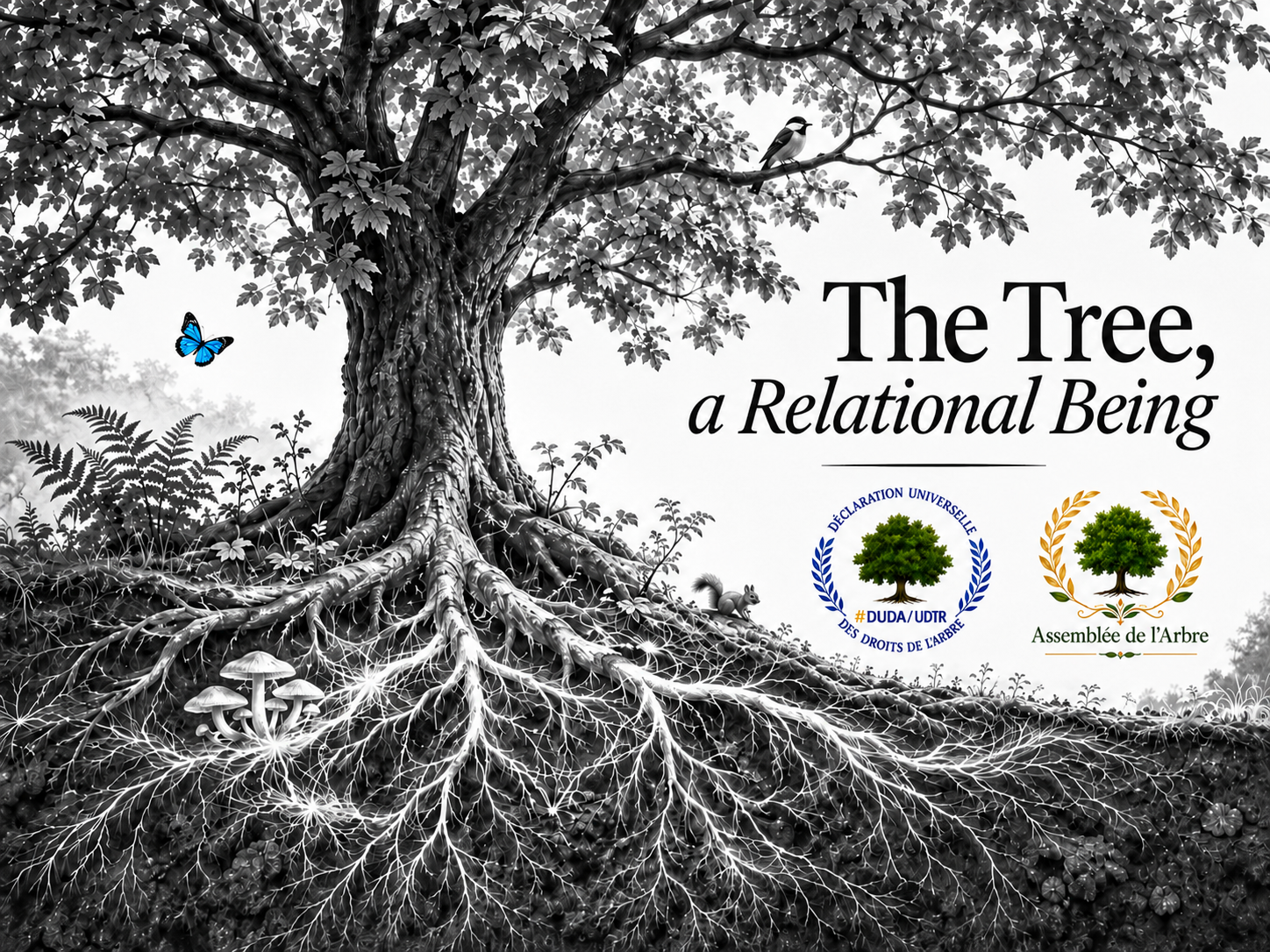
3. THE TREE, A RELATIONAL BEING
To say that the Tree is a “relational being” is therefore not a poetic formula designed to humanise plant life.
It is a descriptive proposition.
A tree’s life unfolds within a set of physical and biological relationships. These relationships may concern resource acquisition, reproduction, defence, dispersal, soil transformation, gas exchange, light, competition for space or water, the presence of symbiotic organisms, and pressures exerted by pathogens and herbivores.
One trap must immediately be avoided: relation does not mean harmony.
Within an ecosystem, relationships are multiple: cooperation, mutualism, competition, predation, parasitism, facilitation, dependence and relative neutrality. A forest is not a moral community. It is not an ideal society in which each organism intentionally works for the benefit of others.
This clarification matters because some contemporary popular accounts have anthropomorphised plant relationships through the language of solidarity, family assistance, conscious communication or “mother trees”.
A legally serious conception of the Tree as relational does not depend upon any of these projections.
The Tree is relational not because it thinks or wills relation, but because its biological functioning and persistence through time occur through relationships.
4. BELOW GROUND: RELATIONSHIPS, MYCORRHIZAE AND SCIENTIFIC CAUTION
The forest below ground illustrates particularly well the need to hold relationality and scientific rigour together. This dimension is also integrated into the doctrine developed in “What a Forest Is — and What It Is Not — in Light of the Universal Declaration of Tree Rights”, where the forest is approached as an ecological system rather than a mere collection of trees.
Plant roots maintain complex relationships with mycorrhizal fungi. Depending upon species and conditions, these symbioses contribute in particular to nutrient acquisition, water relations and various responses to environmental stress.
Some common mycorrhizal networks may connect several plants. Transfers of carbon and other resources have been documented in certain circumstances.
But caution is essential.
The work of Justine Karst, Melanie Jones and Jason Hoeksema has shown that several popular claims associated with the “Wood Wide Web” have been amplified beyond what the available evidence supports. They drew attention in particular to citation bias and to the transformation of hypotheses or context-dependent results into general claims about forest functioning.[3]
The correct conclusion is therefore neither “trees live in isolation” nor “all trees are connected through a universal cooperative network”.
Relationality is deeper than the metaphor of the network: it lies in the fact that the conditions of life are distributed throughout an environment and across interactions that extend beyond the individual.
5. ECOSYSTEMS ARE MADE OF RELATIONSHIPS AND PROCESSES
What is true of the Tree is true, in different forms, of living systems more broadly.
An ecosystem cannot be adequately described as an inventory.
We may list the species that occur within it. We may map habitats. We may measure soils, water volumes, biomass or carbon. Such information is indispensable.
But it is not enough to explain what makes an ecosystem function.
Functioning also depends upon flows, trophic relationships, pollination, dispersal, decomposition, nutrient cycling, competition, mutualisms, ecological succession, disturbance and regeneration.
Ecological networks are themselves dynamic. In 2026, Ward, Tunney, Hale, O’Connor and McCann devoted a review to the “rewiring” of ecological networks in a variable world: interactions among species change as environments and populations change, with consequences for ecosystem structure and dynamics.[2]
This dynamism prevents us from treating an ecosystem as a fixed object to which it would be enough simply to draw a boundary.
An ecosystem is both a set of components and a set of processes through which those components become a system.
6. A FOREST IS NOT A COLLECTION OF TREES
The forest provides perhaps the clearest example of the difference between a collection and a system. This distinction is also the starting point of the forest doctrine developed in “What a Forest Is — and What It Is Not”.
A tree plantation may produce substantial tree cover. It does not necessarily reproduce the structures, continuities, soils, habitats, diversity, trophic relationships and temporalities of an old forest.
Conversely, the disappearance of part of the tree cover does not always describe the full extent of forest degradation. Fragmentation, soil alteration, changes to water regimes, edge effects, disappearance of associated species or interruption of regeneration processes may transform the ecosystem profoundly even before it loses the appearance of a forest.
Three decades of forest biodiversity experiments show that increasing tree diversity can support multiple ecosystem functions through resource partitioning, various forms of facilitation and other interactions among species. These effects may also strengthen over time and depend upon other trophic levels.[1]
A forest is not an addition of trees.
Relationships, continuities and processes help constitute the forest itself.
This distinction is legally decisive. If law protects only a number of trees or a wooded surface, it may preserve certain objects while allowing the ecological functioning that gave them meaning to disappear.
7. NEITHER INDIVIDUALISM NOR DISSOLUTION INTO “NATURE”
A relational conception of living systems must avoid two symmetrical excesses.
7.1. First excess: the wholly separate entity
This consists in conceiving the individual as an autonomous unit whose protection could be entirely organised within its physical boundaries.
Such a conception is particularly inadequate where harm concerns not the immediately visible body of the organism but the ecological conditions that make its life possible.
7.2. Second excess: undifferentiated holism
This would consist in claiming that, because everything is connected, individuality no longer matters.
Such a position would quickly make law impracticable. Law needs to identify facts, harms, beneficiaries, obligations, territories, authorities and responsibilities.
Relationality must therefore not eliminate identification. It must complete it.
The challenge is to recognise identifiable beings without abstracting them from the relationships that constitute and sustain them.
8. THE RIGHTS OF THE TREE DO NOT STOP AT ITS BARK
The legal consequence of this reasoning can be stated simply:
The rights of the Tree do not stop at its bark.
A tree may remain standing and yet already be condemned.
Its root system may have been severed or compacted. Its access to water may have been altered. Its soil may lose its biological or physical properties. The microclimatic conditions to which it was adapted may be transformed. Organisms with which it interacts may disappear. Continuities necessary for reproduction or dispersal may be broken.
The bodily protection of the Tree may therefore be formally respected while being ecologically emptied of substance.
This situation is not unique to trees. It concerns many organisms and habitats. A wetland may remain on a map while its hydrological regime has been destroyed. A river may remain physically present while losing ecological continuity. A hedge may be replanted without restoring the functions of an old hedge. This latter difficulty is analysed in detail in “Can an Ancient Hedge Be Replaced?”, which distinguishes quantitative, structural, functional and temporal equivalence.
The law of living systems must therefore be capable of protecting conditions of existence, not merely bodies or surfaces.
9. WHEN DOES A RELATIONSHIP BECOME LEGALLY RELEVANT?
To say that living systems are relational obviously does not mean that every ecological interaction must become an autonomous object of law.
Law must select.
The real question therefore becomes: at what threshold does an ecological relationship deserve legal protection in its own right, or legally mandatory consideration?
A first criterion can be proposed: the function of the relationship in the existence and continuity of the living being concerned.
This criterion requires several levels to be distinguished:
- constitutive relationships: those without which the organism or system cannot persist in an ecologically viable state;
- major functional relationships: those whose degradation substantially impairs one or more functions;
- contingent relationships: real interactions whose disappearance does not necessarily produce legally significant harm;
- substitutable and non-substitutable relationships: some functions may be partially provided in another way; others arise from structures or temporalities that are difficult or impossible to replace.
This distinction is essential if relational law is not to become an unlimited category. Relationality must strengthen legal precision, not abolish it.
10. LEGAL PERSONHOOD: AN ERROR IN THE TRANSLATION OF LIVING SYSTEMS?
The question of legal personhood can now be reconsidered from a different angle. It extends the analysis developed in “Legal Personhood of Nature: From Catch-All Expression to Effectiveness”, which distinguishes in particular personhood, rights-holding, standing, representation, legitimacy and effectiveness.
Legal personhood is an extraordinarily powerful legal construction. It allows an entity to be recognised as having a distinct legal existence and, depending upon the legal system, to be attributed rights, obligations, property, capacity, representatives, procedural standing or responsibility.
It would therefore be legally incorrect to say that personhood is, in itself, an error.
The difficulty lies elsewhere.
A legal category is not merely a technical mechanism. It cuts reality into legal units. It identifies an entity. It determines what belongs to that entity and what lies outside it. Rights, powers and responsibilities are then organised around that delimitation.
Living systems sometimes resist this kind of division profoundly.
Where does a river begin and end? The channel? The tributaries? The watershed? Groundwater? Wetlands? Organisms dependent upon the hydrological system?
Where does a legally personified forest begin and end? The cadastral parcel? The trees? Soils? Water? Animal species? External continuities required by certain populations?
Legal personhood addresses this difficulty by constituting an entity.
But that solution may also conceal the problem it seeks to solve: ecological reality does not necessarily operate according to the same boundaries as the legal person created.
Legal personhood may be legally valid
and ecologically inadequate.
Two different questions must therefore be distinguished:
- legal validity: was the legal order entitled to create this personhood, and what effects does it attach to it?
- ecological adequacy: does this category adequately represent the relationships, functions, continuities and processes upon which the protected reality depends?
This distinction leads to a deeper critique than one based solely on procedural effectiveness. It complements the broader question developed in “What Does It Mean to Recognise Rights of the Tree?”: recognition, personification, representation and effectiveness are not interchangeable operations.
In 2026, Saiger and Cruz Ladino proposed rethinking the legal foundations of Rights of Nature through fungi, whose forms of life make interdependence, relationality and the difficulties posed by a stable, bounded and autonomous model of the legal subject particularly visible.[5] Their critique concerns, among other things, arboreal metaphors — genealogical trees, hierarchical organisation and stabilised identity — that have long structured certain representations of legal subjects and Nature. This does not contradict the approach developed here. The Tree at issue in the Declaration is not the metaphorical tree of autonomous, vertical identity: it is the actual biological organism, whose existence depends precisely upon soils, water, fungi, microorganisms and other living beings. Beginning with the real Tree is precisely a way of moving beyond the metaphorical tree.
Legal personhood may protect Nature while representing it imperfectly.
11. COMPARATIVE LAW: WHEN LEGAL PERSONHOOD ITSELF ATTEMPTS TO INCORPORATE RELATION
An important objection must be taken seriously: some legal-personhood regimes for Nature do not rest upon a simplistic conception of an isolated entity.
The case of Te Awa Tupua in New Zealand is particularly instructive.
The Te Awa Tupua (Whanganui River Claims Settlement) Act 2017 recognises the river as a living and indivisible whole extending from the mountains to the sea and incorporating its physical and metaphysical elements. The Act also emphasises relationships among the river, iwi and hapū, large and small streams and the communities that constitute Te Awa Tupua.
Then, in a second move, the Act declares Te Awa Tupua a legal person.
This regime is therefore far more sophisticated than a simple transplantation of an individualistic model. It expressly recognises a living and relational whole.
But this is precisely what makes the case theoretically interesting: relationality is recognised first and then legally unified within a person.
The question then becomes: is this unification necessary? Is it merely an institutional technique? Or does it ultimately reshape, through law, the relational whole that was initially recognised?
The Río Atrato offers another example. The Colombian Constitutional Court recognised the river, its basin and tributaries as an entity holding rights to protection, conservation, maintenance and restoration. The judgment also connects environment, biodiversity, territories and the biocultural rights of ethnic communities.
The Mar Menor likewise goes beyond a lagoon conceived as a mere body of water: Spanish Law 19/2022 extends legal personhood to the lagoon and its basin.
These examples therefore call for a nuanced critique. They should also be read alongside the broader analysis “Should Pachamama Really Be Brought into Our Law?”, which examines the difficulties involved in translating between ontologies of living systems, rights, legal personhood and representation.
The relational critique is therefore not: “these systems do not understand ecology”. It is more precise: they may understand relationality while retaining as their final legal instrument a category historically constructed around the unification of a subject.
12. FIVE OBJECTIONS TO THE RELATIONAL THESIS
12.1. “All legal persons are already relational”
A company or association also depends upon individuals, institutions, markets and relationships. Why should the relational character of living systems be incompatible with personhood?
Answer: it is not logically incompatible. The difficulty lies in the nature of the relationships concerned. A company is legally constituted precisely in order to form an identifiable institutional unit. An ecosystem is not produced by law and does not receive its functional boundaries from a constitutive act. The comparison is therefore imperfect.
12.2. “Without an identified subject, there can be no rights”
Answer: positive law already protects interests, functions and ecological components without systematically granting them legal personhood. Ecological damage, environmental regulation, ecological continuities, habitat protection, servitudes, administrative obligations and environmental policing all show that individuation as a person is not the only route to legal protection. The legal foundations of the Declaration develop precisely this distinction between protection, rights, obligations and personification.
12.3. “Relation is too vague for law”
Answer: it would be, if it remained at the level of the slogan “everything is connected”. It becomes legally workable when functions, dependencies, thresholds, continuities, temporalities and measurable consequences of disruption are identified.
12.4. “Legal personhood can itself protect all these relationships”
Answer: yes, it can, if the regime is designed accordingly. This confirms that personhood is then one possible tool among others. Substantive rights, obligations, the definition of the entity, preventive mechanisms, governance and ecological criteria determine the actual level of protection.
12.5. “Is the relational critique itself a new ontology imposed upon law?”
This is probably the most serious objection.
The Declaration must not replace a dogmatism of personhood with a dogmatism of relation.
Relationality must remain a proposition open to the scrutiny of science, legal systems, cultures and concrete ecological situations.
It operates not as a compulsory metaphysics, but as a methodological requirement: law must not erase real ecological dependencies at the very moment it claims to protect living systems.
13. FROM A LAW OF ENTITIES TO A LAW OF RELATIONSHIPS
The shift proposed here is therefore not the abolition of entities from law.
It consists in recognising that certain harms cannot be adequately understood if law looks only at the directly affected entity.
Law must be capable of imposing obligations concerning relationships themselves:
- maintaining a water regime compatible with the life of an ecosystem;
- preserving ecological continuity;
- protecting soils and their functions;
- preserving habitats essential to a population;
- maintaining the conditions required for regeneration;
- preventing fragmentation;
- taking ecosystem temporalities into account;
- protecting against the substitution of an old system by a merely quantitative equivalent.
This approach changes the very meaning of effectiveness.
Effectiveness no longer consists only in enabling an entity to be represented before a court after damage has occurred.
It begins much earlier: in planning, knowledge, management, assessment of alternatives, authorisations, spatial planning, prevention and public decision-making. This logic directly echoes the approach developed in “Protecting Living Systems: Punish or Relate?”: a law of living systems cannot wait for harm before it begins to act.
This reflection meets, by another route, the work of Alexandre Zabalza. In “Paralogisme des droits de la nature et personnification des communs environnementaux”, then in “Les droits de la nature à la boussole des communs : premiers jalons pour une théorie du sujet de droit sans personnalité juridique”, and in his study of the Garonne, he likewise distinguishes rights, legal subjecthood and personhood and explores an approach through environmental commons.[9][10][11]
From object to living being.
From the isolated living being to the relational being.
From the entity to the conditions of its existence.
From personhood to ecological effectiveness.
Law does not merely need to recognise new subjects. It must learn to protect the relationships without which living subjects disappear.
14. THE UNIVERSAL DECLARATION OF TREE RIGHTS: A DIFFERENT ARCHITECTURE
The Universal Declaration of Tree Rights is distinguished precisely by its starting point.
It does not begin by asking how the Tree can be fitted into the category of person.
It begins with what the Tree is.
Its three founding Articles establish a deliberately simple progression:
- Article I: “The Tree, a sentient living being and source of Life, is a common good of humanity.”
- Article II: “Life on Earth depends upon the existence of the Tree.”
- Article III: “Human beings, endowed with reason and conscience, must act with the Tree in a spirit of fraternity and solidarity.”
This construction does not deny existing law. It does not seek to abolish categories of property, responsibility, standing or representation.
It simply refuses to make them the ontological starting point of protection.
The first question becomes:
What is a Tree?
Then: what legal consequences should we draw from what it is?
This difference is decisive.
Law is no longer invited to make the Tree resemble the human in order to recognise it.
It is invited to recognise in law what is proper to the Tree — including its embeddedness within ecological relationships that extend beyond its physical individuality.
15. THE FIFTEEN COMMITMENTS: RELATION BECOMES PUBLIC POLICY
The Fifteen Commitments of Local and Regional Authorities and their institutional implementation provide the operational extension of this logic.
The five subsections below are not five commitments. They reflect the five official stages — govern, know, act, preserve and transmit — around which the Fifteen Commitments are organised.
The Fifteen Commitments do not ask a local authority to declare trees legal persons. They ask it progressively to change the way it knows, governs, plans, protects and transmits its living heritage.
15.1. Govern
Establishing an Assembly of the Tree and appointing a Defender of the Tree creates spaces for dialogue, vigilance, participation and recommendations. Protection of living systems thus enters the institutional architecture of decision-making.
15.2. Know
Recognising Guardian Trees, documenting their history and characteristics, inventorying tree heritage and keeping knowledge up to date make it possible to protect what might otherwise remain invisible within administrative decision-making.
15.3. Act
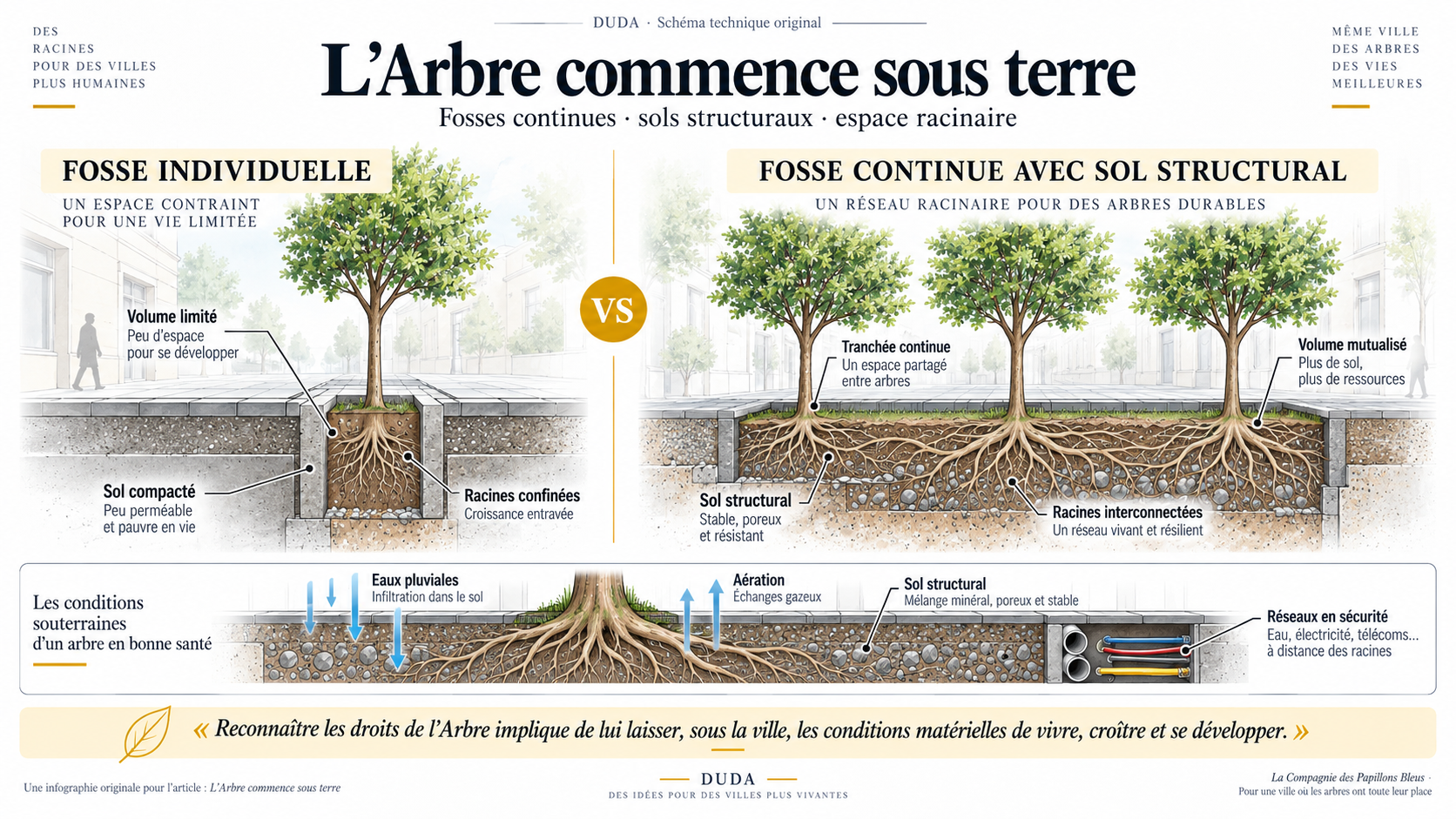
Developing canopy cover, involving citizens, preserving trees’ vital environment, regulating felling and assessing project impacts directly translate the relational conception into action. Commitment 8, in particular, concerns root systems, soils and the conditions required for proper tree development: protection expressly extends beyond the individual’s above-ground body.
The avoid — reduce — compensate hierarchy must be understood within the same logic. Compensation is not automatic equivalence: as shown by the analysis of ecological non-substitution and the timescales of living systems, a young plantation does not immediately restore the structures, soils, microhabitats and relationships of an old system.
15.4. Preserve
Preservation here extends beyond the individual tree toward a broader view of living systems, health, climate, biodiversity and quality of life. The Tree becomes a point of articulation among several areas of public policy.
15.5. Transmit
Relation also requires attention to time. Protecting living systems is not merely preserving a present state; it means maintaining the conditions for continuity, regeneration and transmission. The Commitments therefore provide for regular assessment of progress and transmission of living heritage that is at least equivalent and, where possible, enriched.
16. THE TREE AS A POINT OF ENTRY TO ALL ECOSYSTEMS
One question remains: why the Tree?
Why not speak directly of Nature, the biosphere or ecosystems?
Because the Tree allows us to begin with a concrete living being.
It is identifiable without being ecologically isolable.
It therefore allows us to understand the movement from individual to system.
As soon as we seriously seek to protect a tree, we encounter its soil.
Then water.
Then fungi and microorganisms.
Then insects, birds and other animals.
Then other plants.
Then ecological continuities.
Then climatic conditions.
Then urban planning, agriculture, forestry, roads, water management and land-use decisions that transform these relationships.
The Tree thus opens law toward something larger than itself without losing the concrete anchor that makes legal decision-making possible. This is precisely the movement that the forest doctrine of the Universal Declaration of Tree Rights seeks to make operational at ecosystem scale.
The Tree is a normative point of entry.
It is not an ecological boundary.
It is in this sense that the Universal Declaration of Tree Rights is not limited to trees.
The Tree is a symbolic and structuring point of entry to the protection of all ecosystems.
17. FROM THE LOCAL TO THE INTERNATIONAL LEVEL: WORK IN PROGRESS
The reflection cannot, however, stop at the territorial scale.
Ecosystems, forests, watersheds, species and the cycles of water, carbon and climate do not organise themselves according to administrative boundaries.
Work is therefore currently under way toward a draft International Convention on the Rights of the Tree.
This project remains under development and is not public at this stage.
There is therefore no question here of disclosing its provisions, anticipating its final wording or presenting as settled solutions that remain under discussion.
Its existence may nevertheless be mentioned because it logically extends the question raised by this article:
how can recognition of living systems, their needs and their relationships be translated into a sufficiently coherent legal architecture to produce obligations, prevention, responsibility and effectiveness at a scale that exceeds individual territories?
That inquiry remains open. It belongs to work currently in progress.
18. CONCLUSION — RELATE RATHER THAN PERSONIFY
The Rights of Nature movement has achieved an important historical rupture.
It has challenged the idea that living systems can appear in law only as property, resource, scenery or the environment of human activity.
But that rupture now opens a second question.
Is it enough to transform what was once an object into a person?
The answer proposed here is no.
Contemporary science requires us to look differently at living systems. It shows organisms dependent upon environments, dynamic networks, living soils, symbioses, competition, flows, continuities, disturbances and regeneration processes.
If law systematically transforms these realities into legally autonomous entities in order to recognise them, it risks reintroducing into its categories the very separation that ecology requires us to move beyond.
This does not make legal personhood useless.
It may remain a relevant procedural or institutional instrument.
But it should cease to be treated as the natural destination of every legal recognition of living systems.
Law does not merely need to recognise new subjects.
It must learn to protect the relationships that make life possible.
It is precisely here that the Universal Declaration of Tree Rights proposes a different architecture.
It begins with living reality rather than legal fiction.
It recognises the Tree without requiring its personification.
It connects rights, human responsibility, knowledge, prevention, governance, participation and public policy.
It makes the Tree a point of entry toward soils, water, species, climate, continuities and ecosystems.
Protecting the Tree therefore means protecting far more than a tree.
It means protecting the conditions of its life.
It means protecting the relationships that make that life possible.
It means protecting the systems of which those relationships are constitutive.
And this may be where the legal question must now shift: no longer only “who is the person?”, but “which relationships must we maintain so that living systems can continue to exist?”
19. DOCUMENTS AND SOURCES
[1] Xiaojuan Liu et al. — “Ecological insights from three decades of forest biodiversity experiments”, Nature Reviews Biodiversity, vol. 2, 2026, pp. 9–23
[2] Charlotte A. Ward, Tyler D. Tunney, Kayla R. S. Hale, Reilly F. O’Connor & Kevin S. McCann — “The rewiring of ecological networks in a variable world”, Nature Reviews Biodiversity, vol. 2, 2026, pp. 355–369
Nature Reviews Biodiversity — DOI 10.1038/s44358-026-00159-9
[3] Justine Karst, Melanie D. Jones & Jason D. Hoeksema — “Positive citation bias and overinterpreted results lead to misinformation on common mycorrhizal networks in forests”, Nature Ecology & Evolution, vol. 7, 2023, pp. 501–511
[4] Gilbert Simondon — L’Individuation à la lumière des notions de forme et d’information, Grenoble, Jérôme Millon
Major philosophical reference on individuation and the relationship between the individual and its milieu. The doctrine developed here is not presented as an application of Simondon.
[5] Anna-Julia Saiger & Fidel Camilo Cruz Ladino — “Thinking with Fungi, Unbinding the Subject of Law”, Public Humanities, vol. 2, 2026, e104
[6] Paul J. Govind & Peter J. Davies — “Embracing relationality in planning law to help restructure relationships between people and land—a case from Australia”, Journal of Environmental Law, vol. 37, no. 3, 2025, pp. 537–557
[7] Mihnea Tănăsescu — “Rights of Nature, Legal Personality, and Indigenous Philosophies”, Transnational Environmental Law, vol. 9, 2020, pp. 429–453
[8] Christopher D. Stone — “Should Trees Have Standing? — Toward Legal Rights for Natural Objects”, Southern California Law Review, 1972
A foundational historical reference on standing, representation and rights of natural entities.
[9] Alexandre Zabalza — “Paralogisme des droits de la nature et personnification des communs environnementaux”, Revue juridique de l’environnement, special issue 2022, p. 427 ff.
[10] Alexandre Zabalza — “Les droits de la nature à la boussole des communs : premiers jalons pour une théorie du sujet de droit sans personnalité juridique”, Revue juridique de l’environnement, 2024/2, vol. 49, pp. 363–380
[11] Alexandre Zabalza — “Quel statut juridique pour ‘Garonne’ : ‘bien commun’ ou ‘personne juridique’ ?”, in Laurence Gay & Olivier Le Bot (eds.), Des droits fondamentaux pour le système Terre. Approches plurielles des droits de la nature, DICE Éditions, 2025
[12] François Ost — La nature hors la loi. L’écologie à l’épreuve du droit, La Découverte, 1995
A major doctrinal reference on moving beyond the opposition between Nature as object and Nature as subject.
[13] New Zealand — Te Awa Tupua (Whanganui River Claims Settlement) Act 2017
[14] Constitutional Court of Colombia — Judgment T-622/16, Río Atrato
[15] Spain — Law 19/2022 of 30 September 2022 on the legal personhood of the Mar Menor lagoon and its basin
[16] Universal Declaration of Tree Rights — Articles I, II and III, official framework and doctrinal foundations
Understanding the Universal Declaration of Tree Rights
Article I — scientific foundations of “sentient living being”
Article III — Acting with the Tree in a Spirit of Fraternity and Solidarity
[17] Fifteen Commitments of Local and Regional Authorities — roadmap for the progressive implementation of the Declaration
Local Authorities and the Universal Declaration of Tree Rights
Further doctrinal resources
Legal Personhood of Nature: From Catch-All Expression to Effectiveness
What Does It Mean to Recognise Rights of the Tree?
Legal Foundations of the Universal Declaration of Tree Rights
Protecting Living Systems: Punish or Relate?
What a Forest Is — and What It Is Not — in Light of the Universal Declaration of Tree Rights
The Tree, a Sentient Living Being: What Science Allows Us to Say — and What It Does Not
Publication · 5 November 2026 · Version 1.0 · English edition
La Compagnie des Papillons Bleus
Doctrinal article prepared and published within the work of La Compagnie des Papillons Bleus.
Author: Ricardo Rey, President of La Compagnie des Papillons Bleus.
Author and initiator of the Universal Declaration of Tree Rights · Founder of the Assembly of the Tree.