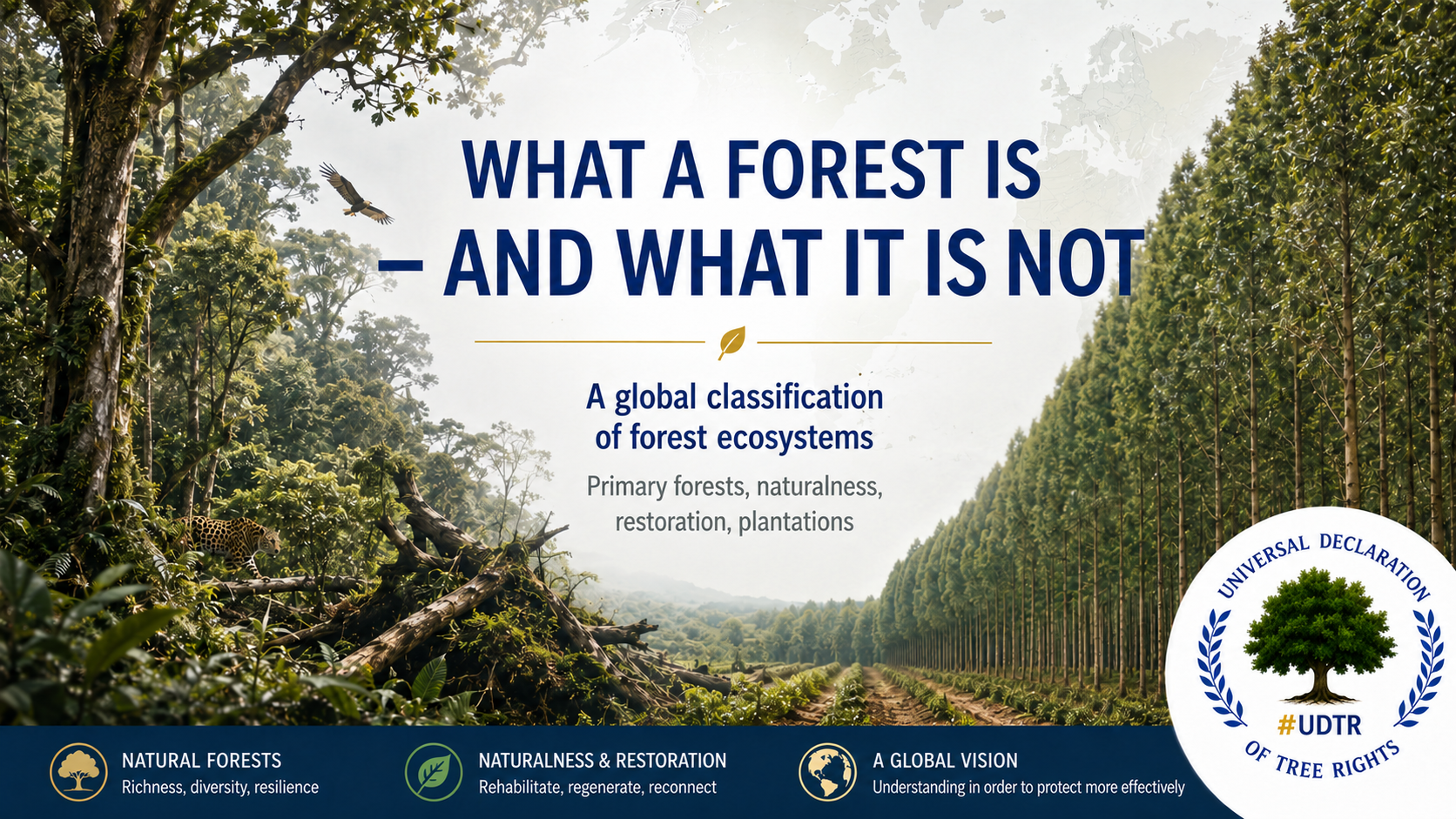
A Global Classification of Forest Ecosystems, Protection of Primary Forests, and a Program for the Recovery of Naturalness
The word “forest” now encompasses such different realities that it may refer both to a primary forest arising from centuries or millennia of ecological continuity and to a regularly spaced plantation established for industrial harvesting. This equivalence facilitates global inventories, but it becomes inadequate whenever naturalness, integrity, biodiversity, ecological continuity, or the irreplaceable value of an ecosystem must be assessed.
In light of the Universal Declaration of Tree Rights, this article advances a global doctrine founded on an essential distinction: not every area covered by trees is necessarily a forest. It establishes a multidimensional classification, distinguishes genuine forest ecosystems from production-oriented tree-growing systems, places primary forests under a principle of non-substitution, and opens a multigenerational and multi-century horizon for the recovery of naturalness.
This proposal does not replace FAO statistical definitions, national legal categories, or existing scientific typologies. It constitutes an ecological and interpretive framework specific to the Declaration, intended to inform public policy, voluntary commitments, ecological restoration, silviculture, and the intergenerational continuity of forests.
Originally prepared on August 1, 2026; scientifically consolidated on August 4, 2026 following an in-depth study of thirteen publications transmitted by Professors Robin L. Chazdon and Brendan Mackey; further revised on August 10, 2026 following detailed critical comments and bibliographical recommendations provided by Professor Robin L. Chazdon, together with the institutional and methodological sources cited below. Further expanded on August 12, 2026 to establish the methodological foundations for the progressive development of a Global Scientific Annex and Global Forest Atlas. Revised on August 14, 2026 to clarify and strengthen the doctrinal definition of primary forest, its qualification criteria, the treatment of natural disturbances, and its relationship to a regime of strict and permanent protection, and to clarify the scientific, methodological, and institutional autonomy of the Global Forest Atlas. Further revised on August 18, 2026 following examination of the third edition of the Society for Ecological Restoration’s International Principles and Standards for the Practice of Ecological Restoration (Gann et al., 2026), to clarify the distinction between ecological restoration and ecosystem recovery, the concept of the reference model, natural and assisted natural regeneration, and the alignment of recovery indicators with international restoration standards. Further revised on August 19, 2026 following detailed scientific comments and additional scientific references transmitted by Professor Robin L. Chazdon, including Degradation and Recovery in Changing Forest Landscapes: A Multiscale Conceptual Framework (Ghazoul and Chazdon, 2017), to clarify that expected natural regeneration, assisted natural regeneration, or future restoration cannot justify destruction or conversion of an existing primary forest; to distinguish structural and aboveground-biomass recovery from recovery of native biodiversity and community composition; to recognize the importance of even small primary-forest remnants as sources of propagules, habitat, and landscape recovery; to incorporate the concept of recovery debt; and to refine the assessment of resilience, regeneration, degradation, and ecological continuity. Further doctrinal supplement on August 19, 2026 to make explicit, before the classification begins, the progression of the Declaration’s three articles—characterize, substantiate, impose obligations—and their scientific, ecological, and legally delimited translation into the forest doctrine. Further revised on August 24, 2026 following critical scientific comments and two publications transmitted by Dr. Dominick A. DellaSala, to delimit more precisely the scientific scope of Articles I and II; strengthen the definition of forest degradation as loss of ecological integrity relative to appropriate reference conditions; distinguish severe natural disturbance from anthropogenic or climate-amplified degradation; clarify the role of biological legacies and the meaning of recovery according to disturbance origin; reinforce the multi-scale Principle–Criteria–Indicators–Verifiers approach, gross-loss accounting, road and fragmentation indicators, and post-disturbance safeguards; and incorporate the Tongass case study as an illustration of shifting timber supply away from remaining old-growth forests where ecologically and socially appropriate. Further revised on August 25, 2026 after Dr. Dominick A. DellaSala corrected the earlier attachment and transmitted the intended Forest Biome: Trees of Life chapter, followed by five additional materials concerning complex early-seral forests, fire-mediated biological legacies, primary-forest policy, ecological justice, and the role of primary forests and large old trees. This revision distinguishes natural post-disturbance succession and seral states from reference-dependent ecological recovery; makes explicit that severe natural disturbance can generate high-integrity complex early-seral forest rather than a degraded state; strengthens the treatment of biological legacies as continuity structures linking seral stages; clarifies that recovery debt presupposes a demonstrated reference-dependent ecological loss rather than mere difference from a pre-disturbance appearance; and introduces a narrowly delimited ecological-justice framing under Article III without turning it into a scientific Atlas assessment layer.
The use of these publications and the incorporation of scientific comments or bibliographical recommendations do not imply personal or institutional endorsement of this article, its classifications, or its programmatic proposals by the authors, reviewers, or their affiliated institutions.
From the Declaration’s Three Articles to an Ecological Doctrine of Forests
The classification advanced here is not an artificial addition to the Universal Declaration of Tree Rights. It addresses a prior question: when the Declaration’s three articles are used to inform forest protection, what ecological reality must first be recognized, how can scientific knowledge characterize that reality, and what human responsibilities can reasonably be derived from it?
The Declaration’s legal foundations describe a three-stage progression: characterize, substantiate, impose obligations. Article I characterizes the Tree from its living reality; Article II identifies the scientific and ecological basis for the dependence of terrestrial life-support systems on trees and the functions in which they participate; Article III draws from that reality a human responsibility. Applied to forests, this method does not automatically transform a forest into a new legal person or legal subject. It first requires us to determine what is actually being protected and to prevent the single word “forest” from making ecologically non-equivalent realities appear legally or politically interchangeable.
Article I — Characterizing the Tree as Living Leads to Characterizing the Forest as a Living System
Article I of the Universal Declaration of Tree Rights
“The Tree, a sentient living being and source of Life, is a common good of humanity.”
Article I begins by characterizing the Tree. The expression “sentient living being” is retained as the official wording of the Declaration. It should not be presented as a scientific conclusion that trees possess subjective experience, phenomenal consciousness, animal-like feeling, emotion, or pain. Current plant science does document the capacity of trees to detect relevant changes in internal and external conditions, transduce and transmit signals, mount physiological and chemical responses, alter growth and form in response to resources and stress, and participate in complex biological interactions. These capacities support a scientific characterization of trees as responsive living organisms, but they do not resolve the contested question of sentience in the phenomenal or animal sense. The term therefore belongs to the Declaration’s doctrinal vocabulary; the scientific analysis used here is limited to biological capacities that can be evidenced without claiming more than current knowledge supports. See the dedicated scientific and terminological analysis.
That requirement immediately changes the scale of analysis when moving from the Tree to the forest. A forest tree does not exist in isolation: its development depends upon soils, water, microclimate, fungi, microorganisms, fauna, other plants, and processes of dispersal, pollination, decomposition, and regeneration. This is why the doctrine later defines a forest as a living community structured by trees, rather than as the mere addition of woody individuals or the presence of a specified percentage of canopy cover.
The concept of a common good of humanity does not, by itself, call property rights into question and does not automatically transfer ownership or public authority. Within the doctrine, it expresses that a living reality may possess a value extending beyond its private or economic use. Ecological assessment should therefore not be reduced to title, timber volume, or market value. It must document separately ecological origin, integrity, naturalness, continuity, and trajectory.
Article II — Life’s Dependence Substantiates the Need to Distinguish Functions, Continuities, and Irreplaceability
Article II of the Universal Declaration of Tree Rights
“Life on Earth depends upon the existence of the Tree.”
Article II supplies the ecological foundation of this progression. It refers to the role of trees and forest systems in water, soil, carbon and nutrient cycles, climate regulation, habitat, biodiversity, and ecosystem resilience. The Declaration’s legal foundations expressly connect this article to established scientific knowledge and to the conditions that make Earth habitable. Protecting the living world is therefore not merely a landscape preference; it concerns ecological conditions upon which human societies and other living communities depend.
The scientific scope of this proposition must nevertheless remain exact. Article II is not treated here as an experimentally established counterfactual claim that the disappearance of every tree would, by itself and in isolation, mechanically cause the extinction of every form of life on Earth. A total-loss scenario would necessarily involve cascading planetary changes and causal conditions that cannot be reduced to a single variable. Its scientific foundation is narrower and stronger: trees and forest ecosystems are major components of terrestrial life-support systems and participate in hydrological, carbon and nutrient cycles, soil processes, climate regulation, habitat formation, biodiversity, and ecosystem resilience. The foundational wording of Article II should therefore not be confused with a claim of literal experimental proof beyond what ecological science can establish. This life-support framing is consistent with the primary-forest literature, which emphasizes the role of primary forests in planetary life-support systems and their irreplaceable contributions to biodiversity, climate regulation, and ecosystem functioning. Mackey et al. (2015).
This proposition does not mean that all trees are ecologically identical or that every tree-covered area has the same conservation value. It requires the opposite: if the functions and continuities that sustain Life differ according to a system’s history, composition, structure, soils, biological relationships, and trajectory, then those systems must be distinguished before they are counted, protected, managed, or restored. This is the basis for moving from tree cover alone to a multidimensional ecological classification.
Article II therefore helps explain the priority given to conservation of existing ecological continuity. A primary forest is not simply an assemblage of older trees. It belongs to an ecological continuity in which biological legacies, soils, interactions, processes, and regenerative dynamics have developed over long periods, even where some aboveground structures are young following a natural disturbance. This temporal and relational reality is central to ecological irreplaceability.
The scientific consequence is decisive: the return of trees, canopy cover, or aboveground biomass does not demonstrate the return of the same ecosystem. Native species composition, soils, large old trees, faunal communities, microbial communities, ecological interactions, and long-developed structural attributes may recover at very different rates. The existing English doctrinal analysis of primary tropical forests, existing carbon, and restoration applies the same logic: protection must precede attempts to compensate for or rebuild losses that may be rapid, uncertain, and ecologically non-equivalent.
This is why the doctrine develops a principle of non-substitution: a plantation, future restoration project, assisted natural regeneration pathway, or expected recovery trajectory may generate important ecological gains, but none can be treated as an ecological equivalent that retroactively makes the avoidable destruction of an existing primary forest acceptable.
Article III — “Act with the Tree” Translates Knowledge into Human Responsibility
Article III of the Universal Declaration of Tree Rights
“Human beings, endowed with reason and conscience, must act with the Tree in a spirit of fraternity and solidarity.”
Article III marks the transition from characterization and scientific foundation to responsibility. The decisive expression is “act with the Tree”. Acting with the Tree does not mean renouncing every form of human intervention. It means that intervention must be designed from the reality of the living system—its own capacities, limits, relationships, and temporalities—rather than from a presumption that ecological processes can always be replaced by technical action.
That responsibility has a concrete scientific translation: assess self-regeneration before planting; allow natural succession to operate where conditions permit; remove limiting pressures where assisted natural regeneration or ecological restoration is needed; restore soils and hydrology rather than treating canopy alone; maintain dispersers and pollinators; conserve biological legacies; measure trajectories over decades; and recognize that some old-growth attributes require centuries. It also means not diagnosing a naturally disturbed forest as needing ecological “repair” merely because it has moved into a different seral state: where disturbance remains within the characteristic regime and ecological continuity persists, natural succession may itself be the appropriate process. In this sense, the ecological meaning of solidarity begins with protecting existing living continuity before relying upon future repair.
The legal scope must nevertheless remain exact. The word “must” expresses the Declaration’s normative dimension, but the Declaration does not, by itself, constitute a statute, regulation, judicial decision, or international treaty currently in force. It does not automatically confer legal personality, alter ownership, or transfer public authority. The Official Framework of the Universal Declaration of Tree Rights defines this institutional and legal scope. The forest doctrine developed here is therefore an ecological, interpretive, and programmatic translation of the three articles; any binding legal consequence must be adopted by the competent authority under the applicable legal system, as explained further in What the Declaration Does Not Say and the Legal and Methodological Note.
At the normative level, this responsibility also intersects with ecological justice. Ecological justice is used here as an ethical lens extending consideration beyond the distribution of environmental benefits and harms among human communities to the continued integrity, functioning, and existence of non-human communities and ecosystems. It does not replace environmental justice, social justice, human rights, Indigenous rights, or applicable law, and it is not introduced as a scientific classification variable. DellaSala’s discussion of ecocentric conservation and ecojustice is relevant to this distinction, particularly where a naturally disturbed forest may be treated as “damaged” because it no longer conforms to a preferred human visual or productive state. DellaSala (2020). Within the Global Forest Atlas, ecological justice remains a doctrinal and ethical consideration; it is not a substitute for evidentiary ecological assessment and does not become an independent scientific Atlas layer.
| Article | Ecological reality engaged | Consequence for the forest doctrine | Exact legal scope |
|---|---|---|---|
| Article I — characterize | The Tree is a living organism embedded in biological relationships and in a life-supporting environment. | Distinguish tree, stand, tree cover, plantation, and forest ecosystem; assess naturalness, integrity, origin, and continuity. | Doctrinal characterization and principle of consideration; no automatic legal personality and no automatic transfer of ownership or public authority. |
| Article II — substantiate | Trees and forest ecosystems participate in water, carbon, and nutrient cycles, soils, habitats, climate regulation, biodiversity, and the resilience of living systems. | Assess integrity and irreplaceability; distinguish ecological categories; conserve existing continuity; reject substitution of a primary forest by a plantation or a promise of future recovery. | Scientific and doctrinal foundation for protection, prevention, and intergenerational transmission; binding obligations require translation into an instrument adopted by a competent legal authority. |
| Article III — impose obligations | Forests possess dynamics, regenerative capacities, interactions, and temporalities that human action must understand before intervening. | Act with the ecosystem: avoid irreversible losses, support regeneration, restore processes, adapt management to ecological category, and monitor trajectories through time. | Normative principle guiding responsibilities, public policy, and future legal development; no automatic transfer of public authority and no immediate creation of autonomous legal capacity. |
The relationship between the three articles and the classification can therefore be stated simply: if the Tree must be recognized as a living reality, if Life depends upon the functions and relationships in which it participates, and if human beings must act with the Tree rather than treat it as interchangeable material, then tree-covered realities must be scientifically distinguished before deciding how they should be protected, managed, restored, or passed on. The classification that follows is the instrument proposed by the Declaration for making that distinction.
I. Why the Words “Tree,” “Plantation,” and “Forest” Are Not Interchangeable
A tree is a living organism. A group of trees is a stand. An area on which trees form a canopy is tree-covered land. A plantation is an area in which trees have been deliberately established for a defined purpose. A forest, by contrast, is a biological ecosystem in which trees structure a living community that extends far beyond the trees themselves. A natural forest is not created by people, although it may have been modified, inhabited, stewarded, or managed by people without losing its natural ecological origin.
These categories may overlap, but they are not identical. A forest contains trees, but the presence of trees alone does not necessarily create a forest ecosystem. A plantation may develop into a complex forest ecosystem, but it does not necessarily possess that quality when it is established. Conversely, a natural forest may be relatively species-poor without ceasing to be a forest: some boreal, montane, swamp, or naturally monodominant forests contain few tree species while retaining fully functioning forest soils, ecological cycles, interactions, and regeneration.
The distinction cannot rest on a single criterion. The number of tree species, regular alignment, planted origin, mode of establishment, or economic purpose are indicators. What truly characterizes a forest ecosystem is their interaction with the site’s history and ecological legacies, soil condition and land-use history, diversity of organisms, capacity for self-regeneration, trophic and symbiotic networks, the presence of multiple phases of life and death, and the ecosystem’s capacity to continue its own dynamics.
Fundamental Terminological Principle
A group of trees may constitute tree cover without constituting a forest ecosystem.
This formulation does not diminish the value of planted trees. Every tree remains a living being and performs biological functions. Nor does it deny the economic usefulness of timber production, the climate-related functions of certain stands, or the landscape value of a park. It simply rejects any claim that systems with radically different histories and modes of establishment, levels of biological or ecological complexity, and functions are ecologically equivalent.
II. The Limits of Current Statistical Definitions
FAO defines forest as land spanning more than 0.5 hectares with trees higher than 5 meters and a canopy cover of more than 10 percent, or trees able to reach those thresholds in situ, excluding land that is predominantly under agricultural or urban land use. This definition performs an indispensable function: it enables States to describe land use, track change over time, and compare highly diverse national data. Consult FAO’s FRA 2025 Terms and Definitions.
That inventory and accounting function is not, however, a comprehensive definition of an ecosystem. Two areas meeting precisely the same thresholds of height, area, and canopy cover may exhibit opposite levels of naturalness, diversity, integrity, continuity, and ecological autonomy.
FAO itself recognizes this heterogeneity. It distinguishes naturally regenerating forests from planted forests and, within the latter, forest plantations that are intensively managed and meet, at planting and stand maturity, the criteria of one or two species, even age class, and regular spacing, from other planted forests that may eventually resemble naturally regenerating forests. Consult the official definitions of planted forests and forest plantations.
| Framework | Primary Function | What It Measures Properly | What It Cannot Determine by Itself |
|---|---|---|---|
| FAO statistical definition | Global inventory, land-use reporting, and comparability among States. | Area, canopy cover, natural or planted origin, and broad management and use categories. | Complete ecological integrity, fine-grained naturalness, historical continuity, soil quality, biological complexity, or functional equivalence. |
| Scientific ecosystem typologies | Describe ecosystem types according to composition, functioning, and ecological drivers. | Biomes, functional groups, processes, collapse risks, and biogeographic differences. | A legal or ethical doctrine specific to the Declaration. |
| Ecological definition proposed by the Declaration | Assess what constitutes a living forest community and its place within protection or restoration policy. | Naturalness, integrity, functionality, autonomy, history, trajectory, and non-substitution. | An automatic amendment of national laws or FAO categories. |
The issue, therefore, is not that the FAO definition is incorrect. It answers a different question. It asks: what area must be reported within an internationally standardized land-use category? The doctrine advanced under the Declaration asks: what kind of living system should be recognized, protected, restored, and preserved for future generations as a forest ecosystem?
The Declaration therefore proposes the simultaneous use of two vocabularies without setting them against one another: definitional and accounting language, which is indispensable to international reporting and cooperation, and ecological language, which is indispensable to protecting the living world.
Methodological Clarification
Consistent with Chazdon et al. (2016), this doctrine does not claim that a single definition of forest can serve every statistical, legal, productive, climatic, cultural, and ecological purpose. It is a purpose-built ecological and interpretive framework designed specifically to assess protection, restoration, naturalness, integrity, ecological trajectory, and non-substitution under the Universal Declaration of Tree Rights. It should therefore complement, rather than displace, international statistical definitions, national legal classifications, and scientific ecosystem typologies. Chazdon et al. (2016).
III. The Definition of a Forest in Light of the Declaration
In light of the Universal Declaration of Tree Rights, a forest may be defined as a terrestrial, coastal, or seasonally or periodically inundated ecosystem in which trees constitute a structural component of a biological community capable of self-organization, renewal, and evolution. Human management may occur within such a system, but management intensity, purpose, and ecological effects must be assessed separately from the ecosystem’s origin and condition.
That community cannot be reduced to visible trunks, standing timber volume, or aboveground biomass. Its biotic components include trees, understory flora, animals, fungi, bacteria, other microorganisms, decomposers, roots, seeds, and mycorrhizal networks. Its physical resources and substrates include soils, organic and mineral horizons, water, and the forest microclimate. Its processes include self-regeneration, succession, decomposition, nutrient cycling, characteristic disturbance regimes, and, where a reference-dependent ecological loss has occurred, recovery. Its ecological interactions include pollination, herbivory, predation, dispersal, symbiosis, competition, and facilitation. Deadwood, cavities, young trees, mature and senescent trees, and retained biological legacies are integral parts of this system.
1. Constitutive Characteristics
A forest, in the ecological sense advanced by the Declaration, is identified through a combination of characteristics:
- a biological community, comprising multiple trophic, symbiotic, microbial, faunal, floral, and functional levels;
- an ecological structure, through which trees organize light, humidity, temperature, soils, and habitats;
- an internal dynamic, consisting of growth, competition, cooperation, mortality, decomposition, regeneration, and succession;
- material and biological continuity and ecological legacies, especially in soil structure and condition, propagules, root networks, fauna, microorganisms, nutrient pools, and retained organic matter;
- a capacity for self-regeneration, whether natural or progressively restored, that does not depend exclusively on complete human re-establishment at every cycle;
- functional diversity, which may exist even where tree-species diversity is naturally low;
- territorial embeddedness, connecting the stand to water, landform, climate, neighboring ecosystems, and species movements;
- a history and mode of establishment, because a forest ecosystem is also the product of ecological continuity, past land use, disturbance, management, and ecological trajectory.
2. Operational Meaning of Ecological Naturalness
For the purposes of this doctrine, ecological naturalness does not mean “untouched,” “pristine,” or “free of people,” and it is not used in the commercial sense in which the word “natural” may be applied to products. It denotes the degree to which the composition, structure, ecological processes, disturbance regimes, self-regeneration, and trajectory of a forest are governed by the ecosystem’s own dynamics in relation to an appropriate ecological reference, while recognizing compatible Indigenous, traditional, community, or other low-impact human uses.
Ecological naturalness must therefore be operationalized through explicit criteria and indicators rather than inferred from appearance or from the mere absence of planting. It should be assessed alongside integrity, origin, management regime, land-use history, and trajectory.
3. A Definition Based on Trajectory
Classification cannot be treated as static. A degraded area may recover forest functions. Where planting is used for ecological restoration or rehabilitation, the planted intervention may assist a trajectory toward a self-regenerating forest ecosystem; the initial act of planting does not by itself define the later ecological condition. Conversely, a naturally regenerating forest may lose its structure, fauna, soils, and capacity for renewal without immediately disappearing from forest statistics.
The proposed doctrine therefore assesses both present condition and trajectory. It does not ask only, “What do we see today?” It also asks, “Where did this area come from? Which processes remain active? What successional, seral, recovery, or degradation pathway is it following? Is intervention necessary, or should natural processes be allowed to proceed?”
4. Definition of “Natural Forest” for the Purposes of This Article
For the purposes of this article, a “natural forest” is a forest whose establishment or renewal relies primarily on natural regeneration processes and whose functioning is not organized around complete artificial re-establishment at each cycle. A natural forest may nevertheless be subject to compatible management, including selective silvicultural interventions, customary use, non-timber forest-product management, or wildlife-oriented management; those management regimes must be described separately.
This classification describes the stand’s predominant origin and trajectory. It does not necessarily mean that the forest is primary, long-continuity, intact, or composed exclusively of native species. Its integrity, composition, degree of degradation, and historical continuity should be assessed separately. Consult FAO’s FRA 2025 Terms and Definitions.
5. The Place of Human Intervention
Human presence is not, in itself, incompatible with a forest. Indigenous Peoples and local communities have lived in, cultivated, harvested from, protected, and governed forest environments for generations without necessarily interrupting their major ecological processes. The relevant boundary therefore does not separate nature “without people” from nature “with people.” It distinguishes uses compatible with the continuity of the living world from uses that simplify, convert, or persistently disrupt the ecosystem. Ownership, tenure, land-use rights, customary rights, and governance should be identified separately because they answer different legal and institutional questions.
Proposed Doctrinal Definition
A forest is a living community structured by trees, rooted in soil and a water regime, and capable of regeneration, evolution, and ecological relationships extending beyond the production of biomass alone.
IV. A Multidimensional Global Classification by Ecological Origin, Condition, Management, and Trajectory
A simple list of “forest types” is scientifically inadequate. The same area may simultaneously be tropical, montane, humid, naturally regenerated, old-growth, fragmented, managed, peat-forming, and governed under Indigenous, community, public, private, or shared tenure. The proposed doctrine therefore uses a multidimensional classification rather than forcing every forest into a single mutually exclusive class.
Ecological naturalness remains an important axis, but it is not a moral scale and it is not a synonym for absence of people. It must be read together with ecological origin and history, present condition and integrity, management regime and objective, tenure and governance, spatial context, and temporal trajectory.
| Axis | Question | Illustrative Categories or Evidence |
|---|---|---|
| Ecological origin and history | How was the system established, and what ecological and land-use history produced it? | Primary continuity; natural regeneration after disturbance; planted establishment; enrichment planting; post-agricultural recovery; historical or unknown intervention. |
| Present ecological condition and integrity | What ecological structures, processes, biological communities, soils, hydrology, and regenerative capacities are present now? | Very high integrity; complex early-seral, intermediate, mature, or old-growth structure; reference-dependent recovering condition where applicable; degradation; fauna and microbial integrity; connectivity. |
| Management regime and objective | Why and how is the area managed? | Minimal intervention; Indigenous or traditional stewardship; managed natural forest for timber; non-timber forest products; wildlife conservation; ecological restoration; production-oriented tree cultivation. |
| Trajectory | In what direction is the ecosystem moving? | Natural succession; seral transition; maturation; reference-dependent recovery; increasing self-regeneration; stability; decline; recurrent disturbance; ecological restoration; ecological transition; conversion risk. |
| Spatial context | At what level of spatial organization is the assessment made? | Stand or patch; forest ecosystem; forest complex; watershed; landscape mosaic; ecoregion. A landscape may contain several forest and non-forest ecosystem types. |
| Rights, tenure, and governance | Who owns, holds, uses, governs, or has legally or customarily recognized rights in relation to the land and forest? | Ownership; tenure; land-use rights; customary rights; Indigenous or community territories; public or private status; shared governance. |
Primary Forests
For the purposes of this doctrine, a primary forest is a naturally regenerated forest ecosystem dominated by native species, in which natural ecological and evolutionary processes, biological legacies, characteristic disturbance regimes, and ecological continuity remain predominant, and whose composition, structure, functions, ecological relationships, and trajectory have not been fundamentally reorganized by industrial intervention or other intensive human intervention. Primary status does not require the absence of human presence and remains compatible with Indigenous, traditional, cultural, or subsistence uses that maintain ecological continuity and integrity. This formulation builds on scientific work concerning primary forests and on existing international definitions without being confined to their statistical reporting function. See Kormos et al. (2017) and FAO FRA 2025 Terms and Definitions.
A primary forest or primary-forest complex may include young, intermediate, mature, and old seral stages created by natural fire, windthrow, flooding, insect outbreaks, or other disturbances operating within the ecosystem’s characteristic regime. These phases commonly occur as a patch or gap mosaic within the larger forest system. Natural disturbances and the seral stages resulting from them do not, by themselves, terminate primary status where they remain compatible with the characteristic disturbance regime and ecological continuity of the ecosystem. Primary status cannot be excluded solely on the basis of forest age, canopy openness, fragment size, absence of a legal protection status, the existence of a management plan, or historical low-intensity human use. The term primary forest should not be read as “virgin” or wholly untouched. DellaSala et al. (2014); DellaSala (2020).
Seral stage is therefore an orthogonal descriptor, not a substitute for ecological origin. A forest may be primary by continuity and simultaneously occupy a complex early-seral state after a characteristic natural disturbance. Conversely, a young stand created by clear-cutting may also appear early-seral while possessing a different causal history, a different legacy structure, and a different integrity trajectory. DellaSala et al. (2014) show that complex early-seral forests generated by natural stand-replacing disturbance can retain abundant living and dead biological legacies and support distinctive, highly diverse communities that are not ecologically equivalent to early-seral conditions produced by commercial forestry. The classification must therefore record origin, disturbance regime, biological legacies, seral state, and trajectory separately.
Primary-forest qualification must rest on a converging body of evidence concerning, in particular, natural regeneration, ecological continuity, biological legacies, characteristic disturbance regimes, the history of interventions and land use, present ecological attributes, and landscape context. No single threshold, canopy appearance, age class, statistical category, or administrative listing should be treated as conclusive by itself. The absence of a forest from a national or international inventory or map does not constitute evidence that it is not primary.
Across primary forests—and, where relevant, across the other ecological categories below—the assessment should separately disclose integrity, fragmentation, protection, ownership or tenure, land-use rights, and governance. For primary forests, useful descriptors include:
- large, intact primary forest;
- fragmented primary forest;
- primary forest subject to compatible traditional uses;
- primary forest under threat or undergoing degradation;
- primary forest legally protected and effectively conserved;
- primary forest protected in law but inadequately protected in practice;
- primary forest without a specific legal protection status.
Forests of Very High Ecological Naturalness
This category covers forests that retain nearly all attributes of a primary forest, but whose history includes ancient, limited, or unknown human intervention. It may include some long-continuity forests, mature or late-successional forests, forests subjected to ancient selective harvesting, second-growth forests that have regained complex structure, and traditionally managed forests that have not undergone major alteration.
Five concepts should remain distinct:
- primary forest: natural regeneration, predominance of natural ecological and evolutionary processes, biological legacies, characteristic disturbance regimes, and ecological continuity, without fundamental reorganization of composition, structure, functions, ecological relationships, or trajectory by industrial intervention or other intensive human intervention;
- long-continuity forest: historical continuity of forest cover, without that fact alone determining current integrity;
- old-growth or old forest: advanced structural development, including old trees, large diameters, cavities, deadwood, and long-developed microhabitats;
- mature or late-successional forest: an advanced developmental stage that does not, by itself, establish primary continuity;
- high-integrity forest: composition, structure, functioning, and connectivity close to the ecosystem’s natural reference condition.
Naturally Regenerating Second-Growth (Secondary) Forests
A second-growth (secondary) forest re-establishes after a substantial break in ecological continuity, prior land use, or human intervention that has materially reorganized the system—for example abandoned agriculture, significant logging, partial conversion, severe human-caused fire, conflict, or another major transformation. As natural regeneration, ecological interactions, and forest dynamics progressively recover, the area gradually regains the attributes of a forest ecosystem; no single canopy or age threshold should be treated as an instantaneous proof of recovery. A natural disturbance operating within the characteristic regime of a primary forest does not, by itself, transform that forest into secondary forest where primary ecological continuity persists.
The category should distinguish young second-growth forest, intermediate second-growth forest, mature second-growth forest, post-agricultural forest, post-logging forest, and other forest-recovery trajectories following a documented break in prior continuity. Post-fire or post-storm situations must be classified in light of site history and disturbance regime: the event alone is not sufficient to establish secondary origin. Their value cannot be measured by age alone: proximity to seed sources, the effects of previous land use on soil structure, nutrients and soil carbon, hunting, grazing, invasive species, hydrology, and fragmentation determine their trajectory.
Degraded Natural Forests
A forest may remain visible in satellite imagery while having lost much of its integrity. Repeated removal of the largest trees, drainage, roads, human-caused fires, hunting that eliminates seed dispersers, erosion, pollution, or introduced species may profoundly simplify the ecosystem without immediately removing its canopy.
Degradation should therefore be distinguished from deforestation. Deforestation converts forest to another land use. Degradation may retain a superficial appearance of forest integrity, or remain within a statistical forest category, while reducing diversity, structure, functioning, resilience, or regenerative capacity.
For the purposes of this doctrine, forest degradation is an anthropogenic reduction of ecological integrity relative to an appropriate reference condition, expressed through deterioration in native composition, keystone structures, ecological processes, soils, hydrology, regeneration, connectivity, resilience, or other ecosystem attributes, without necessarily causing conversion to a non-forest land use. Degradation is therefore best understood as a continuum of integrity loss operating from individual trees and stands to landscapes, rather than as a binary category. DellaSala et al. (2025).
Where primary or old-growth forests remain, they can provide particularly important reference conditions for assessing loss of integrity. Where such forests no longer exist, reference conditions may be reconstructed from mature or near-natural forests, historical evidence, naturally regenerating structurally complex forests, and other ecologically appropriate evidence. Reference selection must be explicit, biome- and region-specific, and accompanied by uncertainty where historical or ecological reconstruction is incomplete. DellaSala et al. (2025).
Forests Under Ecological Restoration
This category includes areas in which deliberate actions have been taken to assist ecosystem recovery: removing pressures, assisted natural regeneration, hydrological restoration, reconnection, re-establishment of native species, soil restoration, targeted control of invasive species, or setting land aside for natural processes. Ecological restoration is used here in the more specific sense of the process of assisting the recovery of a native ecosystem and should be distinguished from the broader umbrella of ecosystem restoration, which includes a wider continuum of restorative activities.
Ecological restoration denotes the process of assisting the recovery of a native ecosystem; it does not itself constitute the ecological outcome sought. Recovery denotes the outcome sought or achieved, and a project should be evaluated in relation to the recovery trajectory it initiates or supports. A project, budget, or planting operation therefore does not prove that the ecosystem is recovering. Taxonomic diversity, structure, ecological functions, soils, hydrology, and faunal or microbial communities may follow different recovery trajectories and progress at different rates. Assessment should be based on an appropriate reference model of a native ecosystem, measurable ecological goals and indicators, transparent monitoring, and adaptive management. The reference model should not be understood as a frozen reproduction of a historical condition: it describes a high-integrity condition and an appropriate range of ecological variability while accounting for past and anticipated environmental change. See Gann et al. (2026), International Principles and Standards for the Practice of Ecological Restoration, Third Edition.
Planted Establishment Within Ecological Restoration or Rehabilitation Pathways
Planting should not be treated here as a separate final ecological class. It is a mode of establishment or restoration intervention whose significance depends on its purpose, ecological context, subsequent management, and trajectory. Planting may be used for ecological restoration or rehabilitation where seed sources, soils, hydrology, or succession conditions have been severely altered; it may also take the form of limited enrichment planting after selective harvesting. In such cases, the objective is not merely to establish trees, but to assist recovery toward a diversified, ecologically coherent, increasingly self-regenerating forest ecosystem.
Classification therefore depends not on planting alone but on the objective and ecological trajectory: whether the intervention is commercial, restorative, conservational, or rehabilitative; whether management progressively reduces dependence on intervention; whether deadwood and understory develop; whether multiple age classes and native or ecologically coherent communities establish; whether fauna and microbial processes recover; whether self-regeneration becomes possible; and whether water and soil cycles are restored. A planted intervention that remains permanently organized around recurrent production cycles belongs in the production-plantation category rather than in a restoration trajectory.
Example. On former agricultural land where native seed sources and dispersal are severely depleted, a mixed planting of locally appropriate native species may be used to create recruitment nuclei, restore shade and microclimate, and facilitate the return of dispersers and spontaneous regeneration. The planted phase is then reported as a restoration intervention. If, over time, the system develops self-regeneration, multiple age classes, ecological interactions, soil and hydrological recovery, and decreasing dependence on human re-establishment, its later ecological condition is assessed on those attributes rather than permanently defined by the fact that planting occurred at the beginning.
V. Production-Oriented Tree Plantations: Why They Must Be Classified Separately from Forest Ecosystems under the Declaration
For the ecological and interpretive purposes of the Declaration, production-oriented tree plantations should be classified separately from forest ecosystems where their predominant purpose is the planned production of raw materials and their management persistently limits ecological autonomy, structural diversity, natural regeneration, and forest dynamics. This separate classification does not alter FAO statistical categories or national legal designations. Its purpose is to prevent production systems from being treated as ecologically equivalent to natural, regenerating, or ecologically restored forest ecosystems, and to prevent the establishment of plantations that replace natural forest ecosystems from being reported as an ecological gain. DellaSala’s forest-biome synthesis likewise argues that tree-cover categories should be complemented by ecological-integrity and forest-quality distinctions and that primary forests provide an important reference condition for comparison with other forest types. DellaSala (2020), Forest Biome: Trees of Life.
Depending on how they are actually established and managed, this category may include plantations of conifers, eucalyptus, poplar, rubber trees, or teak; short-rotation coppice; industrial tree-growing systems; energy plantations; pulpwood plantations; and certain offset plantations established primarily to generate carbon credits or offset claims.
1. Identification Criteria
No single criterion is sufficient. Classification results from a converging set of indicators:
- deliberate establishment and mechanical site preparation;
- one or two dominant tree species selected for production performance;
- trees of the same age or within very narrow age ranges;
- regular rows and spacing;
- genetic selection directed toward uniform output;
- short or predetermined production cycles;
- scheduled thinning, inputs, treatments, or harvesting;
- limited representation of senescent stages and deadwood;
- simultaneous harvest or clear-cutting at stand scale;
- low capacity for self-regeneration and the need for re-establishment at every cycle;
- a production function that clearly predominates over other functions;
- persistent simplification of soils, understory, fauna, or ecological networks.
2. A Classification That Does Not Condemn Timber Production
Wood may provide a renewable material resource when it is produced under ecologically sustainable conditions and used efficiently, particularly in long-lived products. Production plantations may reduce pressure on some natural forests, provide employment, and supply timber and fiber value chains. This does not imply that the combustion of forest biomass is carbon neutral, that wood extraction is ecologically interchangeable with forest protection, or that a plantation replaces the ecosystem it may help preserve.
Terminological transparency also protects the legitimacy of production. A well-designed tree plantation that is clearly reported and integrated into a landscape mosaic can be assessed on its own merits: productivity, soils, water, pesticide use, genetic diversity, fire risk, connectivity, social conditions, and its actual contribution to reducing pressure on natural ecosystems.
3. Other Tree-Based Systems
The following should likewise be distinguished from forests without being devalued:
- orchards and fruit-tree crops;
- olive groves and oil-palm plantations;
- agroforests, agroforestry, and silvopastoral systems, which should be reported separately from orchards, parks, and other tree-based systems because of their distinctive combination of trees, crops or pasture, management, livelihoods, and food-security functions;
- hedgerow-based bocage landscapes, hedgerows, and windbreaks;
- urban parks, gardens, and tree-covered cemeteries;
- roadside rows of trees and isolated trees;
- nurseries and Christmas-tree crops;
- ornamental or heritage plantations.
Agroforestry requires a distinct reporting category. Agroforests and silvopastoral systems can combine substantial ecological value with food production, livelihoods, soil protection, shade, carbon storage, and landscape connectivity. Their mixed agricultural–tree character is precisely why they should not be collapsed either into forest categories or into a residual category with orchards, gardens, and parks.
| System | Can It Have High Ecological Value? | Why Does It Remain Distinct from a Forest? |
|---|---|---|
| Bocage or hedgerow network | Yes: corridors, habitats, soil protection, microclimate, and pollinators. | A linear structure embedded in an agricultural landscape, without the full range of forest dynamics at the scale of the landscape feature. |
| Agroforest / agroforestry system | Yes: diversity, production, soils, shade, carbon, and adaptation. | An intentional association of trees with crops or pasture, with its own ecological, food-production, livelihood, and management functions. |
| Long-established urban park | Yes: old trees, cavities, cooling, landscape, health, and biodiversity. | A designed urban environment in which soils, uses, and regeneration are strongly managed. |
| Production plantation | Yes, to varying degrees: carbon, soil functions, some habitat value, and wood production. | A system organized primarily around production cycles, often simplified and dependent on re-establishment. |
VI. The Planet’s Major Forest Biomes
Degree of naturalness alone does not describe the world’s forest diversity. The classification should be cross-referenced with the major climatic domains. FAO reports the 2025 global forest area across tropical, boreal, temperate, and subtropical domains. That broad framework should then be refined by precipitation, seasonality, elevation, soils, and biogeography. Consult the Global Forest Resources Assessment 2025.
| Domain | Principal Ecosystem Groups | Structuring Dynamics | Major Vulnerabilities |
|---|---|---|---|
| Tropical | Tropical evergreen rain forests, seasonal forests, semi-deciduous forests, dry forests, montane forests, cloud forests, swamp forests, peat forests, flood forests, coastal forests, and mangroves. | High productivity, intense hydrological cycles, complex animal–plant interactions, rapid decomposition, and very high diversity. | Agricultural conversion, logging, roads, mining, human-caused fires, peat drainage, fragmentation, and climate change. |
| Subtropical | Humid, dry, montane, conifer, sclerophyll, monsoon, and subtropical island forests. | Marked seasonality, transitions between tropical and temperate influences, and drought or monsoon regimes. | Urbanization, agriculture, fire, drought, invasive species, and severe fragmentation. |
| Temperate | Deciduous, evergreen, mixed, conifer, temperate rain, alluvial, riparian, swamp, montane, Mediterranean, and analogous forests. | Contrasting seasons, mosaics of ages and disturbances, and a long history of human use in many regions. | Silvicultural intensification, fragmentation, climate-related decline, wildfire, storms, pests, and land conversion and development. |
| Boreal | Closed taiga, open taiga, mixed boreal forests, peatland forests, riparian forests, tundra-transition forests, and forests shaped by large natural fire cycles. | Slow cycles, cold, permafrost, peatlands, vast landscapes, and a major ecological role for fire and insects. | Rapid warming, permafrost thaw, intensifying fire, resource extraction, infrastructure, and loss of continuity. |
This bioclimatic classification should remain compatible with more detailed frameworks, including the IUCN Global Ecosystem Typology, which distinguishes ecosystems by their functions, biotic assemblages, and ecological drivers. The doctrine advanced under the Declaration is not intended to replace those typologies, but to add an analysis of naturalness, protection, and trajectory. Consult the IUCN Global Ecosystem Typology.
VII. Forests in Relation to Water, Soils, and Landforms
A forest never exists independently of its substrate. The same assemblage of species does not have the same ecological meaning on alluvial soil, peat, a dune, a volcanic slope, karst, or permafrost. Water, soil, landform, and physical disturbance should therefore form a separate axis of classification.
1. Major Physical Settings
- lowland and plateau forests;
- slope, ravine, and scree forests;
- montane, subalpine, and cloud forests;
- alluvial and riverine forests;
- riparian and gallery forests;
- swamp and seasonally flooded forests;
- forests on peatlands;
- mangroves and coastal forests;
- dune forests;
- karst and limestone forests;
- volcanic forests;
- forests on permafrost;
- dry and xeric forests or forests subject to pronounced seasonal water limitation.
2. Disturbance Regimes Are Part of the Ecosystem
Fire, wind, floods, avalanches, insects, windthrow, and natural mortality are not always anomalies external to a forest. In many systems they create gaps, recycle nutrients, trigger regeneration, or maintain an age mosaic. The doctrine distinguishes disturbances that are inherent to the ecosystem from direct anthropogenic disturbances, climate-amplified disturbances, and chronic stresses that human activity has intensified, displaced, or rendered destructive.
Protection therefore cannot mean the universal suppression of all fire, flooding, or mortality. It should preserve natural ecological regimes while reducing human-caused risk, ecological threshold crossings, and dangerous consequences for human communities.
A disturbance should be assessed as part of a regime rather than recorded as an isolated event. Relevant attributes include origin, intensity, frequency, duration, spatial extent, recurrence, interactions with other pressures, retained biological legacies, post-disturbance succession and seral state, and—where a demonstrated loss relative to an appropriate reference makes the term applicable—recovery. The analysis should distinguish natural disturbance, direct anthropogenic disturbance, and natural processes whose frequency or severity has been amplified by anthropogenic climate change.
Severity alone does not establish degradation. A severe natural disturbance may remain within the characteristic regime of an ecosystem, initiate biodiversity-rich early-seral stages, and retain the biological legacies required for succession, habitat continuity, and continued ecological functioning. Conversely, degradation risk increases where disturbance intervals become unnaturally short, disturbances become chronic or interact cumulatively, or climate-amplified drought, fire, or insect activity combines with logging, roads, mining, grazing, drainage, fragmentation, or other anthropogenic pressures. In such cases the relevant question is whether the disturbance regime and interacting pressures are pushing the ecosystem beyond its characteristic range of variation toward persistent loss of integrity or ecological type conversion. DellaSala et al. (2025); DellaSala et al. (2014).
3. Natural Post-Disturbance Succession Is Not Presumptively “Recovery”
Recovery is a reference-dependent descriptor; it should not be the default name for every post-disturbance forest trajectory. Where a fire, windthrow, flood, insect outbreak, or other disturbance remains compatible with the ecosystem’s characteristic regime and ecological continuity, the forest may be undergoing natural post-disturbance succession, ecological reorganization, or a seral transition rather than recovering from degradation. The fact that the post-disturbance forest looks radically different from the pre-disturbance forest does not, by itself, establish ecological loss.
This distinction is especially important for complex early-seral forests. After stand-replacing natural disturbance, retained live trees, standing dead trees, downed wood, seed banks, resprouting tissues, fungi, shrubs, regenerating trees, and other biological legacies can generate structurally heterogeneous and species-rich habitat. In such systems, early-seral forest is not merely an incomplete version of mature green forest; it is a functional stage in a connected successional system. DellaSala et al. (2014) document this explicitly for the Sierra Nevada, while DellaSala (2020) emphasizes the multi-scale role of fire-mediated biological legacies and the need to distinguish natural pulse disturbances from chronic land-use disturbances. DellaSala et al. (2014); DellaSala (2020).
Renewal, maturation, senescence, mortality and regeneration are linked and recurring phases of forest dynamics, rather than a linear progression from an ecologically inferior state toward a superior one.
The characteristic seral states of an ecosystem, when expressed through its natural dynamics, each possess ecological value in their own right. They should not be ranked according solely to their resemblance to mature or old-growth forest; their importance must be understood through their ecological functions, biological legacies, role within disturbance and succession regimes, and landscape context.
4. Fire Vulnerability Is Multifactorial and Biogeographically Specific
Wildfire vulnerability and burn severity result from interactions among fire weather, moisture availability, topography, vegetation composition, fuel loads, stand age, forest structure, landscape continuity, and management history. These relationships are non-linear and cannot be reduced to a universal rule according to which older forests always burn more or less severely.
In the sectors analysed after the 2023 Quebec megafires, burn severity was associated most strongly with topographic wetness, fire weather, topographic position, forest age, and vegetation type. Severity was comparatively elevated in forests approximately twenty to forty years old within that study area, followed by a moderate decline and stabilization in older age classes. This regional result should not be universalized, but it demonstrates that uniform landscape rejuvenation cannot be presumed to reduce fire severity.
Fire-resilient landscapes should retain hydrological refuges, natural age diversity, mature and old forest classes, structural heterogeneity, and ecologically appropriate vegetation mosaics: Mackey et al. (2025), Quebec megafire severity.
VIII. Forest Structure and Ecological Integrity
Two areas with the same canopy cover may have radically different structures. A global description should therefore integrate the horizontal, vertical, temporal, and functional dimensions of a stand.
| Structural Axis | Possible Conditions | Ecological Question | Useful Indicators |
|---|---|---|---|
| Canopy closure | Closed, open, sparse, or mosaic. | Is the degree of openness natural and related to climate and disturbance, or does it result from degradation? | Canopy cover, size and frequency of gaps, and light reaching the ground. |
| Spatial continuity | Continuous, fragmented, isolated, corridor-forming, or relict. | Can species, genes, water, and ecological processes move through the landscape? | Fragment size, distance between core areas, and matrix permeability. |
| Age structure | Even-aged, multi-aged, or uneven-aged. | Are the different stages of life represented? | Diameter distribution, old trees, and regeneration. |
| Vertical layers | Single-layered or multi-layered. | Does the habitat provide multiple levels of structure and microclimate? | Canopy, subcanopy, shrubs, herb layer, lianas, and epiphytes. |
| Composition | Monodominant, species-poor, or diverse. | Does composition reflect the natural functioning of the biome or artificial simplification? | Native species, functional diversity, genetic diversity, trophic diversity, terrestrial vertebrates and invertebrates, and microbial-community indicators. |
| Deadwood and senescence | Rare, moderate, abundant, or diverse. | Are death, decomposition, and recycling phases present? | Volume, diameter classes, decomposition stages, standing deadwood, and downed wood. |
| Regeneration | Natural, assisted, planted, or absent. | Can the system renew itself without complete re-establishment? | Seedlings and recruits, propagule sources, age classes, disperser and pollinator activity, herbivory, and evidence of continuing recruitment across native species. |
| Soils and hydrology | Intact, modified, drained, compacted, eroded, or restored. | Do the physical foundations of the ecosystem remain functional? | Soil carbon, moisture, porosity, horizons, water table, and watercourses. |
The Four Interdependent Dimensions of Forest Integrity
| Dimension | Principal Content | Indicative Evidence |
|---|---|---|
| Structural integrity | Age classes, large trees, vertical layers, deadwood, microhabitats, and spatial heterogeneity. | Diameter distributions, canopy structure, old trees, standing and downed deadwood, gap mosaics. |
| Biological integrity | Native species, genetic diversity, fauna, pollinators, dispersers, predators, decomposers, and ecological interactions. | Species and functional-group inventories, occupancy, trophic interactions, genetic and community data, including indicators for vertebrates, invertebrates, fungi, bacteria, and other microbial communities. |
| Ecological integrity | Hydrology, nutrient cycles, regeneration, disturbance regimes, migration, connectivity, and landscape processes. | Water and soil data, regeneration, disturbance history, corridors, ecological flows, resistance and recovery. |
| Biocultural integrity | Continuity among territories, communities, governance, knowledge, practices, responsibilities, and cultural relationships. | Recognized rights, representative institutions, community-defined indicators, continuity of knowledge and stewardship practices. |
Fauna, microbial communities, and the interactions that drive regeneration require explicit indicators. Ecological-integrity assessment should not infer biological integrity solely from vegetation structure. Vertebrates, invertebrates, fungi, bacteria, and other microorganisms perform essential functions in dispersal, pollination, herbivory, predation, decomposition, nutrient cycling, and soil processes. Their presence, abundance, functional roles, and community composition should therefore be included where appropriate. Where interactions essential to regeneration are severely depleted—for example dispersal or pollination networks—the persistence of canopy or biomass may conceal a substantial loss of regenerative resilience. No single indicator can determine whether a forest has lost resilience or whether it will recover without assistance; that conclusion requires converging evidence concerning composition, ecological interactions, regeneration, structure, soils, disturbance history, connectivity, and trajectory. See Velásquez-C et al. (2024).
No dimension should be treated as a universal substitute for another. High biomass cannot automatically compensate for the loss of fauna, soils, connectivity, regenerative capacity, or legitimate territorial governance. Depending on the objective, certain criteria may require minimum thresholds or rules of non-compensability.
Ecological integrity results from coherence among composition, structure, function, and process. It does not mean the absolute absence of change. An intact forest evolves, may burn, undergo mortality, migrate, or change in composition. It remains ecologically integral when those transformations are compatible with its fundamental processes, diversity, continuity, and capacity for renewal. This multidimensional approach is consistent with Kormos et al. (2017), Rogers et al. (2022), and Mackey, Morgan, and Keith (2024).
Landscape-scale integrity must also be assessed. The Forest Landscape Integrity Index, for example, combines observed pressures, inferred pressures, and loss of connectivity to show that tree cover alone does not describe the condition of remaining forests. Consult the foundational scientific paper on the Forest Landscape Integrity Index.
Forest degradation may occur without deforestation. A landscape can remain statistically forested while losing old-age classes, large interior cores, connectivity, biological legacies, and functional habitat. Roads, repeated harvesting, edge effects, and the cumulative spatial arrangement of disturbances must therefore be assessed across the landscape and over time. See Mackey et al. (2024) on cumulative impacts in boreal landscapes
IX. Ecological Condition, Integrity, Stability, Trajectory, Origin, Risk, and Vulnerability
These concepts are related, but they answer different questions and should not be merged into a single undifferentiated score. Condition and integrity primarily describe present ecological attributes; stability and trajectory are explicitly temporal; origin and causal attribution explain how observed change arose; risk and vulnerability concern future loss and the system’s susceptibility to it. Their separation is necessary for interpreting change, identifying restoration priorities, and avoiding false conclusions from a single satellite image or inventory.
| Concept | Question Addressed | Examples of Evidence |
|---|---|---|
| Condition | What does the ecosystem contain, and how does it function at the time of observation? | Composition, structure, soils, water, carbon, biodiversity, and present ecological functions. |
| Integrity | To what extent does it retain its characteristic composition, structures, processes, relationships, and governance context? | Structural, biological, ecological, and biocultural dimensions compared with an appropriate reference. |
| Stability | How does it vary over time, resist or absorb disturbance, reorganize, and persist? | Resistance, resilience, persistence, variability, photosynthetic activity, hydric stress, post-disturbance reorganization, and recovery rates where recovery is the appropriate reference-dependent descriptor. |
| Trajectory | What temporal pathway is it following—natural succession, seral transition, maturation, recovery from demonstrated loss, stagnation, regression, conversion, or ecological transition? | Time-series trends, seral state, succession, recurrent disturbance, regeneration, recovery provenance where applicable, and direction of change. |
| Origin / causal attribution | What natural, anthropogenic, or mixed origin or causal process explains the observed change? | Fire, harvesting, insects, drought, roads, drainage, pollution, or climate-amplified disturbance. |
| Risk and vulnerability | What is the probability and temporal consequence of future loss, how reversible might it be, and how vulnerable is the system to the relevant pressures? | Exposure, sensitivity, adaptive capacity, thresholds, permanence, and recovery time. |
A stable canopy is not necessarily an integral ecosystem: a simplified plantation or degraded forest may remain spectrally stable for years. Conversely, an unstable or abruptly opened canopy may reflect a normal post-disturbance seral transition or natural succession rather than ecological degradation. Stability indicators therefore require interpretation through ecological history, origin and causal attribution, disturbance regime, biological legacies, vulnerability, and field evidence.
Recovery should therefore be treated as conditional vocabulary. It is appropriate where an ecosystem is being evaluated relative to a demonstrated loss, degradation state, restoration target, or other explicit reference-dependent deficit. It should not be used automatically to imply that every naturally disturbed ecosystem is moving back toward a single preferred prior state. Natural succession may be directional, cyclically connected across seral stages, or otherwise dynamic while remaining compatible with ecological integrity. DellaSala et al. (2025); DellaSala et al. (2014).
This separation is informed particularly by the ecosystem-integrity framework and the boreal canopy-stability analysis: Rogers et al. (2022); Mackey et al. (2024), Canopy Stability Index.
Ecological thresholds and tipping points should be treated with comparable caution. In many forest systems an exact universal threshold cannot be established in advance, even when cumulative evidence shows movement toward a fundamentally altered state. The absence of a precise threshold is not evidence that degradation is absent. Assessment should therefore disclose the indicators of approaching regime change, the interacting pressures involved, and the associated uncertainty rather than manufacture a false numerical certainty. DellaSala et al. (2025).
X. The Global State of Forests in 2025
FAO’s Global Forest Resources Assessment 2025 provides the most comprehensive international statistical baseline. It draws on national reports, common terms, and a coordinated process covering the world’s countries and territories. Its figures should be used rigorously while recognizing differences in methods, inventory capacity, and national categories. Consult the Global Forest Resources Assessment 2025.
| Global Indicator | FAO 2025 Figure | What the Figure Establishes | Limit of Interpretation |
|---|---|---|---|
| Area classified as forest | 4.14 billion hectares, approximately 32 percent of the world’s land area. | The global area meeting FAO’s statistical definition of forest. | Includes planted forests and highly transformed systems. |
| Naturally regenerating forests | 3.83 billion hectares, approximately 92 percent of the total. | The predominance of natural regeneration globally. | Does not guarantee integrity, age, or freedom from degradation. |
| Planted forests | 312 million hectares, approximately 8 percent of the total. | Area established predominantly through planting or deliberate seeding. | Combines intensively managed plantations with other planted forests following very different trajectories. |
| Primary forests | At least 1.18 billion hectares. | A minimum reported order of magnitude for remaining primary forest. | Incomplete data and heterogeneous national definitions and capacities; “at least” is essential. |
| Change in primary forests | A decrease of 110 million hectares in reported statistics between 1990 and 2025. | Continued erosion of the primary-forest category. | The change may combine real loss, reclassification, and improved knowledge. |
| Forests within legally protected areas | 813 million hectares, approximately 20 percent of total forest area. | The area located within legally established protected areas. | Legal designation, management resources, governance, and effective protection do not always coincide. |
| Bioclimatic distribution | Approximately 45 percent tropical, 28 percent boreal, 17 percent temperate, and 11 percent subtropical. | The relative weight of the major forest domains. | Percentages are rounded and do not describe internal ecosystem diversity. |
These data do not permit the area of “real forests” to be calculated by simple subtraction. Deducting the 312 million hectares of planted forests from the official total of 4.14 billion hectares would be methodologically incorrect. Some planted forests develop into complex ecosystems. Conversely, some naturally regenerating forests are highly degraded, severely fragmented, or depleted of fauna.
The conclusion is therefore not to replace existing statistics, but to supplement them with an accounting of naturalness and integrity.
XI. Primary Forests: Definition, Extent, Distribution, and Threats
1. A Definition Based on Predominant Natural Processes, Not the Absence of People
A primary forest is a naturally regenerated forest ecosystem dominated by native species, in which natural ecological and evolutionary processes, biological legacies, characteristic disturbance regimes, and ecological continuity remain predominant, and whose composition, structure, functions, ecological relationships, and trajectory have not been fundamentally reorganized by industrial intervention or other intensive human intervention. Primary status does not require the absence of human presence. Indigenous Peoples and local communities may live in, govern, and use such forests where their traditional, cultural, or subsistence practices maintain ecological continuity and integrity. Kormos et al. (2017).
The relevant distinction is therefore not between a forest “without people” and one “with people.” It distinguishes relationships that maintain the continuity and integrity of the living system from interventions that fundamentally reorganize its composition, structure, functions, ecological relationships, or trajectory. Primary status may coexist with compatible Indigenous, traditional, cultural, or subsistence practices; it may be lost where industrial intervention or other intensive human intervention produces a substantial break in ecological continuity.
Natural disturbances—including fire, storms, flooding, insect outbreaks, or windthrow—and the young or intermediate seral stages that result from them do not, by themselves, terminate primary status where they remain compatible with the ecosystem’s characteristic disturbance regime and ecological continuity. Primary status cannot be excluded solely on the basis of forest age, canopy openness, fragment size, absence of a legal protection status, the existence of a management plan, or historical low-intensity human use.
Qualification must be evidentiary and multidimensional. It must rest on a converging body of evidence concerning, in particular, natural regeneration, ecological continuity, biological legacies, disturbance regimes, the history of interventions and land use, present ecological attributes, and landscape context. No single threshold, canopy appearance, age class, or administrative listing is conclusive by itself. The absence of a forest from an inventory, statistical category, or national or international map does not constitute evidence that it is not primary.
Where credible evidence indicates possible primary status but the available evidence remains insufficient to reach a conclusion with an adequate level of confidence, the classification should remain explicitly provisional or not yet determined. For any decision capable of causing conversion, extraction, or irreversible harm, that uncertainty should not be interpreted against the forest: precautionary protection should apply until an independent scientific assessment has been completed.
2. Resilience, Regeneration, and the Boundary of Primary Continuity
There is no single ecological indicator that can determine whether a forest has lost resilience, whether it can continue through natural succession without assistance or—where degradation has occurred—recover toward an appropriate reference condition, or whether an intervention has crossed the boundary from compatible use into substantial degradation or rupture of primary continuity. The assessment must consider the intensity, frequency, duration, spatial extent, and cumulative effects of interventions together with composition, structure, soils, biological communities, ecological legacies, disturbance regimes, regeneration, connectivity, self-organization, and long-term trajectory. This process-based approach is consistent with Ghazoul and Chazdon (2017), who frame degradation and recovery through changes in regenerative capacity, ecological interactions and feedbacks, resilience, and recovery trajectories rather than through a single universal threshold. Ghazoul and Chazdon (2017).
Regeneration is central to this assessment, but it must be understood as a process involving an ecological community rather than tree recruitment alone. Seed dispersal, pollination, herbivory, predation, recruitment, soil biota, and other interactions help determine whether the forest can continue to renew itself. Their severe loss may leave an area that remains visibly forested while becoming increasingly dependent on human intervention for recovery.
“Recovering forest” is a reference-dependent trajectory descriptor, not a sufficient ecological origin or the default label for a post-disturbance forest. The assessment must first ask whether recovery is even the appropriate concept and, if it is, recovering from what, relative to which reference, and after which disturbance? A primary forest following a natural fire, storm, insect outbreak, or other characteristic disturbance may instead be undergoing post-disturbance succession or occupying a complex early-seral state. Where biological legacies, native processes, natural regenerative pathways, and ecological continuity persist, the system need not be interpreted as degraded merely because it differs from the green forest that preceded the disturbance. By contrast, recovery after logging, road development, conversion, drainage, or another substantial anthropogenic disturbance must retain that causal history in the classification—for example as logged natural forest, degraded natural forest, second-growth forest, or a restoration trajectory, as the evidence warrants. Whenever the term recovery is used, present progress must never erase the causal history and reference condition from which that recovery is being assessed. DellaSala et al. (2014); DellaSala (2020).
The existence of human use does not itself establish a rupture of primary continuity. Archaeological, ecological, and Indigenous evidence shows that areas now regarded as primary may have long histories of stewardship, harvesting, or fire use. The relevant scientific question is therefore the ecological effect and cumulative trajectory of the use, not the mere fact of human presence. This scientific qualification question remains distinct from the strict protection rule adopted by this doctrine, under which commercial or industrial timber or biomass exploitation is excluded from primary forests as a precautionary and non-substitution requirement.
3. Distinguishing Primary Forest, Old Forest, Mature Forest, Intact Landscape, and High Integrity
- Primary forest refers to natural regeneration, predominance of natural ecological and evolutionary processes, biological legacies, characteristic disturbance regimes, and ecological continuity, without fundamental reorganization of composition, structure, functions, ecological relationships, or trajectory by industrial intervention or other intensive human intervention.
- Old-growth or old forest refers to advanced structural development, including old trees, large diameters, cavities, and deadwood.
- Mature forest refers to a developmental stage and does not, by itself, establish primary continuity.
- Intact forest landscape refers to a large, relatively unfragmented landscape-scale condition and should not erase the value of smaller primary remnants.
- High-integrity forest refers to composition, structure, processes, connectivity, stability, and biocultural relations close to an appropriate ecological reference.
These concepts should also be compared with operational monitoring frameworks. Global Forest Watch / Global Nature Watch, for example, treats primary forests through ecological-integrity and human-disturbance considerations while recognizing that Indigenous presence is compatible with primary-forest status; intact forest landscapes operate at a larger spatial scale and use explicit size and fragmentation criteria. These approaches are complementary rather than interchangeable. Consult the Global Forest Watch discussion of primary forests.
4. An Uneven Global Distribution That Is Still Imperfectly Documented
Major primary-forest continuities are concentrated in particular within the tropical basins of the Amazon and Congo, the boreal regions of North America and Eurasia, parts of New Guinea and Southeast Asia, and temperate, montane, or island massifs that remain relatively intact. That distribution should not obscure small relict primary forests, which may be essential to an ecoregion and far more vulnerable to a single infrastructure project. Even small primary-forest fragments can be disproportionately important as habitats, sources of seeds and other propagules, refuges for dispersers and pollinators, and ecological anchors for regeneration in surrounding degraded or deforested landscapes. Their small area is therefore not evidence of low conservation value.
Mapping should combine several levels of analysis:
- continent, State, and territory;
- biome and ecoregion;
- river basin;
- size and continuity of the forest complex;
- protection status;
- public, community, Indigenous, private, or shared governance;
- degree of fragmentation;
- current pressures and authorized projects;
- quality and date of the data.
At landscape scale, fragmentation should be treated as a process capable of changing ecological function even where forest cover remains. The intact-forest-landscape framework provides one operational example of explicit scale and fragmentation criteria and of temporal monitoring of intactness. See WRI on fragmentation and intact forest landscapes.
5. Direct and Indirect Threats
Primary forests are threatened by agricultural conversion, livestock expansion, mining, oil and gas development, roads, dams, energy infrastructure, logging, human-caused fires, drainage, pollution, invasive species, unsustainable hunting, land conflict, and land grabbing.
Climate change acts as a threat multiplier. It alters rainfall regimes, increases drought and heat waves, shifts climatic zones, intensifies some fires, and may exceed species’ capacity to migrate or adapt. A primary forest that is legally protected but isolated, subject to drought, hydrologically altered, or surrounded by infrastructure may therefore progressively lose its integrity.
6. Degradation That May Be Invisible from Above
An apparently continuous canopy does not always reveal selective extraction, the disappearance of large animals, the loss of deadwood, hunting, understory alteration, drainage, or soil damage. Remote sensing is indispensable, but it should be complemented by field inventories, Indigenous and local knowledge, and indicators of fauna, soils, structure, and functioning.
XII. Why Primary Forests Are Irreplaceable
A primary forest is not merely a group of older trees. It is the accumulation of an ecological history that cannot be reproduced within the time frame of a human project. Its soils, trees, microorganisms, dispersal networks, predator–prey relationships, cavities, deadwood, genetic variation, and evolutionary continuities have developed over periods that often exceed many human generations. The concept of ecological irreplaceability requires attention to attributes, places, and processes for which replacement or offset claims are scientifically inadequate or subject to major temporal and ecological limits. See Maron et al. (2026).
1. Biological and Genetic Diversity
Primary forests support specialized species that depend on old trees, large diameters, cavities, microhabitats, long-decomposing deadwood, undisturbed soils, or complex ecological relationships. Many cannot persist within short rotations, uniform stands, or fragmented landscapes. A broad tropical meta-analysis found primary forests to be irreplaceable for sustaining tropical biodiversity relative to human-modified forest systems. Gibson et al. (2011).
2. Soils and Underground Networks
A decisive share of the ecosystem is invisible: soil carbon, roots, fungi, bacteria, pore structures, organic horizons, and relationships among plants. Planting young trees does not immediately reconstruct these components. Some may partly recover; others depend on long continuity that is difficult or impossible to recreate in identical form.
3. Carbon: Protect Existing Stocks Before Promising Future Flows
Primary forests contain major carbon stocks in biomass and soils. Their destruction causes immediate or progressive emissions, whereas a new plantation absorbs carbon only over time. Comparing only future growth flows may therefore conceal the loss of an already accumulated stock and uncertainty regarding long-term storage.
4. Water, Regional Climates, and Resilience
Large forests influence evapotranspiration, rainfall, runoff, water quality, temperatures, and soil stability. Simplification or fragmentation may reduce those functions even where some tree cover remains.
5. Cultures, Knowledge, and Relationships to Territory
Many primary forests are territories of life, memory, spirituality, food, and knowledge. Their value cannot be reduced to a carbon price, timber volume, or species count. Protecting the ecosystem therefore entails recognizing the peoples and communities connected to it.
6. Temporal Asymmetry: Loss Can Be Rapid, Full Recovery Can Take Centuries
Forest loss and the destruction of ecological legacies can occur over very short periods, whereas complete recovery after that loss may require centuries or, for some compositional and ecological attributes, even longer. This asymmetry is fundamental to conservation decisions: a future possibility of recovery is not temporally or ecologically equivalent to maintaining an existing primary ecosystem.
Recovery rates differ strongly among ecosystem attributes. Canopy closure, structural development, or aboveground biomass may recover substantially before native species composition, rare or poorly dispersed species, old-growth microhabitats, large trees, faunal communities, and ecological interactions have converged toward an old-growth reference. Structural recovery or aboveground biomass should therefore never be used as a universal proxy for recovery of native biodiversity. Ghazoul and Chazdon (2017) emphasize that recovery rates for timber volume, biomass, hydrological services, biodiversity, and other ecosystem functions can differ widely, and that the interpretation of degradation and recovery depends on the attributes and temporal scales assessed. Ghazoul and Chazdon (2017). Recent studies further reinforce this multi-metric and long-term understanding: Metz et al. (2026); Macdonald et al. (2026); Brancalion et al. (2025).
7. Recovery Debt: Ecological Loss Accumulates During the Time to Recovery
Ghazoul and Chazdon (2017) use the concept of recovery debt to connect degradation and recovery through time. Recovery debt represents the cumulative loss of selected ecosystem functions, services, biodiversity, or other attributes relative to a reference or target condition during the period of degradation and subsequent recovery. A system that eventually recovers may therefore still have incurred substantial ecological losses throughout the interval preceding that recovery; where recovery is arrested, the debt may remain open-ended. Ghazoul and Chazdon (2017).
For the purposes of this doctrine, recovery debt strengthens the temporal dimension of non-substitution but does not create a conversion factor by which future restoration can authorize present destruction. Its proper role is to make visible the magnitude and duration of ecological losses once degradation has occurred, to compare recovery trajectories, and to reinforce the priority of avoiding preventable damage to ecosystems whose existing continuity can still be conserved.
Recovery debt must not be assigned merely because a naturally disturbed forest differs from its pre-disturbance appearance. The concept presupposes a demonstrated loss relative to an explicit reference or target condition. A characteristic natural fire that produces a biologically rich early-seral stage does not, by that fact alone, create a recovery debt; the relevant assessment is whether ecological integrity, continuity, or other reference-dependent attributes have actually been lost.
Recovery-Debt Principle
Recovery debt applies to demonstrated ecological loss, not to the mere passage of a forest through a characteristic natural seral stage. Where recovery is genuinely occurring, it can reduce future ecological loss; it does not erase losses accumulated during degradation and recovery, and it cannot be invoked to justify the avoidable destruction of an existing primary forest.
Principle of Irreplaceability
What has developed over centuries or millennia cannot be deemed replaced by planting, by a restoration promise, or by the expectation that ecological recovery may occur in the future.
XIII. The Principle of Non-Substitution: Existing Natural Forests, Plantations, and Future Recovery
The principle of non-substitution provides that the destruction or degradation of a primary forest—and, more broadly, of a high-integrity natural forest—cannot be treated as ecologically offset or justified by establishing a plantation, restoring another site, invoking assisted natural regeneration, or anticipating future ecological recovery, even where the future area is equal or larger.
One hectare of recent plantation, regenerating forest, or restoration project does not replace one hectare of existing primary forest because it does not reproduce its historical continuity, soils, biological legacies, specialized species, diversity of ages, ecological interactions, carbon stocks, or evolutionary continuity. Restoration and regeneration can generate major ecological gains; those gains must be recognized without converting them into a retrospective equivalence with the ecosystem that was lost.
Non-substitution applies not only to land categories, but also to carbon reservoirs, temporal processes, ecological structures, and landscape functions. Fossil carbon emissions are not physically neutralized by temporary terrestrial storage; an immediate loss is not equivalent to a future and uncertain recovery; the return of canopy cover is not equivalent to the recovery of integrity; and deadwood retained within an ecosystem is not ecologically equivalent to material removed and burned as an energy feedstock. Mackey et al. (2013); Mackey et al. (2020); Mackey et al. (2025) on biomass.
Relationship to the international restoration Standards. This doctrinal rule finds important methodological support in, but is not identical to, the third edition of the Society for Ecological Restoration Standards. Those Standards state as an underpinning assumption that the potential for ecological restoration should never be invoked as justification for destroying, damaging, or unsustainably utilizing existing native ecosystems. They nevertheless recognize compensatory restoration and offsets within some legal frameworks and recommend offsets only after the earlier steps of the mitigation hierarchy have been thoroughly examined and shown to be ineffective and technically unachievable. The principle of non-substitution advanced in this article is therefore a distinct requirement of the Declaration and should not be presented as a rule adopted by SER. Gann et al. (2026).
Proper use of recovery-potential evidence. Expected natural regeneration, assisted natural regeneration, and restoration potential are relevant to identifying suitable recovery areas, choosing interventions, estimating time horizons, and designing monitoring. They should not be used to reduce the conservation requirement applying to an existing primary forest or to justify its destruction or conversion. This distinction is especially important where primary remnants themselves provide the seed sources, habitat, dispersers, connectivity, or ecological legacies on which surrounding regeneration depends.
1. The Mitigation Hierarchy and the Doctrine’s Non-Substitution Rule
The sequence below corresponds to the widely used mitigation hierarchy. The doctrine applies it across multiple ecological dimensions and adds an explicit rule of non-substitution: mitigation or compensation in one dimension cannot automatically erase losses in another, and residual measures cannot be presented as ecological equivalence. See Chazdon (2020). The following hierarchy should apply:
- avoid destruction or degradation;
- minimize impacts that cannot be avoided;
- restore on site the functions that have been altered;
- remedy residual harm without presenting that remedy as ecological equivalence;
- create additional gains elsewhere only where those gains are additional to protection of the threatened ecosystem and are not used to authorize its destruction.
2. The Difference Between Accounting Compensation and Ecological Restoration
An offset may balance an administrative, financial, or carbon unit. It does not necessarily recreate the ecosystem that was destroyed. Restoration seeks to recover composition, structure, function, and trajectory. Even when successful, it requires time and does not guarantee the return of every lost attribute.
3. The Disclosure Rule
Any project causing the loss of a natural forest should separately disclose:
- the area and ecosystem type lost;
- the degree of naturalness and integrity;
- the species, soils, stocks, and functions affected;
- permanent and temporary impacts;
- avoidance and minimization measures;
- on-site restoration measures;
- plantations or actions carried out elsewhere, without aggregating them into the balance of the natural forest.
XIV. Second-Growth (Secondary) Forests and Restoration Trajectories
The higher conservation priority accorded to primary-forest protection should not lead to the undervaluation of second-growth (secondary) forests. In many territories, they constitute much of the remaining forest, provide major habitat, protect water, store carbon, and offer a principal opportunity to recover ecological integrity and high naturalness. Young regrowth forests are themselves conservation priorities because their persistence strongly affects future recovery trajectories. See Chazdon (2025).
1. Recognizing Their Value Without Erasing Their History
A mature second-growth (secondary) forest may become highly complex and functional. It may regain a diversified canopy, substantial biomass, decomposition cycles, rich fauna, and self-regeneration. It does not thereby become historically primary, nor should a restored or naturally regenerating ecosystem be assumed to be ecologically equivalent to an existing or previous primary ecosystem merely because some attributes have recovered. Different components recover at different rates, and species composition, rare or dispersal-limited taxa, old-growth structures, and ecological interactions may require far longer than canopy or biomass. Maintaining the distinction preserves the truth of the trajectory without diminishing the ecological value acquired.
2. Favoring Natural Regeneration First
Where soils, hydrology, seed sources, landscape connectivity, ecological interactions, and human pressure permit, natural regeneration—including assisted natural regeneration where necessary—often provides the closest fit to local conditions. It mobilizes existing genetic diversity, allows locally adapted recruitment, and avoids some of the impacts associated with intensive site preparation. Remaining native and primary vegetation can be decisive: even small fragments may provide seeds, habitat, dispersers, pollinators, microclimatic refuges, and other ecological legacies that support recovery of surrounding areas.
Natural regeneration may be assisted by protection from grazing or cutting, targeted control of invasive species, hydrological restoration, limited enrichment planting, creation of ecotones, reconnection of fragments, or—where key ecological interactions have been lost—carefully designed measures intended to restore the processes required for regeneration. Assisted natural regeneration should remove or reduce barriers to recovery rather than substitute permanent management for ecosystem self-organization.
3. Where Recovery Is the Appropriate Descriptor, It Is Multidimensional: Structure and Biomass Are Not Proxies for Biodiversity
Where a documented loss, degradation state, restoration objective, or other explicit reference makes recovery the appropriate descriptor, recovery must be assessed through multiple, non-interchangeable dimensions. Canopy cover, basal area, height, or aboveground biomass can recover relatively rapidly while taxonomic composition, functional composition, old-growth-associated species, large trees, faunal communities, and ecological interactions remain substantially different from reference conditions. A structural metric can therefore demonstrate structural recovery without demonstrating full biological or ecological recovery.
Recent evidence illustrates this divergence. In a tropical rainforest, recovery across sixteen taxonomic groups showed strong recovery of abundance and diversity while community composition converged more slowly toward old-growth conditions; boreal evidence likewise shows that biodiversity recovery after clear-cut harvest can extend over many decades and, for some groups and forest types, beyond conventional harvest rotations. Biodiversity-centred restoration research further emphasizes that successful restoration must monitor taxa and ecological outcomes beyond tree establishment alone. Metz et al. (2026); Macdonald et al. (2026); Brancalion et al. (2025).
4. Intervening Without Locking the Ecosystem into Permanent Dependence
Restoration may require substantial initial work. Its purpose should nevertheless be to restore to the ecosystem an increasing capacity to function without continual intervention. A project that indefinitely requires planting, inputs, artificial drainage, or intensive control may improve some functions, but it has not yet recovered advanced naturalness. Where scientifically and practically feasible, treated areas should be evaluated against appropriate reference conditions and against comparable areas undergoing unassisted recovery over time, so that the effect of intervention can be distinguished from recovery that would have occurred without it.
5. Measuring Long Time Horizons
Results should be monitored across several horizons:
- approximately fifteen years: establishment, survival, hydrology, erosion, early regeneration, and immediate pressures;
- approximately twenty-five years: structural development, recruitment, soil and nutrient trajectories, fauna, and connectivity;
- approximately fifty years: diversification, self-regeneration, functional and compositional trajectories, mature structural attributes, large-tree development, and landscape integration, without presuming convergence with old-growth reference conditions;
- one century: maturity, old trees, deadwood, soils, and functional continuities;
- several centuries: very high ecological naturalness, advanced succession, and intergenerational continuity.
These horizons are monitoring milestones, not predicted dates of ecological equivalence. Recovery may be rapid for some attributes and extremely slow for others. Published evidence therefore supports comparing multiple structural, taxonomic, functional, and compositional metrics over decades rather than inferring recovery from a single indicator. Ghazoul and Chazdon (2017) show that recovery rates differ among biomass, biodiversity, hydrological services, and other ecosystem attributes; more recent studies likewise document divergent and often prolonged recovery trajectories across biological and structural dimensions. Ghazoul and Chazdon (2017); Metz et al. (2026); Macdonald et al. (2026).
International restoration standards reinforce this trajectory-based approach: ecological restoration should be guided by an appropriate reference model of a native ecosystem, measurable attributes, transparent monitoring, and adaptive management. The 2026 third edition also places ecological restoration within a broader continuum of restorative activities and aligns it with the United Nations Decade on Ecosystem Restoration. Consult the International Principles and Standards for the Practice of Ecological Restoration.
XV. The Global Program for the Recovery of Forest Naturalness
The Declaration could establish an international program for areas that are no longer primary but may recover very high ecological naturalness over multiple generations.
In this programmatic title, recovery is used for areas whose documented anthropogenic alteration, degradation, conversion history, or loss of ecological continuity provides a reference-dependent basis for seeking greater naturalness. It is not intended to describe a primary forest merely passing through a characteristic natural disturbance cycle or seral stage.
1. Eligible Areas
- mature second-growth (secondary) forests;
- long-continuity forests that have been exploited but retain major ecological continuities;
- degraded but still connected natural forest complexes;
- former plantations capable of developing toward autonomous forest structure;
- buffer zones around primary forests;
- corridors between natural forest complexes;
- strategic watersheds;
- restorable alluvial forests and forested peatlands;
- former agricultural land undergoing natural or assisted natural regeneration;
- territories in which a community seeks to commit to very long-term succession.
2. Conditions for Registration
Registration should not be granted on the basis of a promise alone. It would require:
- an independent initial assessment;
- public mapping and stable boundaries;
- identification of ownership, tenure, land-use rights, customary rights, and governance arrangements;
- an ecological baseline and reference condition;
- a stated trajectory and measurable indicators;
- a prohibition on conversion;
- a financial regime ensuring continuity of the undertaking;
- a scientific and community-based monitoring system;
- review, alert, and accountability mechanisms.
Admission and verification require an institutional architecture. Eligibility should be determined through a transparent protocol by an independent or pluralistic assessment body whose composition, expertise, conflicts of interest, procedures, evidence standards, and review mechanisms are public. The program should specify who conducts the initial assessment, who validates registration, how contested rights or data are handled, and how periodic re-assessment may confirm, revise, suspend, or withdraw status.
Long-term protection also requires durable incentives and finance. Possible mechanisms may include public conservation finance, payments for verified ecosystem stewardship, community and Indigenous direct-access funding, conservation easements or covenants where domestic law permits, endowments, trusts, fiscal incentives, and other arrangements that reward protection without converting the registered area into an offset authorizing ecological loss elsewhere.
3. Long-Term Regime
Depending on the needs of each site, registered areas would be subject to a regime including:
- no industrial exploitation;
- priority for natural or assisted natural regeneration where ecologically appropriate;
- initial restoration of soils and hydrology;
- progressive removal of unnecessary infrastructure;
- targeted control of invasive species where indispensable;
- reconnection with neighboring ecosystems;
- retention of old trees, deadwood, and microhabitats;
- local, Indigenous, community, public, private, or shared governance consistent with recognized ownership, tenure, customary, and land-use rights;
- protection against land speculation and changes of use;
- indefinite duration or a legally secured commitment extending across several centuries.
4. A Transparent International Register
For every site, the program should publish its status, initial condition, owners or custodians, use rights, funding, indicators, interventions, results, and any failures. Registration must not become a decorative label or an opaque carbon asset.
XVI. Sanctuaries for Multi-Century Forest Succession
Within the Global Program, certain areas could receive the enhanced status of a “regenerating forest sanctuary” or, where more appropriate, a “forest under protected natural succession.” These terms may include regenerating degraded forests as well as other eligible recovery areas. “Sanctuary” does not imply exclusion of human communities. It denotes protection of the ecological trajectory against conversion, production rotations, and incompatible changes in land use.
| Status | Definition | Principal Conditions | Use of the Term “Primary” |
|---|---|---|---|
| Forest under protected natural succession | The naturalization trajectory has just been initiated or legally secured. | Pressures removed, conversion prohibited, initial condition documented, and monitoring established. | No. The site retains the classification corresponding to its documented history. |
| Forest of advanced naturalness | Natural structures, species, and processes have been substantially restored. | Self-regeneration, age diversity, functional soils, deadwood, connectivity, and low pressure. | No, unless international primary-forest criteria are independently established and compatible with the documented history. |
| Forest of recovered naturalness | Composition, structure, and ecological processes correspond to very high ecological naturalness after a long period of protected succession. | Scientific assessment, continuity, autonomy, high integrity, and enduring governance. | The historical distinction from primary forests with long ecological continuity should be preserved. |
A forest of recovered naturalness may perform many of the ecological functions associated with a primary forest. It may become long-established, mature, rich in deadwood, and highly diverse. It does not, however, recreate exactly the history that was lost. Preserving that distinction prevents restoration from becoming an argument for destroying the last areas of primary-forest continuity.
Legally Securing Duration Across Generations
The principal challenge is institutional. Political mandates, budgets, and contracts are short; forest development unfolds over centuries. Regenerating forest sanctuaries or areas under protected natural succession therefore require instruments capable of maintaining continuity beyond individual owners, governments, and generations: conservation easements or covenants adapted to domestic law, trusts, foundations, protected areas, legally recognized Indigenous territories, very long-term agreements, perpetual endowment funds, and public oversight mechanisms.
XVII. Global Objectives for 2030, 2050, 2100, and Beyond
A single global target for forest cover would be scientifically dangerous. It could lead to tree planting in savannas, grasslands, steppes, heathlands, open peatlands, or tundra whose ecological value depends precisely on their non-forest character.
Objectives should therefore be defined by biome, ecoregion, watershed, potential natural vegetation, species requirements, connectivity, climate projections, land and territorial rights, and the need to protect other natural ecosystems from inappropriate afforestation.
1. Proposed Baseline for 2030
| Objective | Nature of the Objective | Basis | Minimum Indicator |
|---|---|---|---|
| Zero anthropogenic conversion and zero significant anthropogenic degradation of primary forests | Doctrinal proposal advanced under the Declaration. | Irreplaceability and priority of avoidance. | Area converted or significantly degraded each year, by cause and legal authorization. |
| Zero conversion of natural forest into plantation | Doctrinal proposal. | Non-substitution and ecological transparency. | Annual conversions, by forest type and plantation type. |
| Mapping of 100 percent of primary forests and forests of very high integrity | Operational proposal. | The need to know before protection can be effective. | Share mapped, data quality, and date of update. |
| Effective protection of all remaining primary forests | Doctrinal proposal to be implemented consistently with rights. | Global value and irreversibility of loss. | Status, resources, governance, threats, and outcomes. |
| At least 30 percent of degraded forest ecosystems under effective restoration | Forest-specific implementation of Kunming–Montreal Target 2. | The international target calls for at least 30 percent of degraded ecosystems to be under effective restoration by 2030. | Area effectively engaged, objectives, funding, and monitoring. |
| At least 30 percent of each major forest biome and each forest ecoregion effectively conserved | Proposal strengthening the representativeness requirement of Target 3. | Prevent a global percentage from concealing a lack of protection for particular ecosystem types. | Representativeness, connectivity, governance, and effectiveness. |
| No plantation should be counted as ecological compensation equivalent to a natural forest | Accounting and doctrinal principle. | Differences in structure, history, and function. | Separate reporting and no misleading aggregation. |
The restoration objective corresponds to Kunming–Montreal Target 2, which calls for at least 30 percent of areas of degraded terrestrial, inland water, coastal, and marine ecosystems to be under effective restoration by 2030. The conservation objective corresponds to Kunming–Montreal Target 3, which calls for ecologically representative, well-connected, and equitably governed systems, while recognizing Indigenous and traditional territories.
The 30 percent threshold constitutes a minimum floor for representative conservation, not a presumed level of ecological sufficiency. Depending on the ecological functioning, history, degree of fragmentation, hydrological requirements, species, connectivity, and vulnerability specific to each biome or ecoregion, the ecologically necessary proportion may be substantially higher—40 percent, 60 percent, 80 percent, or more where scientific assessment so justifies.
This minimum does not in any way limit the protection of all remaining primary forests or the higher levels of conservation required by the ecological characteristics of a territory.
Relationship to Existing Global Forest Frameworks
The proposed objectives should be read in relation to, rather than in isolation from, existing forest commitments. The New York Declaration on Forests (2014) is a voluntary, multi-stakeholder political declaration launched at the 2014 UN Climate Summit; it is not a treaty or a resolution of the United Nations General Assembly. Its goals include ending natural forest loss, restoring degraded landscapes and forestlands, improving governance and finance, and reducing emissions from deforestation and degradation. Consult the New York Declaration on Forests.
The United Nations Forest Instrument, renamed in 2015 and adopted by the General Assembly through resolution A/RES/70/199, provides a globally agreed, non-legally binding framework for sustainable forest management. The United Nations Strategic Plan for Forests 2017–2030, adopted by the General Assembly through resolution A/RES/71/285, establishes six voluntary and universal Global Forest Goals. Consult the United Nations Strategic Plan for Forests 2017–2030.
The contribution proposed by this doctrine is more specific and ecological: it separates natural forest loss from plantation gain; distinguishes ecological origin, condition, management, and trajectory; applies a principle of non-substitution to primary and high-integrity natural forests; requires reporting of ecological quality as well as area; and extends restoration and natural-succession commitments across intergenerational and multi-century horizons. These propositions are intended to complement existing instruments, not to replace or reinterpret their legal status.
2. Objectives for 2050
The Global Biodiversity Framework calls for ecosystem integrity, connectivity, and resilience to be maintained, enhanced, or restored, and for the area of natural ecosystems to increase substantially by 2050. The proposed forest doctrine translates that direction into the following objectives:
- a substantial increase in the area of natural forests;
- no gross or net loss of natural forests;
- restoration of continuity among major forest complexes;
- re-establishment of essential hydrological regimes;
- a major reduction in fragmentation;
- restoration of all severely depleted forest ecoregions;
- a representative network of forests placed under very long-term natural-process management in every biome;
- transition of the most vulnerable production plantations toward more diversified landscape mosaics;
- legal security for the rights, financing, and governance required for conservation.
Consult the 2050 goals of the Global Biodiversity Framework.
3. The Horizon of 2100 and Beyond
By 2100, States and territories should be able to demonstrate:
- that an ecologically sufficient share of every forest ecoregion is placed under indefinite natural succession;
- that continental and transboundary corridors function in practice;
- that primary forests are surrounded by buffer zones and ecologically compatible landscapes whose land uses maintain or restore connectivity, hydrological function, fire-regime compatibility, low edge pressure, permeability to species movement, and respect for recognized land and territorial rights;
- that mature forests are being rebuilt across several human generations;
- that the area of forests of very high ecological naturalness is measurably increasing;
- that legal commitments are carried forward across generations.
“Compatible landscape” is not a residual label. It means a surrounding landscape whose uses and management do not undermine the ecological continuity of the protected forest and, where possible, actively support connectivity, hydrology, disturbance-regime coherence, climate adaptation, community rights, and reduced conversion pressure. Compatibility must be assessed against the needs of the particular biome, ecoregion, species assemblages, and rights-holders rather than presumed from a generic land-use category.
4. Why No Single Global Percentage Should Be Declared at This Stage
The ecological need for forest varies by region. A historically forested and heavily deforested ecoregion may require extensive restoration. A natural steppe or savanna may, by contrast, be degraded by afforestation. Percentages should therefore remain indicators derived from ecological analysis, not abstract objectives imposed uniformly.
XVIII. Protection of the Rights of Indigenous Peoples and Local Communities
A global doctrine of forest protection would be legally and morally unacceptable if it turned the peoples who live in forests into obstacles to conservation. The territorial, cultural, political, and economic rights of Indigenous Peoples and local communities should be integral to the very definition of effective protection.
1. Human Presence Must Not Be Confused with Degradation
Many high-integrity forests have been maintained in inhabited and governed territories. Traditional practices may contribute to regeneration, fire stewardship, habitat diversity, seed dispersal, and protection against industrial conversion.
2. Minimum Safeguards
- recognition of lands, territories, and resources;
- respect for representative institutions;
- full, effective, and equitable participation in decision-making;
- free, prior and informed consent where required by applicable standards;
- protection of customary uses compatible with conservation;
- direct access to financing;
- protection of environmental and human-rights defenders;
- respect for ownership, control, and confidentiality of knowledge;
- fair and equitable benefit-sharing;
- access to justice and effective remedies.
These requirements are consistent with the United Nations Declaration on the Rights of Indigenous Peoples and with the participation, information, justice, and rights safeguards reflected in Target 22 of the Global Biodiversity Framework. Practical rights-based forest governance should also draw on the experience and documentation of organizations working directly on Indigenous Peoples’ and forest peoples’ rights, including land and territorial rights, self-determination, free, prior and informed consent, and access to justice. Consult the United Nations Declaration on the Rights of Indigenous Peoples Consult Target 22 of the Global Biodiversity Framework. See also Forest Peoples Programme.
3. Rejecting Exclusionary Conservation
The creation of a protected area should not cause displacement, criminalization, or loss of livelihoods for populations whose practices have maintained the ecosystem. Protection should be equitably governed, recognize Indigenous territories, and integrate communities into monitoring, decision-making, and the allocation of resources.
XIX. Global Indicators of Ecological Naturalness, Integrity, Management, and Connectivity
The Declaration should propose a global dashboard complementary to existing inventories. Indicators should be measurable, comparable, and sufficiently disaggregated to prevent gains in plantation area from concealing losses of natural forest.
| Indicator Family | Minimum Indicators | Question Addressed |
|---|---|---|
| Area by ecological origin and condition | Primary forest, very high ecological naturalness, mature second-growth forest, degraded natural forest, areas under ecological restoration, protected succession, production plantations, agroforestry, and other tree-based systems. | What share of the territory corresponds to each ecological origin, condition, or tree-based system? |
| Loss and conversion | Annual gross loss, degradation, and conversion to agriculture, mining, infrastructure, or plantation. | Which ecosystems are actually disappearing, regardless of gains elsewhere? |
| Structure | Age and diameter diversity, vertical layers, old trees, deadwood, and density of microhabitats. | Does the forest possess the structures necessary for its functioning? |
| Composition | Native species, functional and genetic diversity, and presence of specialized or invasive species. | Is composition coherent with the reference model and climate trajectory? |
| Fauna and microbiota | Vertebrate and invertebrate assemblages, pollinators, dispersers, predators, decomposers, fungi, bacteria, and other microbial communities and functions. | Are the biological interactions and functional communities required for ecological integrity present and recovering? |
| Regeneration | Seedlings, young age classes, recruitment, dispersal, herbivory, and dependence on planting. | Can the forest renew itself? |
| Soils and water | Carbon, organic matter, erosion, compaction, moisture, water table, water quality, and hydrological continuity. | Are the physical foundations of the ecosystem being maintained? |
| Connectivity | Fragment size, distances, corridors, permeability, road density, roadless core area, road–stream intersections, edge exposure, and watershed continuity. | Can populations and ecological processes move and adapt? |
| Management regime and objective | Management purpose, intensity, silvicultural interventions, harvesting regime, non-timber uses, restoration actions, fire stewardship, wildlife objectives, and dependence on recurrent intervention. | How is management affecting integrity, self-regeneration, resilience, and trajectory? |
| Effective protection | Legal status, budget, personnel, governance, violations, authorized activities, and outcomes. | Does protection exist in practice? |
| Rights and governance | Ownership and tenure, recognized Indigenous and community territories, customary and land-use rights, participation, consent, land conflict, governance arrangements, and access to finance. | Is conservation legitimate, equitable, and durable? |
| Temporal trajectory | Expected and observed condition at approximately 15, 25, 50, 100, and 500 years, with indicator-specific monitoring intervals defined by protocol. | Is the area genuinely progressing toward greater naturalness? |
From Doctrine to Verification: Principle, Criteria, Indicators, and Verifiers
A doctrinal principle becomes operational only when it is connected to criteria, indicators, and verifiers. This chain of evidence should be adapted to the biome, ecoregion, natural disturbance regime, spatial scale, decision context, and quality of available data.
This architecture is reinforced by the multi-scale degradation framework developed by DellaSala et al. (2025), which applies a Principle–Criteria–Indicators–Verifiers approach to departures from high-integrity reference conditions. Its illustrative verifier families include age and diameter structure, large old trees, snags and coarse woody debris, carbon stocks, native and non-native species, threatened species, hydrological condition, soil compaction and productivity, mycorrhizal functionality, climate buffering, patch size, road density, roadless area, connectivity, and cumulative disturbance. These examples should not become universal fixed thresholds: the specific indicators and verifiers used by the Atlas must remain calibrated to forest type, spatial scale, available evidence, and the decision being examined.
| Level | Function | Illustration for Forest Integrity |
|---|---|---|
| Principle | States the higher ecological condition sought. | Integrity and the capacity of the living system to organize, maintain, and renew itself. |
| Criteria | Identify the dimensions necessary to satisfy the principle. | Structure, processes, composition, emergent properties, landscape characteristics, and biocultural relations. |
| Indicators | Describe observable conditions, changes, or distance from a reference. | Large trees, deadwood, regeneration, hydrology, vertebrates, invertebrates, microbial communities, resistance, connectivity, management effects, trajectory, risk, and vulnerability. |
| Verifiers | Identify the data and methods used to establish the evidence. | Field inventories, remote sensing, soil and water measurements, biodiversity data, historical records, and Indigenous and local knowledge. |
This architecture follows the methodological framework developed for forest-landscape integrity: Mackey, Morgan, and Keith (2024).
The Central Accounting Principle
National and international reports should separately disclose:
- losses of primary forest;
- losses and degradation of natural forest;
- managed natural forests, with management objective and intensity reported separately;
- gains through natural expansion or regeneration;
- areas under ecological restoration;
- planted establishment used within ecological restoration or rehabilitation pathways, identified separately from the ecological condition ultimately attained;
- production-oriented tree plantations;
- offset or carbon plantations;
- agroforests and other agroforestry or silvopastoral systems;
- other agricultural, urban, and linear tree cover.
Losses should be disclosed on a gross basis before any net balance is presented. A gain in tree cover, plantation area, or recovering forest elsewhere should not cancel the record of primary-forest loss or degradation of a high-integrity natural forest. Gross accounting preserves the ecological identity of what was lost and what was gained and prevents a positive aggregate balance from concealing irreversible or long-duration losses. DellaSala et al. (2025).
XX. Complementary Ecological Accounting: Forest Ecosystems, Plantations, and Other Tree-Based Systems
Complementary ecological accounting does not abolish FAO categories and does not mean that forests are divided into only two ecological classes. It proposes two reporting layers: the existing international statistical account and a multi-category ecological account that disaggregates ecological origin, condition, management regime, trajectory, and type of tree-based system. A State could therefore continue reporting forest area under international criteria while separately publishing the ecological nature and management of the areas concerned.
Carbon-Stock Clarification
Consistent with Brancalion and Chazdon (2017), pre-existing or residual carbon stocks retained in natural forest ecosystems must be distinguished, both quantitatively and qualitatively, from carbon newly accumulated through natural regeneration, ecological restoration, or tree planting. Existing stocks and future removals are not ecologically or temporally interchangeable. The clearing of an old-growth or high-integrity forest causes immediate carbon emissions and losses of biodiversity, structure, soils, and ecosystem functions, whereas carbon accumulation through regeneration or restoration is gradual, less predictable, and may require decades or longer. Restoration reporting should therefore disclose separately the conservation or loss of pre-existing stocks, avoided emissions, newly accumulated carbon, the period required for its accumulation, permanence risks, and the ecological nature of the system in which that carbon is stored. Brancalion and Chazdon (2017).
| International Statistical Account | Complementary Ecological Account | Why Both Are Necessary |
|---|---|---|
| Forest under the FAO definition. | Primary forest, forest of very high ecological naturalness, second-growth forest, degraded natural forest, forest under ecological restoration, managed natural forest descriptors, and other relevant ecological conditions or trajectories. | To compare land use while identifying ecological quality and trajectory. |
| Planted forest. | Production-oriented tree plantation, or planted establishment used within an ecological restoration or rehabilitation pathway, with the purpose and subsequent trajectory reported separately. | To avoid combining systems whose objectives and trajectories are fundamentally different. |
| Net gain in forest area. | Gross losses, natural gains, second-growth recovery, ecological restoration, planted restoration interventions, production plantations, agroforestry, and other tree-cover gains reported separately. | To prevent a positive balance from concealing destruction of irreplaceable ecosystems. |
| Legally protected area. | Effective protection, ownership and tenure, governance, resources, authorized activities, management regime, and outcomes. | To distinguish formal designation from realities on the ground. |
An Example of Reporting That Should No Longer Be Acceptable
A country that loses 100,000 hectares of natural forest and establishes 120,000 hectares of plantations should not report only a “net gain” of 20,000 hectares. Its report should simultaneously disclose:
- 100,000 hectares of natural forest lost;
- the naturalness and integrity of the forests destroyed;
- 120,000 hectares of plantations established;
- their composition, purpose, location, and management regime;
- the statistical balance, presented as such and not as an ecological gain.
XXI. Forest Carbon, Carbon-Carrying Capacity, and Biomass Energy
Forest carbon policy must distinguish existing stocks, potential ecological capacity, gross emissions, gross removals, avoided emissions, foregone sequestration, and permanence risks. A single net balance can conceal the loss of old stocks and the degradation of the living system that stores them.
1. Current Carbon Stock and Ecological Carbon-Carrying Capacity
Current Carbon Stock (CCS) is the carbon presently stored in an ecosystem, reflecting both environmental conditions and the accumulated effects of land use and forest management. Carbon-Carrying Capacity (CCC) is the stock that an ecosystem type could maintain under its environmental conditions and characteristic natural disturbance regime in the absence of direct anthropogenic depletion. The difference between CCC and CCS can reveal historical depletion, foregone storage, and recovery potential.
European primary-forest data show the importance of using an ecological reference rather than treating historically depleted stocks as normal: Keith et al. (2024).
2. Gross Emissions, Gross Removals, and Foregone Sequestration
Gross emissions and gross removals should be disclosed separately. A territorial forest sector may remain a net sink while harvesting, clearing, or combustion still generates substantial emissions. Accounting should also include foregone sequestration: the carbon that a forest would probably have continued to accumulate if it had been protected and allowed to mature.
The Tongass rainforest provides a concrete illustration of this temporal asymmetry. Drawing on prior carbon simulations, DellaSala and Furnish (2020) report that only a no-logging scenario maintained carbon stores over time and that, after clearcutting an old forest, regenerating young forest may remain a net CO2 emitter for approximately five to fifty years depending on site productivity. This regional case should not be generalized as a universal recovery period, but it demonstrates why future regrowth cannot be booked as an immediate climatic equivalent to the loss of an existing old-growth carbon stock. DellaSala and Furnish (2020).
3. Terrestrial Carbon Does Not Physically Offset Fossil Carbon
Terrestrial carbon storage is finite and reversible, whereas fossil carbon introduces additional carbon into the active atmosphere–ocean–land system from geological reservoirs. Forest protection and restoration are indispensable complements to rapid reductions in fossil-fuel emissions, not substitutes for them.
The distinction among reservoirs, stocks, flows, and time horizons is established in: Mackey et al. (2013).
4. Forest Biomass Energy and the Absence of Presumed Carbon Neutrality
The biological renewability of wood does not create a presumption of immediate climate neutrality. Combustion releases carbon at the time it occurs, whereas any subsequent removal through regrowth is delayed, uncertain, and dependent on future management, climate, disturbance, and land-use permanence.
Forest residues are ecological components contributing to soils, nutrient cycles, moisture regulation, habitat, decomposition, and carbon storage. They should not automatically be classified as waste. Any assessment of forest biomass energy should compare the full bioenergy pathway with a counterfactual protection or restoration pathway and account for gross emissions, foregone sequestration, processing and transport, ecosystem integrity, biodiversity adaptation, and the time required for any carbon recovery.
The scientific basis for this precaution is developed in: Mackey, Lindenmayer, Keith, and de Bie (2025).
XXII. What This Doctrine Changes for Silviculture, Climate, and Biodiversity
1. For Silviculture
The doctrine does not abolish silviculture. It clarifies its respective domains. Timber production should be organized in places and through methods compatible with soils, water, biodiversity, resilience, and social needs. It must not extend into primary forests, which are subject to strict and permanent protection excluding all commercial or industrial timber or biomass harvesting, including harvesting described as selective, sanitary, salvage, or post-disturbance. A natural disturbance must never be treated as an automatic opening to exploitation.
Post-disturbance logging requires particular caution because it can transform an ecologically functional disturbance into a second, anthropogenic disturbance. Removal of surviving trees, snags, deadwood, and other biological legacies after fire, windstorm, or insect outbreak may alter nutrient cycling, soils, succession, habitat, hydrology, and the ecosystem’s capacity to continue through natural post-disturbance pathways. In complex early-seral forests, those legacies are not merely debris awaiting removal; they are structural and biological components of the post-disturbance ecosystem. The fact that trees may subsequently be planted does not by itself reverse those losses. DellaSala et al. (2025); DellaSala et al. (2014); DellaSala (2020).
It calls for:
- placing primary forests under strict and permanent protection, outside all commercial or industrial timber or biomass exploitation, while maintaining Indigenous, traditional, cultural, or subsistence uses compatible with their ecological continuity and integrity;
- conserving high-integrity forests and ancient structures;
- diversifying production plantations at stand and landscape scales;
- extending rotations where doing so improves soils, carbon stocks, and habitats;
- reducing large, continuous clear-cuts;
- maintaining ecotones, riparian forests, old trees, corridors, and senescence islands;
- clearly separating production, restoration, and conservation objectives;
- providing remuneration for ecological functions that do not immediately produce timber.
The Tongass case also illustrates a broader planning principle. Where timber production remains economically and socially necessary, transitions can be designed to reduce or end reliance on remaining old-growth forests by shifting supply, where ecologically appropriate, toward previously logged young-growth stands or other already transformed production areas. DellaSala and Furnish (2020) concluded that a faster Tongass transition could be supported by young growth already regenerating from earlier clearcuts, on a substantially smaller timber land base than the transition then proposed, while retaining greater ecological and climate benefits in old growth. This is an illustration, not a universal prescription: second-growth forests can themselves have high conservation value, and any production allocation must remain subject to site-specific ecological classification, landscape needs, rights, and cumulative-impact assessment. DellaSala and Furnish (2020).
2. For Climate Policy
The doctrine calls for a clear distinction between existing carbon stocks and future removals. Protecting an existing stock avoids emissions and maintains an ecosystem. Planting may create a future sink, but that sink is subject to time, fire, drought, harvesting, and permanence of land use.
Climate policies should therefore report separately:
- emissions avoided through protection of natural forests;
- removals attributed to natural regeneration;
- removals from ecological restoration;
- temporary stocks held in production plantations;
- emissions associated with harvesting, soils, inputs, and land-use change;
- non-permanence risks.
Climate claims should also disclose the ecological category in which carbon is stored, the difference between current stock and ecological capacity, gross emissions from harvesting or combustion, foregone sequestration, the expected recovery period, and risks of non-permanence. Forest biomass energy should receive no general presumption of carbon neutrality.
3. For Biodiversity
The doctrine shifts evaluation from a simple count of hectares to ecosystem representativeness, habitat quality, and continuity of processes. It calls for the protection not only of iconic large forest complexes, but also of underrepresented relict, alluvial, dry, island, montane, coastal, and other forest ecosystems.
4. For Finance, Certification, and Corporate Commitments
Public and private actors should separately report impacts on primary forests, other natural forests, degraded forests, and plantations. A “zero-deforestation” commitment should not authorize degradation. A “nature-positive” claim should not aggregate plantations and natural ecosystems. A carbon obligation should not override biodiversity and rights criteria.
5. For Land-Use Planning
Decisions should be made at the scale of watersheds, ecoregions, biological continuities, and fire regimes. Administrative and property boundaries correspond neither to water flows, species movement, nor local climate.
XXIII. What the Declaration Does Not Say
The doctrinal scope of this article requires explicit limits.
| The Declaration Does Not Say… | The Proposed Doctrine States… |
|---|---|
| that trees or forests automatically receive legal personality. | that the Declaration does not provide for legal personality and that any such legal development falls within the authority of the competent institutions. |
| that every felling operation or all silviculture must be prohibited. | that interventions should be tailored to the category, integrity, and functions of the area concerned, and that primary forests are subject, under this doctrine, to a distinct regime of strict and permanent protection excluding commercial or industrial timber and biomass exploitation. |
| that a forest can never have been influenced by human beings. | that compatible uses should be distinguished from transformations that interrupt ecological processes. |
| that all plantations are useless or devoid of ecological value. | that plantations should not be counted as ecologically equivalent to natural forests. |
| that natural forests should cover the same percentage of every country. | that objectives should be determined by biome, ecoregion, watershed, and potential natural vegetation. |
| that trees should be planted in every non-forested area. | that naturally open ecosystems should be protected from inappropriate afforestation. |
| that a restored forest immediately becomes primary forest. | that naturalness may be progressively recovered without erasing the site’s history. |
| that this classification unilaterally amends international or domestic law. | that it is an ecological and interpretive instrument proposed by the Declaration. |
The Declaration and Legal Personality
The Universal Declaration of Tree Rights does not confer legal personality upon trees; legal personality is not provided for in its text. The Declaration does not, by itself, create a cause of action, confer legal capacity to hold or administer assets, or reallocate public powers or jurisdiction. Legal systems may adopt mechanisms of representation, protection, or rights of nature, but those mechanisms should not be attributed to the Declaration when they do not appear in its text.
Its tree-specific scope should likewise not be read as denying or competing with broader rights-of-nature frameworks or proposals for a general bill of rights for nature. The Declaration develops a specific architecture around the Tree and the ecological systems in which trees participate. Broader legal frameworks may recognize rights of ecosystems, species, rivers, landscapes, or nature as a whole; those approaches can be compared, combined, or independently adopted by competent legal systems, but they remain conceptually and legally distinct and should not be attributed to the Declaration unless they are expressly incorporated through a separate instrument.
The Declaration and Production
The distinction between forest and plantation is not intended to disqualify all economic activity. It is intended to prevent economic use from erasing the nature of the system being used. A production plantation may be acknowledged, improved, and integrated within a landscape. It should not become the replacement metric for a natural forest.
XXIV. Conclusion — Passing On Forests, Not Merely Planted Areas
The global forest crisis cannot be understood from the number of hectares covered by trees alone. The world may gain plantations while simultaneously losing natural forests, ancient soils, specialized species, ecological continuities, and cultures connected to forest territories.
The doctrine advanced under the Universal Declaration of Tree Rights rests on a simple requirement: the realities involved must be named before they are counted. A primary forest, a second-growth (secondary) forest, a degraded forest, a restoration area, a production plantation, an agroforest, a hedgerow landscape, and an urban park may all contain trees. They do not share the same history, autonomy, function, or replacement value.
Within the doctrine advanced here, protecting primary forests constitutes a paramount requirement of strict and permanent conservation, incompatible with commercial or industrial timber or biomass exploitation; restoring degraded forests constitutes a requirement of ecological repair. Enabling new forests to recover high naturalness is a responsibility toward the future. Producing timber within transparent, resilient, and appropriately located systems is an economic necessity that should no longer be confused with the conservation of natural ecosystems.
The true ambition is therefore not to maximize a single global figure for forest cover. It is to guarantee, in every biome and ecoregion, a sufficient area of natural forests that are ecologically integral, connected, diverse, and capable of regeneration, while rebuilding over centuries the continuities that human societies have interrupted.
Article III of the Universal Declaration of Tree Rights
“Human beings, endowed with reason and conscience, must act with the Tree in a spirit of fraternity and solidarity.”
To act with the Tree, at the global level, means protecting what cannot be replaced, restoring what can still be restored, producing without concealing impacts, and accepting responsibility for trajectories whose full realization will belong to future generations.
We must pass on not merely trees, but forests.
XXV. Legal and Methodological Note
The classification set out in this article constitutes a doctrinal proposal advanced under the Universal Declaration of Tree Rights. It serves ecological, interpretive, and programmatic functions. It may provide a basis for voluntary commitments, public policies, charters, scientific work, monitoring systems, or future standards. Consult the Official Framework of the Universal Declaration of Tree Rights.
It does not constitute:
- an amendment to FAO terms and definitions;
- a new binding category of international law;
- an automatic amendment of forest codes, property rights, or protected-area regimes;
- a site-specific expert assessment in the absence of field data;
- a presumption that every planted forest is devoid of ecological functions;
- a presumption that every naturally regenerating forest is intact.
The proposed classifications should be applied on the basis of verifiable data, ecological assessment, historical analysis, local and Indigenous knowledge, mapping, indicators, and a transparent and procedurally fair review in which affected rights-holders and stakeholders can be heard.
XXVI. Global Scientific Annex and the Global Forest Atlas
The doctrine advanced in this article proposes the progressive establishment of a Global Scientific Annex and a Global Forest Atlas. The Atlas is conceived as an independent international scientific instrument. It may be recognized and used for the purposes of the Universal Declaration of Tree Rights, the International Convention on Tree Rights, or other instruments without being established, administered, or governed by their bodies. Their purpose is not to replace existing international forest inventories, national forest classifications, scientific ecosystem typologies, or remote-sensing platforms. Their purpose is to connect those sources, where scientifically and legally appropriate, through the multidimensional ecological framework developed in this article.
The Global Forest Atlas should therefore not be conceived as another map of tree cover. It should operate as an evolving, spatially explicit, temporal, and evidentiary system capable of distinguishing what kind of forest or tree-based system is present, what ecological condition it is in, how that condition has changed, what pressures affect it, what rights and governance arrangements apply, how certain the available evidence is, and what conservation, restoration, monitoring, or management needs follow from that evidence.
Its central purpose is to make visible a distinction that conventional area statistics cannot establish by themselves: where trees occur is not the same question as what kind of living forest ecosystem exists there, what has happened to it, or what it is becoming.
The Atlas should be developed progressively. It should not claim global completeness before sufficient evidence exists. Areas or variables for which reliable evidence is unavailable should be identified as such rather than assigned an artificial classification.
1. Institutional and Scientific Purpose
The Global Scientific Annex should provide the methodological framework through which the doctrine may progressively be translated into operational assessment. The Global Forest Atlas, with autonomous scientific, methodological, and institutional governance, should provide the corresponding spatial and temporal expression of that framework. This methodological relationship should neither subordinate the Atlas nor confer upon institutions associated with the Declaration, bodies of the Convention, or States any authority over its classifications, assessments, data governance, or publication decisions.
The two instruments have distinct but complementary functions:
- the Global Scientific Annex should define concepts, criteria, indicators, verifiers, evidentiary standards, methodological safeguards, uncertainty rules, validation procedures, and revision procedures;
- the Global Forest Atlas should organize and display geographically explicit evidence and classifications produced through those methods.
Neither instrument should create a presumption that a mapped classification is legally binding on a State, landowner, Indigenous People, community, public authority, or other rights-holder. Their function is ecological, scientific, interpretive, informational, and programmatic unless a competent legal authority independently decides otherwise.
Institutional stewardship of the project should remain distinct from scientific validation. The independent organization responsible for developing and maintaining the Atlas should guarantee methodological transparency, while scientific classifications and revisions should be subject to pluralistic expertise, documented evidence, declared conflicts of interest, and review procedures appropriate to the consequences of the classification concerned.
2. Data to Be Established for Each Biome, Ecoregion, and Relevant Forest Unit
Assessment should operate across several nested spatial scales. The ecoregion provides a major ecological reference, but it should not constitute the only spatial unit. Depending on the issue being examined, assessment may also concern a biome, river basin, landscape, forest complex, forest ecosystem, stand, patch, restoration site, or other scientifically relevant unit.
For each ecoregion and, where appropriate, for finer-scale forest units, the Atlas should progressively document:
- historical, reconstructed, or ecologically potential distribution of forest ecosystems, with the limitations of such reconstruction explicitly stated;
- current area meeting international statistical forest definitions;
- primary-forest area;
- forests of very high ecological naturalness;
- second-growth or secondary forests, including relevant maturity, secondary-succession, or recovery stages;
- degraded natural forests;
- managed natural forests, with management objective and intensity reported separately;
- forests and other eligible areas undergoing ecological restoration;
- areas under protected natural succession;
- planted establishment used within restoration or rehabilitation pathways;
- production-oriented tree plantations;
- agroforests, agroforestry systems, and silvopastoral systems;
- other relevant forms of tree cover;
- connectivity, fragmentation, interior habitat, ecological corridors, and landscape permeability;
- hydrological condition and major soil constraints;
- characteristic disturbance regimes;
- post-disturbance seral or developmental state, retained biological legacies, and evidence distinguishing natural succession from reference-dependent recovery;
- anthropogenic disturbances and chronic pressures;
- climate exposure, vulnerability, adaptive capacity, and risk of ecological transition;
- current carbon stocks, ecological carbon-carrying capacity where scientifically assessable, gross emissions, gross removals, foregone sequestration, and permanence risks;
- ownership, tenure, land-use rights, customary rights, Indigenous and community territories, and governance arrangements where such information may lawfully and ethically be disclosed;
- protection status and evidence of effective protection;
- essential human needs and compatible uses;
- non-forest ecosystems that require protection from inappropriate afforestation;
- priorities for conservation, restoration, protected succession, field investigation, risk reduction, or compatible production;
- the quality, age, spatial resolution, and limitations of the evidence supporting each assessment.
The absence of data must never be interpreted as evidence of ecological absence, low ecological value, absence of rights, or absence of degradation.
3. A Multidimensional Atlas Rather Than a Single Forest Score
The Atlas should not reduce forest condition to a universal composite score.
Naturalness, integrity, stability, carbon, biodiversity, connectivity, governance, vulnerability, and trajectory answer different questions. A high value in one dimension should not automatically compensate for serious degradation in another.
For example, high biomass cannot by itself compensate for the disappearance of fauna, hydrological disruption, loss of connectivity, impaired regeneration, or violation of legitimate territorial rights. Likewise, a legally protected status cannot by itself establish effective ecological protection, and stable canopy cover cannot establish ecological integrity.
The Atlas should therefore preserve the principal dimensions of assessment separately and allow synthetic indicators only where their construction, weighting, limits, and non-compensability rules are scientifically justified and publicly documented.
4. Evidentiary Architecture of the Global Forest Atlas
The Atlas should operate as a temporal system of evidence, not as a static representation of tree cover.
Its minimum architecture should distinguish the following ten analytically distinct layers:
| Layer | Minimum Content |
|---|---|
| Identity | Biome, ecoregion, ecosystem or forest type, ecological origin and mode of establishment, historical continuity, naturalness, management regime and objective, and relevant land or territorial context. |
| Condition | Composition, structure, soils, water, biodiversity, vertebrate and invertebrate fauna, fungi and microbial communities where data permit, regeneration, carbon stocks, and present ecological functions. |
| Integrity | Structural, biological, ecological, landscape, and biocultural dimensions assessed against appropriate references. |
| Stability | Temporal variability, resistance, resilience, persistence, post-disturbance reorganization, hydric stress, productivity trends, and recovery where a reference-dependent loss or target makes that descriptor applicable. |
| Disturbances and Pressures | Fire, harvesting, insects, drought, storms, drainage, roads, mining, infrastructure, pollution, invasive species, hunting, grazing, and other pressures, with origin, date, intensity, frequency, duration, extent, recurrence, and interactions where known. |
| Trajectory | Natural succession, seral transition or state, maturation, reference-dependent recovery, stability, regression, recurrent disturbance, regeneration failure, conversion, restoration, ecological transition, or indeterminate trajectory. |
| Risk and Vulnerability | Prospective exposure, sensitivity, adaptive capacity, threshold or tipping-point risk, reversibility, likely recovery time, and vulnerability to climate change, disturbance, fragmentation, or other relevant pressures. This layer remains analytically distinct from present condition, integrity, degradation status, trajectory, and evidentiary confidence. |
| Carbon | Current stocks, ecological carbon-carrying capacity where assessable, gross emissions, gross removals, avoided emissions where methodologically established, foregone sequestration, carbon debt, permanence, and carbon-specific risk of loss. |
| Governance and Rights | Ownership, tenure, customary and land-use rights, Indigenous and community territories, representative institutions, participation, protection status, resources, conflicts, violations, and effective outcomes where disclosure is legitimate. |
| Decision Needs | Priority for protection, restoration, protected succession, monitoring, additional field expertise, risk reduction, connectivity measures, governance action, or compatible production. |
These layers should be interoperable but should remain analytically distinguishable.
5. Provenance, Metadata, and Chain of Evidence
Every mapped value or classification should be traceable to the evidence from which it is derived.
Where relevant, the Atlas should disclose at least:
- date or period of observation;
- geographical extent;
- spatial resolution;
- data producer;
- original source;
- version of the source data;
- method of acquisition;
- analytical method;
- ecological reference used;
- principal assumptions;
- known limitations;
- uncertainty;
- confidence level or evidentiary status;
- date of Atlas assessment;
- applicable version of the scientific protocol;
- reviewing or validating body where applicable.
A user should therefore be able to distinguish an observation directly measured in the field from a satellite-derived indicator, a modelled estimate, a historical reconstruction, an expert interpretation, a community-defined indicator, or an inference based on several converging sources.
Remote sensing is indispensable for global screening, repeated observation, disturbance detection, and temporal monitoring. It cannot, by itself, establish every component of ecological integrity, historical continuity, land and territorial rights, biological interactions, or the condition of soils and microbial communities. Field assessment, historical evidence, ecological expertise, and Indigenous and local knowledge remain indispensable where the question being asked requires them.
6. Uncertainty, Confidence, and Insufficient Evidence
Scientific uncertainty must be visible rather than concealed.
The Atlas should distinguish between the ecological classification itself and the degree of confidence that can reasonably be placed in that classification. The Global Forest Atlas Scientific Protocol, in Version 0.1.4 dated 25 August 2026, defines a standardized evidentiary scale capable of distinguishing, at minimum:
- classifications supported by strong and convergent evidence;
- classifications supported by substantial but incomplete evidence;
- provisional classifications requiring further verification;
- contested classifications;
- areas or variables for which evidence is insufficient to support a classification.
The category “insufficient evidence / not yet determined” is therefore an essential component of the Atlas.
Uncertainty should never be converted automatically into a lower ecological classification. A poorly documented forest is not thereby a degraded forest, a secondary forest, a plantation, or an ecologically unimportant area.
7. Reference Conditions and Regional Calibration
No global methodology can treat all forests as though the same structural characteristics, species diversity, fire regime, carbon density, regeneration dynamics, or hydrological conditions were universally normal.
Indicators and thresholds must therefore be calibrated to appropriate ecological references and spatial scales.
For degradation assessment, primary or old-growth forests should be used as reference conditions where suitable examples remain. Where they do not, the reference may draw on near-natural or mature forests, historical reconstruction, naturally regenerating structurally complex forests, and other evidence appropriate to the ecosystem concerned. The Atlas should record the basis of the reference, its spatial and temporal relevance, and the confidence attached to it rather than treating a depleted contemporary baseline as ecologically normal. DellaSala et al. (2025).
A naturally monodominant tropical forest should not be penalized for low tree-species diversity merely because another tropical forest type is species-rich. An open boreal woodland should not be assessed against the canopy closure of a temperate rainforest. A naturally fire-dependent ecosystem should not be evaluated according to a universal objective of fire exclusion.
The Atlas should establish common global principles while permitting scientifically justified biome-, ecoregion-, ecosystem-, and indicator-specific calibration.
8. Scientific Governance, Review, and Conflicts of Interest
The Global Scientific Annex should be developed through pluralistic scientific governance. The Atlas should have its own pluralistic and autonomous scientific, methodological, and institutional governance. Recognition of the Atlas or use of its outputs should not confer upon any institution associated with the Declaration, any body of the Convention, or any State authority to direct, alter, delay, or suppress its methods, classifications, assessments, or scientific publications.
Relevant expertise should include, according to the questions examined:
- forest ecology;
- botany;
- zoology;
- mycology and microbial ecology;
- soil science;
- hydrology;
- biogeography;
- climate science;
- disturbance ecology and fire science;
- remote sensing and geospatial science;
- restoration ecology;
- forestry and silviculture;
- conservation biology;
- landscape ecology;
- carbon science;
- environmental and land law;
- social sciences;
- Indigenous knowledge and governance;
- community-based forest management.
Scientific participation should not be interpreted as endorsement of the Universal Declaration of Tree Rights, of every doctrinal proposition contained in this article, or of every classification subsequently produced by the Atlas.
Membership, mandates, methodological roles, conflicts of interest, funding relationships, declarations of interest, and review procedures should be transparent.
9. Indigenous Peoples, Local Communities, Sensitive Knowledge, and Data Governance
The Atlas must not become a mechanism through which ecological knowledge is extracted from peoples or communities and made public without legitimate authority.
Indigenous Peoples and local communities should participate in the governance and interpretation of information concerning their territories where appropriate. Their knowledge should not be treated merely as an auxiliary data source to be absorbed into an external classification system.
The Atlas should recognize that some information must not be openly displayed. This may include, depending on context and the wishes or rights of those concerned:
- sacred or culturally sensitive sites;
- confidential traditional knowledge;
- precise locations of threatened species vulnerable to collection or persecution;
- information capable of facilitating illegal exploitation;
- data subject to legal, ethical, contractual, customary, or community-defined restrictions.
The Global Forest Atlas Scientific Protocol, in Version 0.1.4, therefore distinguishes between publicly accessible data, restricted scientific data, and confidential or non-disclosable information.
10. Contestability, Correction, and Scientific Versioning
No classification should be treated as permanently immune from challenge.
The Atlas should establish a transparent procedure through which researchers, public institutions, Indigenous Peoples, local communities, rights-holders, civil-society organizations, and other persons with relevant evidence may request review of a classification.
A review request should be capable of relying on, among other evidence:
- peer-reviewed scientific studies;
- field inventories;
- ecological assessments;
- historical documentation;
- remote-sensing analyses;
- land and territorial records;
- verified local observations;
- Indigenous and local knowledge supplied under appropriate conditions;
- evidence of disturbance, restoration, or land-use change occurring after the previous assessment.
Changes should be versioned rather than silently overwritten.
Where practicable, the Atlas should retain a record of:
Scientific Versioning
previous classification → evidence submitted → review → decision → revised classification
together with the applicable dates and protocol versions.
Scientific disagreement should be disclosed when it cannot reasonably be resolved by the evidence presently available.
11. Monitoring Protocols and the Global Forest Atlas Scientific Protocol
This article defines the principal questions the Atlas should address. It does not yet prescribe a complete universal methodology for measuring every variable.
A dedicated Global Forest Atlas Scientific Protocol has therefore been prepared as the next methodological stage. Its first working version establishes the methodological framework for identification, classification, evidence, validation, uncertainty, scientific review, and temporal monitoring within the Atlas.
The protocol defines, at minimum:
- spatial units and rules for changing scale;
- criteria and indicators for each assessment dimension;
- verifiers and acceptable data sources;
- minimum metadata;
- sampling design;
- remote-sensing calibration and validation;
- field protocols;
- ecological reference models;
- treatment of historical evidence;
- procedures for Indigenous and local knowledge;
- treatment of missing data;
- uncertainty estimation;
- confidence and evidentiary-status rules;
- quality assurance and quality control;
- non-compensability rules among ecological dimensions where justified;
- conditions for automated or model-assisted classification;
- conditions requiring expert review;
- review and appeal procedures;
- data-governance rules;
- update frequency;
- version control;
- rules for revising or withdrawing classifications.
Monitoring frequency should depend on the variable concerned. Rapid disturbances may require continuous or near-real-time alert systems where technically possible. Tree cover, fragmentation, fire, drought, and infrastructure pressures may be assessed annually or at other appropriate intervals. Structure, soils, hydrology, fauna, microorganisms, regeneration, and management effects may require periodic field reassessment. Very long ecological trajectories should also be reviewed across the multi-decadal and multi-century horizons described elsewhere in this doctrine.
The intervals identified in this article—approximately fifteen, twenty-five, fifty, one hundred, and five hundred years—are long-term monitoring horizons for the recovery of ecological naturalness. They are not universal measurement frequencies for every indicator.
12. Progressive Implementation and Pilot Regions
The Atlas should be developed progressively rather than through an immediate claim of complete global classification.
Its first operational phase should test the scientific protocol across ecologically contrasted forest systems. Pilot regions should be selected so that the methodology is confronted with substantially different ecological histories, disturbance regimes, management contexts, data availability, governance systems, and restoration challenges.
A pilot phase should therefore include, where possible, contrasting examples such as:
- tropical humid forest;
- boreal forest;
- temperate forest;
- Mediterranean or seasonally dry forest;
- flooded, peat-forming, coastal, or mangrove forest systems.
Pilot classifications should be explicitly identified as such and used to test, revise, and strengthen the methodology before broader deployment.
Global coverage should subsequently distinguish between areas that are:
- methodologically assessed;
- undergoing assessment;
- provisionally classified;
- contested;
- supported only by partial evidence;
- not yet evaluated.
Scientific completeness should never be simulated by filling evidentiary gaps with unjustified certainty.
13. Interoperability with Existing Scientific and Institutional Systems
The Global Forest Atlas should be designed to complement rather than reproduce or supersede existing systems.
Where legally, technically, and scientifically possible, it should remain interoperable with established international statistical definitions, ecosystem typologies, national forest inventories, biodiversity databases, remote-sensing programs, protected-area datasets, climate and carbon datasets, restoration monitoring systems, and relevant territorial or governance information.
The original category, terminology, resolution, methodology, and limitations of imported or linked data should remain identifiable.
The Atlas should never relabel a statistical category as an ecological conclusion without the additional evidence required by this doctrine.
14. No Automatic Equivalence Between Mapping and Legal Status
Inclusion in the Atlas should not, by itself:
- alter ownership or tenure;
- create or extinguish land-use rights;
- establish a protected area;
- confer legal personality;
- create a cause of action;
- prohibit an activity otherwise lawful under the applicable legal system;
- authorize an activity otherwise unlawful;
- determine compensation;
- replace environmental assessment;
- substitute for site-specific ecological expertise;
- resolve a territorial or jurisdictional dispute.
Conversely, the absence of a forest from the Atlas should not be interpreted as evidence that the forest does not exist, lacks ecological importance, or is available for conversion.
The Atlas is an instrument of ecological knowledge, transparency, comparison, monitoring, and decision support. Any binding legal consequence must arise from the competent legal authority and the applicable legal framework.
15. From Observation to Responsibility
The ultimate purpose of the Global Forest Atlas is not cartographic completeness.
It is to make ecological differences, trajectories, natural successions, reference-dependent recoveries, losses, uncertainties, and responsibilities visible at the scales at which decisions are actually made.
A forest should therefore be capable of being followed not only as a location, but as a documented ecological history:
Temporal Chain of Evidence
what it was → what happened to it → what remains → what seral, successional, recovery, or decline trajectory it is following → what risks it faces → what protection, non-intervention, or restoration is required → what evidence supports that conclusion
Such an Atlas would permit forest policy to move beyond the question of how many hectares are covered by trees and toward the more demanding questions posed throughout this doctrine: what kind of forest exists, what degree of integrity and continuity it retains, what trajectory it is following, and what must be done to ensure that a living forest ecosystem can still be passed to future generations.
XXVII. Glossary of Key Terms
This glossary clarifies the principal scientific, ecological, statistical, legal, governance, and doctrinal terms used throughout this article. Its purpose is terminological precision: several expressions are established scientific or institutional terms, while others are definitions or interpretive formulations developed specifically for the ecological doctrine advanced under the Universal Declaration of Tree Rights.
A
SCIENTIFIC / LAND-USE
A deliberately managed land-use system in which trees are combined with crops, pasture, livestock, or other agricultural production. In this doctrine it is reported separately from forests and production-oriented tree plantations because its ecological functions, management objectives, and food-security role are distinct.
SCIENTIFIC / RESTORATION
A restoration approach that supports and facilitates natural ecosystem-recovery processes. It may include removing or reducing barriers to regeneration—such as grazing, recurrent cutting, invasive species, altered fire regimes, hydrological or substrate disruption, fragmentation, or other pressures—and restoring favorable physical or biological conditions. Where natural regeneration remains insufficient for particular ecosystem components, the approach may be combined with targeted reintroduction or augmentation of species, populations, microbiota, or other regenerative units. Such interventions should support, rather than replace, the long-term objective of natural recovery.
B
SCIENTIFIC / GOVERNANCE
The continuity and coherence among an ecosystem, the peoples and communities connected to it, territorial relationships, knowledge, practices, responsibilities, institutions, and legitimate forms of stewardship and governance.
SCIENTIFIC / DOCTRINAL
The degree to which native species, genetic and functional diversity, fauna, microorganisms, trophic relationships, pollination, dispersal, predation, decomposition, and other biological interactions remain characteristic and functional relative to an appropriate ecological reference.
C
SCIENTIFIC / DISTURBANCE ECOLOGY
A post-disturbance forest state occurring after a stand-replacing or other severe natural disturbance and before re-establishment of a closed mature canopy, characterized by retained biological legacies, structural heterogeneity, natural regeneration, and often distinctive biodiversity. It is not ecologically equivalent to early-seral conditions created by clear-cutting or other intensive commercial disturbance. Where characteristic disturbance regimes and ecological continuity persist, a complex early-seral forest may remain part of a primary-forest continuum rather than constituting degradation or secondary origin.
STATISTICAL / DESCRIPTIVE
The presence or proportion of land covered by tree crowns. Tree cover is a measurable structural attribute but, by itself, does not establish that the area constitutes an ecologically integral forest ecosystem.
SCIENTIFIC / CARBON
The carbon stock that an ecosystem type could maintain under its environmental conditions and characteristic natural disturbance regime in the absence of direct anthropogenic depletion. It is an ecological reference against which current stocks and recovery potential may be assessed.
SCIENTIFIC
A persistent or recurrent pressure that alters ecological condition over time rather than acting as a single discrete disturbance event. Examples may include prolonged drought, drainage, pollution, fragmentation, repeated extraction, grazing pressure, or other continuing pressures.
DOCTRINAL / LANDSCAPE
A surrounding landscape whose land uses, infrastructure, management, permeability, hydrology, and disturbance regime do not undermine the ecological continuity, connectivity, regeneration, or long-term integrity of the forest ecosystem that it adjoins or contains.
DOCTRINAL / GOVERNANCE
A human use that can occur without fundamentally interrupting the characteristic ecological processes, structure, regeneration, continuity, or trajectory of the forest concerned. Compatibility must be assessed in context and is not presumed merely because a use is traditional, economic, or legally authorized.
SCIENTIFIC / ASSESSMENT
The observed state of an ecosystem at a particular time: what it contains, how it is structured, and how it functions at the moment of assessment. Condition is distinct from integrity, stability, trajectory, origin, and future risk.
SCIENTIFIC / LANDSCAPE
The degree to which organisms, genes, water, propagules, and ecological processes can move among habitat areas through a landscape. Connectivity depends not only on distance but also on corridors, barriers, fragment size, and the permeability of the surrounding matrix.
SCIENTIFIC / ASSESSMENT
A standardized expression of how strongly the available evidence supports a mapped value, interpretation, or classification. Confidence should be reported separately from the ecological classification itself and should reflect evidence quality, convergence, uncertainty, validation, and methodological limitations.
SCIENTIFIC / CARBON
The quantity of carbon presently stored in an ecosystem, reflecting environmental conditions together with the accumulated effects of land use, disturbance, and forest management.
D
DOCTRINAL / ECOLOGICAL
A forest of predominantly natural origin in which substantial losses of structure, biological communities, soils, hydrology, connectivity, ecological processes, or regenerative capacity have occurred, even though the area may retain canopy cover and continue to be reported statistically as forest.
SCIENTIFIC
The characteristic pattern of disturbances affecting an ecosystem, including their origin, type, intensity, frequency, duration, spatial extent, recurrence, interactions, retained biological legacies, post-disturbance succession, and, where applicable, recovery processes. Disturbance regimes may be natural, anthropogenic, or altered by anthropogenic climate change.
E
DOCTRINAL / ECOLOGICAL
The increasing capacity of a forest ecosystem to maintain its organization, regeneration, ecological interactions, and succession without requiring complete artificial re-establishment or continuous intensive human intervention at each cycle.
SCIENTIFIC / DOCTRINAL
Continuity through time of the ecological conditions, structures, soils, biological legacies, processes, populations, interactions, and regenerative pathways that allow a forest ecosystem to persist and develop beyond a single stand or management cycle.
SCIENTIFIC / DOCTRINAL
The coherence of an ecosystem’s composition, structure, processes, relationships, hydrology, regeneration, connectivity, disturbance regime, and capacity for renewal relative to an appropriate reference. Integrity does not mean absence of change; an integral forest may undergo natural disturbance and succession.
SCIENTIFIC / DOCTRINAL
The property of an ecosystem, component, history, or function that cannot be recreated, exchanged, or compensated for on equivalent terms within a relevant ecological and temporal horizon. Irreplaceability is especially important where ecological continuity has developed over centuries or millennia.
DOCTRINAL / OPERATIONAL
For the purposes of this doctrine, the degree to which the composition, structure, processes, regeneration, disturbance regime, and ecological trajectory of a forest are governed predominantly by ecological processes rather than by continuous artificial re-establishment or intensive human control. Naturalness does not mean absence of people, historical influence, or all management.
SCIENTIFIC / RESTORATION
Management actions that reinstate attributes of physical conditions, including soils and water, and a level of ecosystem functioning on degraded or converted sites, while renewing or improving the ongoing provision of diverse, high-quality ecosystem goods and services. Rehabilitation may support native biodiversity and ecosystem integrity, but it does not achieve substantive recovery of a native ecosystem. In this article, it is distinguished from ecological restoration accordingly.
SCIENTIFIC / RESTORATION
The process of assisting the recovery of a native ecosystem that has been degraded, damaged, or destroyed. Consistent with the Society for Ecological Restoration Standards, restoration denotes the activity or process of assistance, whereas recovery denotes the outcome sought or achieved. In this doctrine, ecological restoration is therefore evaluated through the recovery trajectory it initiates or supports, relative to an appropriate reference model, measurable ecological attributes, monitoring, and adaptive management—not through planting or canopy appearance alone.
SCIENTIFIC / ASSESSMENT
The procedural status assigned to an Atlas assessment according to the character and sufficiency of its supporting evidence—for example strongly supported, substantially supported but incomplete, provisional, contested, or not yet determined. Evidentiary status describes the state of knowledge and must not be confused with ecological condition.
F
SCIENTIFIC / CARBON
The carbon uptake that an ecosystem would probably have achieved over a specified period if it had remained protected or had followed a less depleted ecological trajectory. It is distinct from current carbon stock, gross emissions, and gross removals.
SCIENTIFIC / ASSESSMENT
An anthropogenic reduction of forest-ecosystem integrity relative to an appropriate ecological reference, expressed through deterioration in composition, structure, ecological processes, soils, hydrology, regeneration, connectivity, resilience, or other ecosystem attributes without necessarily causing conversion to a non-forest land use. Degradation is treated as a continuum that may accumulate from tree and stand scales to landscapes; natural disturbance within a characteristic ecological regime is not, by itself, degradation.
DOCTRINAL / ECOLOGICAL
A biological ecosystem in which trees constitute a structural component of a living community whose identity extends beyond the trees themselves and includes biotic communities, soils, water, ecological processes, interactions, regeneration, disturbance regimes, and an ecological history and trajectory.
SCIENTIFIC / DOCTRINAL
The interacting biological community and physical environment organized in substantial part by trees and forest processes. The term emphasizes that a forest cannot be reduced to standing timber, canopy cover, or a collection of individual trees.
DOCTRINAL / RESTORATION
A forest or recovery area in which deliberate actions have been undertaken to assist ecological recovery and in which progress is evaluated through composition, structure, processes, hydrology, soils, biological communities, regeneration, and trajectory rather than by project designation alone.
DOCTRINAL / PROGRAMMATIC
A forest or recovery area whose long-term ecological succession has been deliberately secured against conversion and incompatible exploitation, with pressures reduced, baseline conditions documented, and monitoring established for an intergenerational time horizon.
G
DOCTRINAL / PROGRAMMATIC
An independent international scientific instrument conceived as an evolving, spatially explicit, temporal, and evidentiary system for documenting forest identity, condition, integrity, disturbance, trajectory, risk and vulnerability, carbon, governance, uncertainty, and decision needs through traceable and revisable evidence. Its scientific, methodological, and institutional governance is autonomous. It may be recognized and used for the purposes of the Declaration, the Convention, or other instruments without being placed under their authority. It is intended to complement, not replace, existing statistical, scientific, legal, and institutional systems.
DOCTRINAL / METHODOLOGICAL
The proposed methodological framework accompanying the Global Forest Atlas. It is intended to define concepts, criteria, indicators, verifiers, evidentiary standards, uncertainty rules, validation procedures, data-governance safeguards, and revision procedures used to operationalize the forest doctrine.
LEGAL / INSTITUTIONAL
The institutions, rules, decision-making processes, responsibilities, participation arrangements, accountability mechanisms, and authority through which a forest or territory is governed. Governance is distinct from ownership, tenure, and land-use rights, although the concepts interact.
H
SCIENTIFIC / DOCTRINAL
A forest whose composition, structure, ecological processes, connectivity, stability, and, where relevant, biocultural relationships remain close to an appropriate ecological reference, irrespective of whether the forest is legally protected or formally classified as primary.
I
SCIENTIFIC / DOCTRINAL
An explicit Atlas status used where the available information does not support a scientifically defensible classification of the variable or area concerned. Insufficient evidence must not be converted into an assumption of degradation, low ecological value, absence of rights, or any other substantive ecological or legal conclusion.
L
LEGAL / GOVERNANCE
Rights or legally, customarily, or institutionally recognized entitlements to occupy, access, manage, harvest from, conserve, exclude others from, or otherwise use land and forest resources. They must be distinguished from ownership and from governance authority.
SCIENTIFIC / HISTORICAL
A forest with documented or strongly supported long-term continuity of forest cover or forest ecosystem presence. Long continuity is an important historical attribute but does not, by itself, establish current ecological integrity or primary-forest status.
M
DOCTRINAL / MANAGEMENT
A naturally established or naturally regenerating forest in which human interventions occur for timber, non-timber products, conservation, Indigenous or community stewardship, wildlife, fire stewardship, risk reduction, or other objectives, without the forest thereby becoming a plantation. Management purpose and intensity must be reported separately from ecological origin and integrity. Timber-related management is relevant only in ecological categories in which that purpose is compatible; it is excluded from primary forests, which are subject to strict and permanent protection prohibiting all commercial or industrial timber harvesting or biomass extraction.
SCIENTIFIC / DEVELOPMENTAL
A forest or stand in an advanced developmental stage, generally characterized by developed structure and older age classes. Maturity describes developmental condition and does not, by itself, establish primary origin, long ecological continuity, or high integrity.
SCIENTIFIC / POLICY
A sequence for addressing ecological harm that gives priority to avoidance, then minimization, followed by restoration or remediation of affected functions, with residual measures considered only after prior steps. Under this doctrine, residual measures must not be presented as ecological equivalence where irreplaceable natural forest is lost.
N
DOCTRINAL / ECOLOGICAL
A forest whose establishment or renewal relies primarily on natural regeneration processes and whose functioning is not organized around complete artificial re-establishment at each cycle. Natural origin does not imply absence of human presence, customary use, or compatible management.
SCIENTIFIC
Natural recruitment of biota—including plants, animals, fungi, and microbiota—through colonization, dispersal, reproduction, germination, vegetative regrowth, birth, or other processes operating in situ. It may occur spontaneously after the causes of degradation are removed or may be assisted or facilitated through restoration interventions. In forest ecosystems, the concept includes, but is not limited to, vegetation; it also encompasses recolonization and recovery of fauna, fungi, microorganisms, and biological interactions.
DOCTRINAL
The principle that destruction or degradation of a primary forest or other high-integrity natural forest cannot be treated as ecologically compensated, replaced, or justified by establishing a plantation, restoring another site, creating tree cover elsewhere, invoking expected natural or assisted natural regeneration, or promising future ecosystem recovery or carbon removals. Recovery potential is relevant to planning restoration of degraded areas; it is not a basis for reducing the conservation requirement applying to an existing primary ecosystem. Accounting remedies must not be confused with ecological equivalence.
O
SCIENTIFIC / STRUCTURAL
A forest characterized by advanced structural development, including old trees and age-related features such as large diameters, cavities, deadwood, and complex stand structure. Old-growth describes developmental structure and should not automatically be treated as synonymous with primary forest.
SCIENTIFIC / ASSESSMENT
The identification of the natural, anthropogenic, or mixed processes responsible for the establishment of a system or for an observed ecological change. Origin and cause are analytically distinct from present condition, trajectory, and future risk.
P
SCIENTIFIC / DISTURBANCE ECOLOGY
The ecological reorganization and sequence of seral states following a disturbance. The term is neutral with respect to whether the system is degraded. A characteristic natural disturbance may initiate post-disturbance succession without creating a deficit that must be “recovered” from; recovery should be used only where an explicit reference-dependent loss, degradation state, or restoration objective justifies that interpretation.
SCIENTIFIC / CARBON
The degree to which an ecological or carbon gain is expected to persist over the relevant time horizon, and the probability that it may later be lost through fire, drought, harvesting, land-use change, governance failure, or other disturbance.
STATISTICAL / LAND-USE
An area in which trees have been deliberately established for a defined purpose. Planted origin alone does not determine ecological value or future trajectory; purpose, management, composition, structure, regeneration, and subsequent ecological development must be assessed separately.
SCIENTIFIC / DOCTRINAL
For the purposes of this doctrine, a naturally regenerated forest ecosystem dominated by native species, in which natural ecological and evolutionary processes, biological legacies, characteristic disturbance regimes, and ecological continuity remain predominant, and whose composition, structure, functions, ecological relationships, and trajectory have not been fundamentally reorganized by industrial intervention or other intensive human intervention. Primary status does not require the absence of human presence and may remain compatible with Indigenous, traditional, cultural, or subsistence uses that maintain ecological continuity and integrity. Natural disturbances and the seral stages resulting from them do not, by themselves, terminate primary status where they remain compatible with the ecosystem’s characteristic disturbance regime and ecological continuity. The term does not mean “virgin” or wholly untouched.
DOCTRINAL / PRODUCTION
A deliberately established tree-growing system whose predominant objective is the planned production of timber, fibre, energy, latex, carbon-offset units, or other raw materials and whose management persistently limits ecological autonomy, structural diversity, natural regeneration, or characteristic forest dynamics. Its ecological value must be assessed on its own merits and reported separately from natural forest.
R
SCIENTIFIC / RESTORATION
A reference-dependent ecological outcome sought or achieved whereby a native ecosystem progressively regains integrity that has been demonstrably degraded, damaged, or lost—including composition, structure, function, physical conditions, exchanges, and biotic and abiotic interactions—through the combined effects of restoration activities and the ecosystem’s own processes. Recovery is assessed relative to an appropriate reference model and may be partial or full. It should not be used as the default description of natural post-disturbance succession where no reference-dependent ecological loss has been established. Demonstrated or reasonably predicted capacity for self-organization, self-perpetuation, and continuation of the recovery trajectory is an important indicator. Recovery is multidimensional: return of canopy, structure, or aboveground biomass must not be treated as a universal proxy for recovery of native biodiversity, community composition, ecological interactions, soils, or old-growth attributes.
Full recovery: the condition in which all key ecosystem attributes closely resemble the range of conditions described by the reference model.
Partial recovery: recovery in which some expected attributes or levels have not yet been attained, or cannot be attained, because of resource, technical, environmental, or social constraints.
SCIENTIFIC / ASSESSMENT
A model indicating the expected state, in its high-integrity condition, that the restoration site would exhibit in the absence of degradation, including biota, abiotic elements, functions, processes, and successional states, while reflecting background and predicted environmental change. It is a benchmark for assessing site condition before, during, and after restoration and is ideally developed from an appropriate number of reference sites together with historical, field, Indigenous and local knowledge, and other relevant evidence. It is not a frozen historical state or the degraded baseline.
SCIENTIFIC / ASSESSMENT
An extant site—ideally undegraded or nearly undegraded—with attributes and a successional phase similar or otherwise relevant to the restoration site and capable of informing development of a reference model. Where feasible, the reference model should draw on an appropriate number of reference sites together with other relevant evidence. A reference site is an evidentiary source and should not be confused with the reference model itself.
DOCTRINAL / PROGRAMMATIC
A proposed enhanced status within the Global Program for an area placed under protected long-term regeneration or succession, including qualifying degraded forests in recovery. The term does not imply exclusion of human communities; it denotes protection of the ecological trajectory against conversion and incompatible production cycles.
Scientific / assessment
The cumulative loss of selected ecosystem functions, services, biodiversity, or other attributes relative to a reference or target condition during degradation and subsequent recovery. Recovery debt presupposes a demonstrated reference-dependent loss; it is not assigned merely because a naturally disturbed forest occupies a different seral state from the pre-disturbance forest. Where applicable, recovery debt makes the duration of ecological loss explicit: eventual recovery does not eliminate losses incurred during the interval, and arrested recovery can leave an open-ended debt. In this doctrine the concept is used to assess temporal consequences and recovery trajectories, not to justify destruction through promises of future restoration.
SCIENTIFIC / ASSESSMENT
The capacity of an ecosystem to absorb disturbance, retain or reorganize essential ecological processes, and continue a viable trajectory through time. In forests, resilience cannot be established by a single indicator. It should be assessed through converging evidence concerning regeneration, species interactions, composition, structure, soils, hydrology, biological legacies, connectivity, disturbance regimes, post-disturbance succession, and, where a demonstrated loss exists, recovery over time. Persistent canopy or biomass alone does not demonstrate resilience.
S
SCIENTIFIC / SUCCESSION
A developmental or compositional state within an ecological succession, such as early-seral, intermediate, mature, or late-seral. Seral stage is analytically distinct from ecological origin and continuity: a primary forest may occupy an early-seral state after a characteristic natural disturbance, while an early-seral stand following clear-cutting may have secondary or anthropogenically reorganized origin.
SCIENTIFIC / DOCTRINAL
The retention of a transparent history of Atlas classifications, evidence, reviews, decisions, and protocol versions so that a revised assessment does not silently erase the basis or status of an earlier one. Versioning enables correction, contestability, reproducibility, and historical comparison.
SCIENTIFIC / DOCTRINAL
A forest that re-establishes after a substantial break in ecological continuity, prior land use, or human intervention that materially reorganized the system, and progressively recovers ecological interactions, structure, and self-regeneration. A natural disturbance operating within the characteristic regime of a primary forest does not, by itself, establish secondary origin where primary continuity persists. Its ecological value can become very high with time, but its historical trajectory remains distinct from primary continuity.
SCIENTIFIC / DOCTRINAL
The capacity of a forest ecosystem to renew its populations, communities, and structural components through naturally operating reproductive, dispersal, pollination, recruitment, trophic, soil-biological, and successional processes without complete artificial re-establishment. Self-regeneration depends on functioning interactions as well as on the presence of trees or seedlings.
SCIENTIFIC / ASSESSMENT
The temporal behaviour of an ecosystem, including variability, resistance to disturbance, resilience, post-disturbance reorganization, persistence, and, where appropriate, reference-dependent recovery. A stable canopy is not necessarily an integral ecosystem, and temporary instability may occur during a normal seral transition or a favourable recovery trajectory.
SCIENTIFIC / FORESTRY
A spatially identifiable group of trees or forest vegetation considered as a unit for description, inventory, or management. A stand is not automatically equivalent to an entire forest ecosystem or forest landscape.
SCIENTIFIC / DOCTRINAL
The degree to which characteristic age classes, large trees, vertical layers, deadwood, microhabitats, gap patterns, and spatial heterogeneity remain present and functionally organized relative to an appropriate ecological reference.
T
LEGAL / GOVERNANCE
The system of legally or customarily recognized relationships through which individuals, communities, public bodies, Indigenous Peoples, or other entities hold, occupy, control, access, or use land and resources. Tenure is distinct from governance and may exist without full ownership.
SCIENTIFIC / ASSESSMENT
The direction and pattern of ecological change through time—for example natural succession, seral transition, maturation, reference-dependent recovery, stagnation, regression, recurrent disturbance, conversion, or ecological transition. Trajectory requires time-series evidence and cannot be inferred reliably from a single observation.
Principal References
The revised article distinguishes the core scientific corpus that directly informed the consolidation from the institutional and methodological references used for data, international targets, legal safeguards, and restoration standards. Inclusion in this bibliography does not imply endorsement of the article by the authors or institutions cited.
A. Core Scientific Corpus
- Mackey, B., Prentice, I. C., Steffen, W., House, J. I., Lindenmayer, D. B., Keith, H., and Berry, S. (2013). “Untangling the Confusion Around Land Carbon Science and Climate Change Mitigation Policy.” Nature Climate Change, 3, 552–557.
- DellaSala, D. A., Bond, M. L., Hanson, C. T., Hutto, R. L., and Odion, D. C. (2014). “Complex Early Seral Forests of the Sierra Nevada: What Are They and How Can They Be Managed for Ecological Integrity?” Natural Areas Journal, 34(3), 310–324.
- Mackey, B., DellaSala, D. A., Kormos, C., Lindenmayer, D., Kumpel, N., Zimmerman, B., Hugh, S., Young, V., Foley, S., Arsenis, K., and Watson, J. E. M. (2015). “Policy Options for the World’s Primary Forests in Multilateral Environmental Agreements.” Conservation Letters, 8(2), 139–147.
- Chazdon, R. L., Brancalion, P. H. S., Laestadius, L., Bennett-Curry, A., Buckingham, K., Kumar, C., Moll-Rocek, J., Vieira, I. C. G., and Wilson, S. J. (2016). “When Is a Forest a Forest? Forest Concepts and Definitions in the Era of Forest and Landscape Restoration.” Ambio, 45, 538–550.
- Kormos, C. F., Mackey, B., DellaSala, D. A., Kumpel, N., Jaeger, T., Mittermeier, R. A., and Filardi, C. (2017). “Primary Forests: Definition, Status and Future Prospects for Global Conservation.” Encyclopedia of the Anthropocene.
- Brancalion, P. H. S., and Chazdon, R. L. (2017). “Beyond Hectares: Four Principles to Guide Reforestation in the Context of Tropical Forest and Landscape Restoration.” Restoration Ecology, 25(4), 491–496.
- Ghazoul, J., and Chazdon, R. L. (2017). “Degradation and Recovery in Changing Forest Landscapes: A Multiscale Conceptual Framework.” Annual Review of Environment and Resources, 42, 161–188.
- Mackey, B., Kormos, C. F., Keith, H., Moomaw, W. R., Houghton, R. A., Mittermeier, R. A., Hole, D., and Hugh, S. (2020). “Understanding the Importance of Primary Tropical Forest Protection as a Mitigation Strategy.” Mitigation and Adaptation Strategies for Global Change, 25, 763–787.
- DellaSala, D. A. (2020). “Forest Biome: Trees of Life.” In M. I. Goldstein and D. A. DellaSala (eds.), Encyclopedia of the World’s Biomes, Volume 3, 1–15. Elsevier.
- DellaSala, D. A. (2020). “Fire-mediated Biological Legacies in Dry Forested Ecosystems of the Pacific Northwest, USA.” In E. A. Beever, S. Prange, and D. A. DellaSala (eds.), Disturbance Ecology and Biological Diversity: Scale, Context, and Nature. CRC Press.
- DellaSala, D. A., and Furnish, J. (2020). “Can Young-Growth Forests Save the Tongass Rainforest in Southeast Alaska?” Encyclopedia of the World’s Biomes, Volume 3, 218–225.
- Rogers, B. M., Mackey, B., Shestakova, T. A., Keith, H., Young, V., Kormos, C. F., DellaSala, D. A., Dean, J., Birdsey, R., Bush, G., Houghton, R. A., and Moomaw, W. R. (2022). “Using Ecosystem Integrity to Maximize Climate Mitigation and Minimize Risk in International Forest Policy.” Frontiers in Forests and Global Change, 5, 929281.
- Mackey, B., Morgan, E., and Keith, H. (2024). “Evaluating Forest Landscape Management for Ecosystem Integrity.” Landscape Research, 49(2), 246–267.
- Keith, H., et al. (2024). “Carbon Carrying Capacity in Primary Forests Shows Potential for Mitigation Achieving the European Green Deal 2030 Target.” Communications Earth & Environment, 5, 256.
- Mackey, B., Campbell, C., Norman, P., Hugh, S., DellaSala, D. A., Malcolm, J. R., Desrochers, M., and Drapeau, P. (2024). “Assessing the Cumulative Impacts of Forest Management on Forest Age Structure Development and Woodland Caribou Habitat in Boreal Landscapes: A Case Study from Two Canadian Provinces.” Land, 13, 6.
- Mackey, B., Hugh, S., Norman, P., Rogers, B. M., and DellaSala, D. (2024). “Insights into Boreal Forest Disturbance from Canopy Stability Index.” Land, 13, 1644.
- DellaSala, D. A., Mackey, B., Kormos, C. F., Young, V., Boan, J. J., Skene, J. L., Lindenmayer, D. B., Kun, Z., Selva, N., Malcolm, J. R., and Laurance, W. F. (2025). “Measuring Forest Degradation via Ecological-Integrity Indicators at Multiple Spatial Scales.” Biological Conservation, 302, 110939.
- Mackey, B. G., Lindenmayer, D. B., Keith, H., and de Bie, J. (2025). “Burning Forest Biomass Is Not an Effective Climate Mitigation Response and Conflicts With Biodiversity Adaptation.” Climate Resilience and Sustainability, 4, e70015.
- Mackey, B., Bhatt, T. R., Norman, P., DellaSala, D., Rogers, B. M., and Hugh, S. (2025). “Exploring the Determinants of the 2023 Quebec, Canada, Mega-Wildfire Burn Severity.” International Journal of Wildland Fire, 34, WF24175.
- Gibson, L., Lee, T. M., Koh, L. P., Brook, B. W., Gardner, T. A., Barlow, J., Peres, C. A., Bradshaw, C. J. A., Laurance, W. F., Lovejoy, T. E., and Sodhi, N. S. (2011). “Primary Forests Are Irreplaceable for Sustaining Tropical Biodiversity.” Nature, 478, 378–381.
- Chazdon, R. L. (2020). “Creating a Culture of Caretaking through Restoring Ecosystems and Landscapes.” One Earth, 3(6), 653–656.
- Velásquez-C, K. L., Pérez-Maqueo, O., Guevara, R., Verde Arregoitia, L. D., and Munguía-Carrara, M. (2024). “A Systematic Review of the Role of Terrestrial Vertebrates in Ecological Integrity Assessment.” Environmental and Sustainability Indicators, 23, 100426.
- Chazdon, R. L. (2025). “Young Regrowth Forests Are Worth Saving.” Nature Ecology & Evolution, 9, 1090–1091.
- Metz, T., et al. (2026). “Biodiversity Resilience in a Tropical Rainforest.” Nature, 652, 1232–1239.
- Macdonald, S. E., et al. (2026). “Biodiversity Recovery Is Slow Following Clear-Cut Harvest of Boreal Forests.” Nature Sustainability.
- Brancalion, P. H. S., Hua, F., Joyce, F. H., Antonelli, A., and Holl, K. D. (2025). “Moving Biodiversity from an Afterthought to a Key Outcome of Forest Restoration.” Nature Reviews Biodiversity, 1, 248–261.
- Maron, M., Ward, M., Simmonds, J. S., Wintle, B. A., Possingham, H. P., Venegas, R., Butler, D., Macintosh, A., Reside, A. E., Sonter, L., Dunn, D. C., Kerswell, A., Dielenberg, J., and Watson, J. E. M. (2026). “Ecological Irreplaceability in the Era of Nature Positive.” Conservation Letters, 19(4), e70073.
- Gann, G. D., McDonald, T., Walder, B., Aronson, J., Nelson, C. R., Hallett, J. G., Guariguata, M. R., Gonzales, E. K. G., Hua, F., Echeverría, C., Eisenberg, C., Liu, J., Decleer, K., Barr, Z. E., Bartholomew, D. C. B., Best, M., Chazdon, R., Cliquet, A., Cortina-Segarra, J., Kalirai, H., MacCallum, K., Mosyaftiani, A., Pedrini, S., Young, R., and Dixon, K. W. (2026). “International Principles and Standards for the Practice of Ecological Restoration. Third Edition.” Restoration Ecology, 34, e70441.
B. Institutional and Methodological References
- FAO — Global Forest Resources Assessment 2025
- FAO — Global Forest Resources Assessment portal
- FAO — FRA 2025, Terms and Definitions
- FAO — FRA global data platform
- Convention on Biological Diversity — Target 2
- Convention on Biological Diversity — Target 3
- Convention on Biological Diversity — Global goals for 2050
- Convention on Biological Diversity — Target 22
- IPBES–IPCC — Co-sponsored workshop report on biodiversity and climate change
- IUCN — Global Ecosystem Typology
- United Nations — United Nations Declaration on the Rights of Indigenous Peoples
- Society for Ecological Restoration — International Principles and Standards for the Practice of Ecological Restoration
- Grantham et al. — Forest Landscape Integrity Index, Nature Communications
- Official Framework of the Universal Declaration of Tree Rights
- United Nations Decade on Ecosystem Restoration — Standards of Practice to Guide Ecosystem Restoration
- New York Declaration on Forests (2014; refreshed 2021)
- United Nations — United Nations Forest Instrument, A/RES/70/199
- United Nations Forum on Forests — United Nations Strategic Plan for Forests 2017–2030
- Global Forest Watch / Global Nature Watch — Primary Forests: Definition and Protection
- World Resources Institute — Fragmentation and Fires Are Threatening the World’s Last Intact Forests
- Forest Peoples Programme — Rights, Territorial Governance, and Forest Peoples
C. Complementary Doctrinal and Contextual Materials
These materials informed ethical or contextual interpretation. They are not treated as substitutes for peer-reviewed empirical evidence; where a source is a public scientific briefing rather than a peer-reviewed publication, that status is stated explicitly.
- DellaSala, D. A. (2020). “Has Anthropocentrism Replaced Ecocentrism in Conservation?” In H. Kopnina and H. Washington (eds.), Conservation: Integrating Social and Ecological Justice, 91–103. Springer.
- DellaSala, D. A., and Moomaw, W. R. (2020). “Scientists Announce Importance of the World’s Primary Forests and Large, Old Trees in Climate Regulation and Biodiversity Conservation.” Geos Institute / Forest Legacies, public scientific briefing (30 March 2020; not a peer-reviewed journal article).
By Ricardo Rey
Author and Founder of the Universal Declaration of Tree Rights
President of La Compagnie des Papillons Bleus
Prepared and published within the framework of the work of La Compagnie des Papillons Bleus, the official steward organization of the Universal Declaration of Tree Rights.
Official website: www.declarationuniverselledesdroitsdelarbre.org.