Analyse juridique et institutionnelle · Legal and institutional analysis
Canada et Québec : comment une municipalité peut adopter la Déclaration universelle des droits de l’Arbre et ses Quinze Engagements
Canada and Québec: How a Municipality Can Adopt the Universal Declaration of Tree Rights and Its Fifteen Commitments
1. TERRASSE-VAUDREUIL : UN PRÉCÉDENT CONCRET
TERRASSE-VAUDREUIL: A CONCRETE PRECEDENT
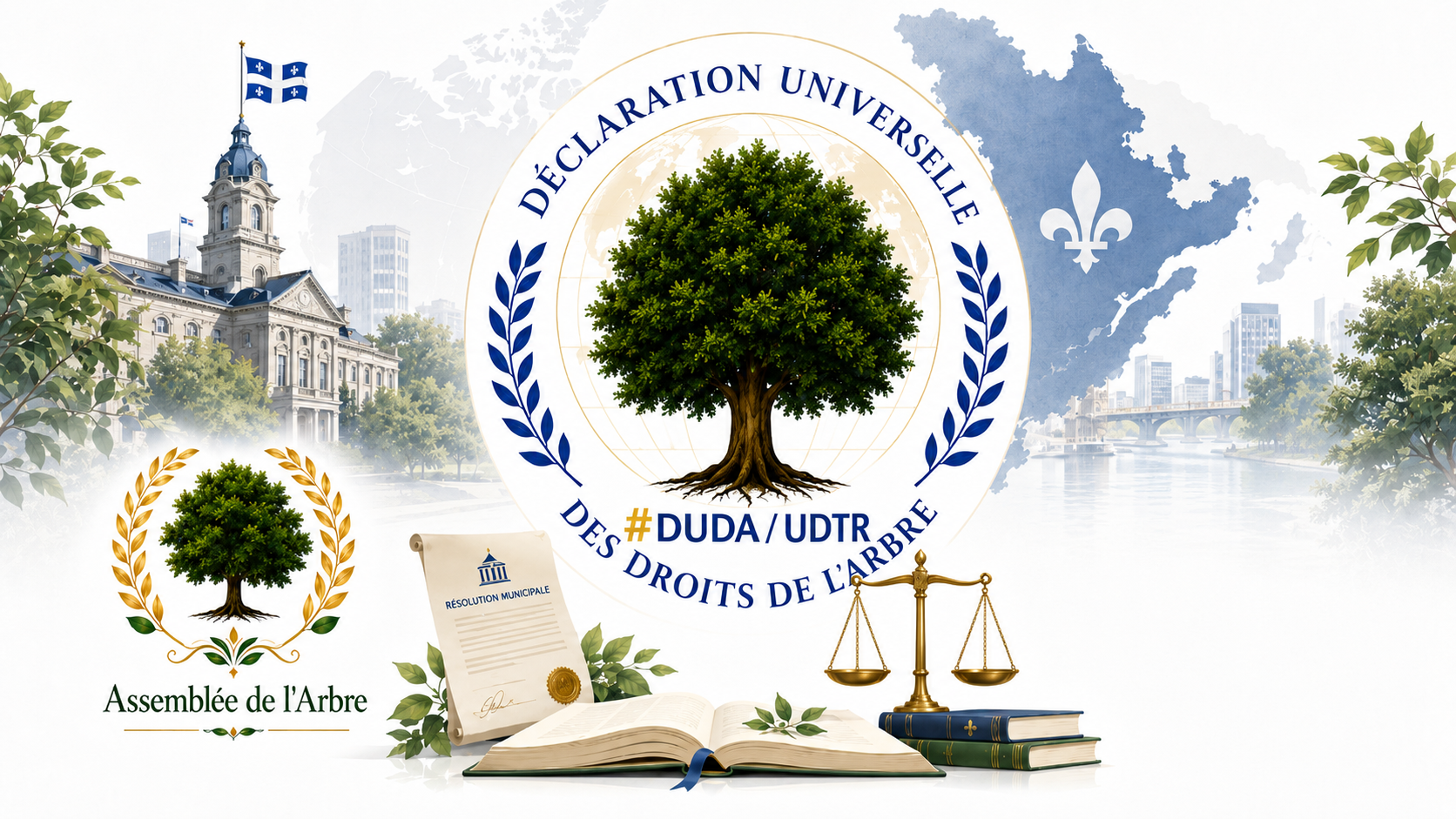
Le 9 juin 2026, le conseil municipal de Terrasse-Vaudreuil, au Québec, a adopté, à l’unanimité des conseillers présents, la résolution no 2026-06-111, intitulée « Engagement municipal pour la protection de la canopée et la reconnaissance des droits fondamentaux de l’Arbre ».
Par cette décision, la municipalité adhère officiellement à la Déclaration universelle des droits de l’Arbre. Elle reconnaît les arbres comme des entités vivantes méritant protection, notamment au regard de leurs droits à la vie, à la croissance naturelle, à l’intégrité et à la régénération. Elle s’engage également à intégrer les principes de la Déclaration dans ses communications, ses politiques de développement, ses pratiques de gestion des actifs verts et la modernisation de sa réglementation d’urbanisme.
L’expérience de Terrasse-Vaudreuil constitue désormais un précédent institutionnel concret pour les collectivités québécoises. Elle montre qu’une municipalité peut engager une démarche officielle de reconnaissance des droits fondamentaux de l’Arbre et organiser leur mise en œuvre progressive dans son action publique.
Dans le cadre institutionnel officiel porté par La Compagnie des Papillons Bleus, l’adoption de la Déclaration par une collectivité est indissociable de l’adoption concomitante et intégrale des Quinze Engagements des collectivités locales et régionales. Toute démarche d’adoption officielle doit en outre être engagée en amont et conduite directement avec La Compagnie des Papillons Bleus, conformément au Cadre officiel.
On 9 June 2026, the Municipal Council of Terrasse-Vaudreuil, Québec, unanimously adopted, among the councillors present, Resolution No. 2026-06-111, entitled “Municipal Commitment to Canopy Protection and Recognition of the Fundamental Rights of the Tree”.
Through that decision, the municipality formally adhered to the Universal Declaration of Tree Rights. It recognised Trees as living entities deserving protection, in particular with regard to their rights to life, natural growth, integrity and regeneration. It also committed to integrating the principles of the Declaration into its communications, development policies, green-asset management practices and the modernisation of its planning regulations.
Terrasse-Vaudreuil’s experience now constitutes a concrete institutional precedent for Québec municipalities. It demonstrates that a municipality can enter into an official process recognising the fundamental rights of the Tree and organise their progressive implementation through public action.
Within the official institutional framework stewarded by La Compagnie des Papillons Bleus, adoption of the Declaration by a public authority is inseparable from the simultaneous and full adoption of the Fifteen Commitments of Local and Regional Authorities. Any official adoption process must also be initiated in advance and conducted directly with La Compagnie des Papillons Bleus, in accordance with the Official Framework.
2. POURQUOI LA DÉCLARATION EST UNIVERSELLE
WHY THE DECLARATION IS UNIVERSAL
La Déclaration universelle des droits de l’Arbre n’est liée à aucun mécanisme juridique, foncier ou territorial particulier. Elle énonce des principes communs susceptibles d’être reconnus dans des pays, des cultures et des ordres juridiques différents.
Au Québec, leur mise en œuvre peut s’appuyer sur les instruments existants du droit municipal, de l’urbanisme, de la conservation et de la protection des milieux naturels, sans que ces instruments se confondent avec la Déclaration.
Pour comprendre plus précisément la nature de la Déclaration, sa distinction avec le mouvement des droits de la nature et sa place dans l’ensemble du dispositif, consultez la page « Comprendre la Déclaration universelle des droits de l’Arbre ».
The Universal Declaration of Tree Rights is not tied to any particular legal, land-tenure or territorial mechanism. It sets out common principles capable of being recognised across different countries, cultures and legal orders.
In Québec, implementation may rely on existing instruments of municipal law, planning law, conservation and natural-environment protection, without those instruments being confused with the Declaration itself.
For a more detailed explanation of the nature of the Declaration, its distinction from the Rights of Nature movement and its place within the broader framework, see “Understanding the Universal Declaration of Tree Rights”.
3. UNE DÉMARCHE COMPATIBLE AVEC LE CADRE CONSTITUTIONNEL CANADIEN
COMPATIBILITY WITH THE CANADIAN CONSTITUTIONAL FRAMEWORK
Le Canada ne possède pas un régime municipal entièrement uniforme. L’article 92, paragraphe 8, de la Loi constitutionnelle de 1867 confie aux provinces la compétence sur les institutions municipales.
Les municipalités exercent donc les pouvoirs qui leur sont attribués par les lois de leur province. Elles ne disposent pas d’une compétence constitutionnelle indépendante comparable à celle du Parlement fédéral ou d’une législature provinciale.
À l’échelle canadienne, les municipalités peuvent adopter des engagements environnementaux et développer des politiques locales dans le cadre des compétences qui leur sont reconnues. La procédure exacte et les modalités d’application doivent toutefois être examinées province par province. La présente analyse porte principalement sur le Québec.
Canada does not have a completely uniform municipal regime. Section 92(8) of the Constitution Act, 1867 assigns authority over municipal institutions to the provinces.
Municipalities therefore exercise the powers granted to them by provincial legislation. They do not possess an independent constitutional jurisdiction comparable to that of the federal Parliament or a provincial legislature.
Across Canada, municipalities may adopt environmental commitments and develop local policies within the powers conferred upon them. The precise procedure and implementation mechanisms must nevertheless be assessed province by province. This analysis focuses primarily on Québec.
4. ADOPTER LA DÉCLARATION N’EST PAS CONCLURE UN TRAITÉ INTERNATIONAL
ADOPTING THE DECLARATION IS NOT CONCLUDING AN INTERNATIONAL TREATY
L’adhésion municipale à la Déclaration universelle des droits de l’Arbre ne constitue pas la signature d’un traité international.
La municipalité ne se substitue ni au gouvernement du Canada ni au gouvernement du Québec. Elle ne devient pas partie au projet de Convention internationale des droits de l’Arbre. Elle ne modifie ni la Constitution canadienne, ni le Code civil du Québec, ni les lois provinciales.
Elle n’acquiert pas davantage de compétences nouvelles. L’adoption de la Déclaration ne crée ni n’impose, par elle-même, aucun mécanisme juridique particulier. Elle ne confère pas automatiquement une personnalité juridique aux arbres et ne crée ni aire protégée, ni réserve naturelle ou écologique, ni fiducie foncière.
Les Quinze Engagements organisent la traduction progressive des principes dans les politiques locales, tandis que chaque collectivité utilise les instruments compatibles avec son droit, ses compétences et ses moyens.
Municipal adoption of the Universal Declaration of Tree Rights does not constitute the signature of an international treaty.
A municipality does not replace either the Government of Canada or the Government of Québec. It does not become a party to the proposed International Convention on Tree Rights. It does not amend the Canadian Constitution, the Civil Code of Québec or provincial legislation.
Nor does it acquire new powers. Adoption of the Declaration does not, by itself, create or impose any specific legal mechanism. It does not automatically confer legal personhood on Trees, nor does it create a protected area, ecological reserve or land trust.
The Fifteen Commitments organise the progressive translation of the principles into local public policy, while each public authority uses instruments compatible with its law, powers and resources.
5. LA NOTION DE BIEN COMMUN : PORTÉE ÉTHIQUE ET POLITIQUE
THE COMMON-GOOD CONCEPT: ETHICAL AND POLITICAL SCOPE
La Déclaration affirme que l’Arbre est un bien commun de l’humanité.
Cette affirmation ne signifie pas que les arbres situés au Québec changeraient automatiquement de propriétaire ou seraient soustraits au régime des biens prévu par le Code civil.
Dans le cadre d’une résolution municipale, la notion de bien commun exprime une responsabilité collective envers les arbres, le vivant, le climat, la biodiversité et les générations futures. Sa traduction en obligations juridiquement opposables suppose ensuite l’utilisation des instruments prévus par le droit québécois.
The Declaration states that the Tree is a common good of humanity.
This does not mean that Trees located in Québec would automatically change ownership or be removed from the property regime established by the Civil Code.
Within a municipal resolution, the concept of a common good expresses a collective responsibility toward Trees, the living world, climate, biodiversity and future generations. Translating that principle into legally enforceable obligations requires the use of instruments provided by Québec law.
6. UNE ADOPTION DE PRINCIPE GÉNÉRALEMENT POSSIBLE PAR RÉSOLUTION
PRINCIPLE-BASED ADOPTION GENERALLY POSSIBLE BY RESOLUTION
Le droit municipal québécois distingue les mesures non réglementaires des règles obligatoires de caractère général.
L’article 4 de la Loi sur les compétences municipales reconnaît notamment aux municipalités locales une compétence en matière d’environnement et leur permet d’adopter des mesures non réglementaires dans les domaines énumérés par la loi. L’article 5 prévoit qu’une municipalité adopte un règlement lorsqu’elle veut rendre obligatoire une règle de caractère général et impersonnel.
Après avoir pris obligatoirement contact avec La Compagnie des Papillons Bleus et préparé avec elle la procédure officielle, une municipalité peut généralement adopter par résolution, conjointement et intégralement, la Déclaration et les Quinze Engagements, annexer les textes à sa décision, autoriser leur signature et annoncer une mise en œuvre progressive.
Lorsqu’elle souhaite imposer aux propriétaires, promoteurs ou entreprises une règle générale — par exemple une autorisation d’abattage, une norme de protection racinaire, une obligation de replantation ou une sanction — elle doit recourir au règlement ou à l’instrument juridique approprié.
Québec municipal law distinguishes non-regulatory measures from binding rules of general application.
Section 4 of the Municipal Powers Act notably recognises local municipal jurisdiction in environmental matters and permits non-regulatory measures within the fields listed by the Act. Section 5 provides that a municipality uses a by-law when it wishes to make a general and impersonal rule binding.
After mandatorily contacting La Compagnie des Papillons Bleus and preparing the official process with it, a municipality may generally adopt by resolution, jointly and in full, the Declaration and the Fifteen Commitments, append the texts to its decision, authorise their signature and announce progressive implementation.
Where the municipality intends to impose a general obligation upon owners, developers or businesses — for example a tree-removal permit, root-protection standard, replanting requirement or sanction — it must use a by-law or another legally appropriate instrument.
7. UNE MISE EN ŒUVRE PROGRESSIVE
PROGRESSIVE IMPLEMENTATION
L’adoption de la Déclaration et des Quinze Engagements ne signifie pas que la municipalité aurait réalisé, dès le jour du vote, l’ensemble des transformations annoncées.
Elle établit une orientation institutionnelle et une feuille de route. La municipalité affirme qu’elle entend progressivement mettre ses politiques, ses pratiques et, lorsque cela est nécessaire, sa réglementation en cohérence avec les principes adoptés.
Cette progressivité n’affaiblit pas l’engagement. Elle permet de l’inscrire dans la durée, de l’adapter aux moyens de la municipalité et d’éviter des promesses juridiquement ou financièrement irréalistes.
Adoption of the Declaration and the Fifteen Commitments does not mean that the municipality has completed every announced transformation on the day of the vote.
It establishes an institutional direction and a roadmap. The municipality states its intention progressively to align its policies, practices and, where necessary, regulations with the adopted principles.
This progressive approach does not weaken the commitment. It allows implementation to be sustained over time, adapted to municipal resources and protected against legally or financially unrealistic promises.
8. LA LOI SUR LES COMPÉTENCES MUNICIPALES
THE MUNICIPAL POWERS ACT
La Loi sur les compétences municipales, chapitre C-47.1, constitue l’un des principaux fondements juridiques de la démarche au Québec.
Son article 2 précise que les pouvoirs municipaux doivent permettre de répondre à des besoins municipaux divers et évolutifs dans l’intérêt de la population. L’article 4 reconnaît notamment l’environnement, les parcs, la salubrité, les nuisances et la sécurité parmi les domaines de compétence des municipalités locales.
L’article 6 permet, dans l’exercice d’un pouvoir réglementaire, d’édicter des prohibitions, d’exiger des permis et d’en déterminer les conditions. L’article 19 permet l’adoption de règlements en matière d’environnement. L’article 85 autorise des règlements visant la paix, l’ordre, le bon gouvernement et le bien-être général de la population.
Ces pouvoirs sont étendus mais non illimités : un règlement municipal incompatible avec une loi ou un règlement gouvernemental peut être inopérant, et la municipalité doit respecter l’ensemble des normes qui la régissent.
Québec’s Municipal Powers Act, chapter C-47.1, provides one of the principal legal foundations for this approach.
Section 2 states that municipal powers are intended to respond to diverse and evolving municipal needs in the public interest. Section 4 notably recognises the environment, parks, sanitation, nuisances and safety as fields of local municipal competence.
Section 6 allows municipalities, when exercising a regulatory power, to establish prohibitions, require permits and determine their conditions. Section 19 authorises environmental by-laws. Section 85 authorises by-laws concerning peace, order, good government and the general welfare of the population.
These powers are broad but not unlimited: a municipal by-law inconsistent with provincial legislation or a government regulation may be inoperative, and the municipality must comply with all governing legal norms.
9. LA JURISPRUDENCE CANADIENNE : SPRAYTECH C. HUDSON
CANADIAN CASE LAW: SPRAYTECH v. HUDSON
La jurisprudence de la Cour suprême du Canada conforte la légitimité de l’action environnementale locale.
Dans l’arrêt 114957 Canada Ltée (Spraytech, Société d’arrosage) c. Hudson, rendu en 2001, la Cour examinait la validité d’un règlement municipal québécois limitant l’utilisation de pesticides.
La Cour a reconnu que la protection de l’environnement et de la santé pouvait relever des activités normales d’une administration municipale lorsque celle-ci agit sur le fondement d’une habilitation législative suffisante. L’arrêt ne confère pas un pouvoir général illimité, mais il confirme la place légitime de l’action environnementale municipale.
The jurisprudence of the Supreme Court of Canada reinforces the legitimacy of local environmental action.
In 114957 Canada Ltée (Spraytech, Société d’arrosage) v. Hudson, decided in 2001, the Court considered the validity of a Québec municipal by-law restricting pesticide use.
The Court recognised that environmental and health protection may fall within normal municipal governmental activity when supported by sufficient legislative authority. The decision does not grant unlimited general power, but it confirms the legitimate role of municipalities in environmental action.
10. LA LOI SUR L’AMÉNAGEMENT ET L’URBANISME
THE ACT RESPECTING LAND USE PLANNING AND DEVELOPMENT
La Loi sur l’aménagement et l’urbanisme, chapitre A-19.1, fournit également des instruments directement mobilisables pour la protection des arbres.
Son cadre permet notamment aux municipalités de réglementer ou restreindre, selon les dispositions applicables, la plantation et l’abattage d’arbres, certains travaux de sol, ainsi que la protection du couvert végétal et forestier.
La réglementation peut aussi prévoir des permis ou certificats avant certains travaux. Ces mécanismes permettent d’examiner un projet avant sa réalisation, d’exiger les documents nécessaires et de prévenir certaines atteintes.
Lorsqu’un abattage contrevient à une disposition réglementaire applicable, la loi peut prévoir des amendes. Une politique de protection des arbres peut donc acquérir une véritable effectivité juridique lorsqu’elle est traduite dans un règlement valide.
The Act respecting land use planning and development, chapter A-19.1, also provides instruments that can be directly mobilised for Tree protection.
Its framework notably allows municipalities, subject to the applicable provisions, to regulate or restrict Tree planting and removal, certain soil works, and the protection of vegetation and forest cover.
Municipal regulation may also require permits or certificates before specified work is carried out. These mechanisms allow a project to be reviewed in advance, supporting documents to be required and certain harms to be prevented.
Where Tree removal violates an applicable by-law, the legislation may provide for fines. Tree-protection policy can therefore acquire genuine legal effect when translated into a valid municipal by-law.
11. LES QUINZE ENGAGEMENTS : UNE MÉTHODE DE MISE EN ŒUVRE
THE FIFTEEN COMMITMENTS: AN IMPLEMENTATION METHOD
Les Quinze Engagements des collectivités locales et régionales constituent une méthode de mise en œuvre et non une accumulation d’obligations devant être réalisées immédiatement.
Ils forment un ensemble indissociable de l’adoption officielle de la Déclaration par une collectivité, mais leur mise en œuvre est volontaire, progressive et évolutive, adaptable aux réalités, aux compétences et aux moyens de chaque territoire.
Ils s’organisent autour de cinq fonctions complémentaires : Gouverner, Connaître, Agir, Préserver et Transmettre.
- Gouverner : mettre en place les conditions institutionnelles de l’engagement, notamment l’Assemblée de l’Arbre et le Défenseur de l’Arbre ;
- Connaître : identifier le patrimoine arboré, les Arbres Gardiens et développer des outils d’inventaire ;
- Agir : intégrer les principes dans les politiques municipales, la gestion, les projets et l’encadrement des abattages ;
- Préserver : renforcer la protection du vivant et développer notamment l’ombrage végétal comme objectif de politique publique ;
- Transmettre : évaluer les progrès, publier les résultats et inscrire l’engagement dans le temps long.
The Fifteen Commitments of Local and Regional Authorities constitute an implementation method rather than a collection of obligations that must all be completed immediately.
They form an inseparable part of the official adoption of the Declaration by a public authority, while implementation remains voluntary, progressive and evolving, adaptable to the realities, powers and resources of each territory.
They are organised around five complementary functions: Govern, Understand, Act, Preserve and Transmit.
- Govern: establish the institutional conditions for the commitment, including the Assembly of the Tree and the Defender of the Tree;
- Understand: identify Tree heritage, Guardian Trees and develop inventory tools;
- Act: integrate the principles into municipal policies, management, projects and Tree-removal controls;
- Preserve: strengthen protection of the living world and develop, in particular, vegetated shade as a public-policy objective;
- Transmit: evaluate progress, publish results and anchor the commitment over the long term.
12. L’ASSEMBLÉE DE L’ARBRE ET LA DÉMOCRATIE MUNICIPALE
THE ASSEMBLY OF THE TREE AND MUNICIPAL DEMOCRACY
L’Assemblée de l’Arbre constitue un espace de réflexion, de dialogue, de participation et de propositions éclairées. Elle peut réunir des savoirs et expériences scientifiques, juridiques, professionnelles, citoyennes, culturelles et territoriales.
Elle n’est ni une juridiction, ni une autorité administrative ou réglementaire, ni un parlement de substitution. Elle ne décide pas à la place du conseil municipal, des services compétents ou des autres institutions publiques. Ses recommandations demeurent consultatives.
Elle peut être instituée comme une instance municipale consultative et participative, selon une forme et des règles de fonctionnement adaptées au régime juridique et à l’organisation de la municipalité. Elle ne doit pas être automatiquement assimilée à un comité consultatif d’urbanisme.
The Assembly of the Tree is a forum for reflection, dialogue, participation and informed proposals. It may bring together scientific, legal, professional, civic, cultural and territorial knowledge and experience.
It is neither a court, nor an administrative or regulatory authority, nor a substitute parliament. It does not decide in place of the municipal council, competent services or other public institutions. Its recommendations remain advisory.
It may be established as a municipal advisory and participatory body, in a form and under operating rules adapted to the municipality’s legal regime and organisation. It should not automatically be equated with a statutory planning advisory committee.
13. UNE MISE EN ŒUVRE ORGANISÉE À PLUSIEURS NIVEAUX
IMPLEMENTATION ORGANISED AT SEVERAL LEVELS
La mise en œuvre peut être organisée à plusieurs niveaux.
- Dès l’adoption : la résolution peut approuver conjointement la Déclaration et les Quinze Engagements, autoriser leur signature, demander un plan d’action, lancer un inventaire, fixer des priorités et créer une démarche consultative ;
- Administration et budget : certaines mesures supposent ensuite des décisions budgétaires ou administratives — inventaires, expertise arboricole, formation, plantations, restauration des sols, adaptation des marchés publics ;
- Règlement : un règlement est nécessaire lorsque la municipalité entend imposer une règle générale et obligatoire aux administrés, notamment en matière d’abattage, de protection racinaire, de remplacement ou de sanctions.
Chaque niveau doit respecter les règles ordinaires relatives aux compétences, au budget, aux contrats, aux délégations de pouvoir, à la consultation et à l’entrée en vigueur des règlements.
Implementation may be organised at several levels.
- At the time of adoption: the resolution may jointly approve the Declaration and the Fifteen Commitments, authorise their signature, request an action plan, launch an inventory, set priorities and establish a consultative process;
- Administration and budget: certain measures subsequently require budgetary or administrative decisions — inventories, arboricultural expertise, training, planting, soil restoration and procurement changes;
- By-law: a by-law is required when the municipality intends to impose a general and binding rule upon residents or regulated actors, including Tree removal, root protection, replacement requirements or sanctions.
Each level must comply with the ordinary rules governing powers, budgets, contracts, delegations of authority, consultation and the coming into force of municipal by-laws.
14. LA PROCÉDURE OFFICIELLE D’ADOPTION EN SIX ÉTAPES
THE OFFICIAL SIX-STEP ADOPTION PROCEDURE
1. Prendre obligatoirement contact avec La Compagnie des Papillons Bleus
Avant toute délibération ou signature, la municipalité doit prendre directement contact avec La Compagnie des Papillons Bleus. Cette prise de contact constitue le point de départ obligatoire de la procédure institutionnelle. Une municipalité ne peut pas adopter seule la Déclaration puis solliciter après coup sa reconnaissance officielle.
2. Recevoir les textes officiels et la procédure institutionnelle
La Compagnie transmet les versions officielles et actualisées de la Déclaration, des Quinze Engagements ainsi que les documents nécessaires à la procédure.
3. Préparer avec La Compagnie l’adoption conjointe
La municipalité prépare avec La Compagnie le projet d’adoption, l’identification exacte des textes, leur éventuelle annexion à la résolution, les modalités de signature et les premières orientations de mise en œuvre.
4. Faire examiner le projet par la direction générale, le greffe ou le conseiller juridique
Le projet est vérifié au regard des compétences de la municipalité, des règles de procédure et du droit québécois applicable.
5. Faire adopter la résolution par le conseil municipal
La résolution identifie précisément la Déclaration et les Quinze Engagements comme les textes conjointement adoptés dans le cadre de la procédure officielle. Elle peut prévoir leur annexion, autoriser leur signature et définir les premières modalités de mise en œuvre.
6. Formaliser l’adoption avec La Compagnie et procéder à l’inscription au Registre
Après le vote, la formalisation institutionnelle est réalisée avec La Compagnie selon la procédure établie. Les documents officiels sont signés par les personnes habilitées, l’adoption est enregistrée et la municipalité peut être inscrite au Registre international des collectivités signataires.
1. Mandatorily contact La Compagnie des Papillons Bleus
Before any deliberation or signature, the municipality must contact La Compagnie des Papillons Bleus directly. This contact is the mandatory starting point of the institutional procedure. A municipality may not adopt the Declaration on its own and then seek official recognition afterwards.
2. Receive the official texts and institutional procedure
La Compagnie provides the official and current versions of the Declaration, the Fifteen Commitments and the documents required for the adoption procedure.
3. Prepare the joint adoption with La Compagnie
The municipality prepares with La Compagnie the proposed adoption, the exact identification of the texts, any annexes to the resolution, signature arrangements and the first implementation directions.
4. Have the proposal reviewed by the general administration, municipal clerk or legal counsel
The proposal is reviewed against the municipality’s powers, procedural rules and applicable Québec law.
5. Have the municipal council adopt the resolution
The resolution precisely identifies the Declaration and the Fifteen Commitments as the texts jointly adopted within the official procedure. It may append them, authorise signature and set out the first implementation arrangements.
6. Formalise the adoption with La Compagnie and register it
Following the vote, institutional formalisation is completed with La Compagnie in accordance with the established procedure. The official documents are signed by the authorised persons, the adoption is recorded and the municipality may be entered in the International Register of Signatory Authorities.
15. UNE ADOPTION JURIDIQUEMENT ACCESSIBLE ET POLITIQUEMENT AMBITIEUSE
A LEGALLY ACCESSIBLE AND POLITICALLY AMBITIOUS ADOPTION
La facilité relative de l’adoption par résolution ne signifie pas que l’engagement serait superficiel.
Elle permet d’éviter deux erreurs : attendre une réforme complète du droit avant d’agir, ou prétendre modifier immédiatement, par une seule résolution, l’ensemble des droits, obligations et règlements applicables aux arbres.
La Déclaration établit les principes. Les Quinze Engagements organisent une méthode progressive. L’Assemblée de l’Arbre crée un espace de connaissance, de dialogue et de participation. Les compétences municipales, les politiques publiques, les programmes administratifs et les règlements permettent ensuite de transformer progressivement ces orientations en mesures effectives.
La voie est juridiquement accessible, politiquement ambitieuse et peut être empruntée par les municipalités qui souhaitent faire de la protection des arbres un principe durable de leur action publique.
The relative accessibility of adoption by resolution does not mean that the commitment is superficial.
It helps avoid two errors: waiting for a complete reform of the law before acting, or claiming that a single resolution can immediately transform every right, obligation and regulation applicable to Trees.
The Declaration establishes the principles. The Fifteen Commitments organise a progressive method. The Assembly of the Tree creates a forum for knowledge, dialogue and participation. Municipal powers, public policies, administrative programmes and by-laws then allow those orientations progressively to become effective measures.
The path is legally accessible, politically ambitious and available to municipalities wishing to make Tree protection a lasting principle of public action.
Sources officielles et textes de référence
Official sources and reference texts
- Résolution no 2026-06-111 de Terrasse-Vaudreuil / Terrasse-Vaudreuil Resolution No. 2026-06-111
- Déclaration et adhésion des collectivités / Declaration and local-authority adoption
- Cadre officiel / Official Framework
- Quinze Engagements des collectivités locales / Fifteen Commitments of Local Authorities
- Assemblée de l’Arbre / Assembly of the Tree
- Loi constitutionnelle de 1867, article 92 / Constitution Act, 1867, s. 92
- Loi sur les compétences municipales / Municipal Powers Act
- Loi sur l’aménagement et l’urbanisme / Act respecting land use planning and development
- Plantation et abattage des arbres — Gouvernement du Québec / Tree planting and removal — Gouvernement du Québec
- Permis et certificats d’urbanisme — Gouvernement du Québec / Planning permits and certificates — Gouvernement du Québec
- Mécanismes de participation publique — Gouvernement du Québec / Public participation mechanisms — Gouvernement du Québec
- Cour suprême du Canada — Spraytech c. Hudson / Supreme Court of Canada — Spraytech v. Hudson
Publication institutionnelle · Institutional publication
Ricardo Rey
Auteur et initiateur de la Déclaration universelle des droits de l’Arbre
Author and initiator of the Universal Declaration of Tree Rights
Fondateur de l’Assemblée de l’Arbre · Founder of the Assembly of the Tree
Président de La Compagnie des Papillons Bleus · President of La Compagnie des Papillons Bleus