Jamaica · local authorities · legal and institutional analysis
Legal basis, Council procedure, and progressive implementation of the Universal Declaration of Tree Rights and its Fifteen Commitments
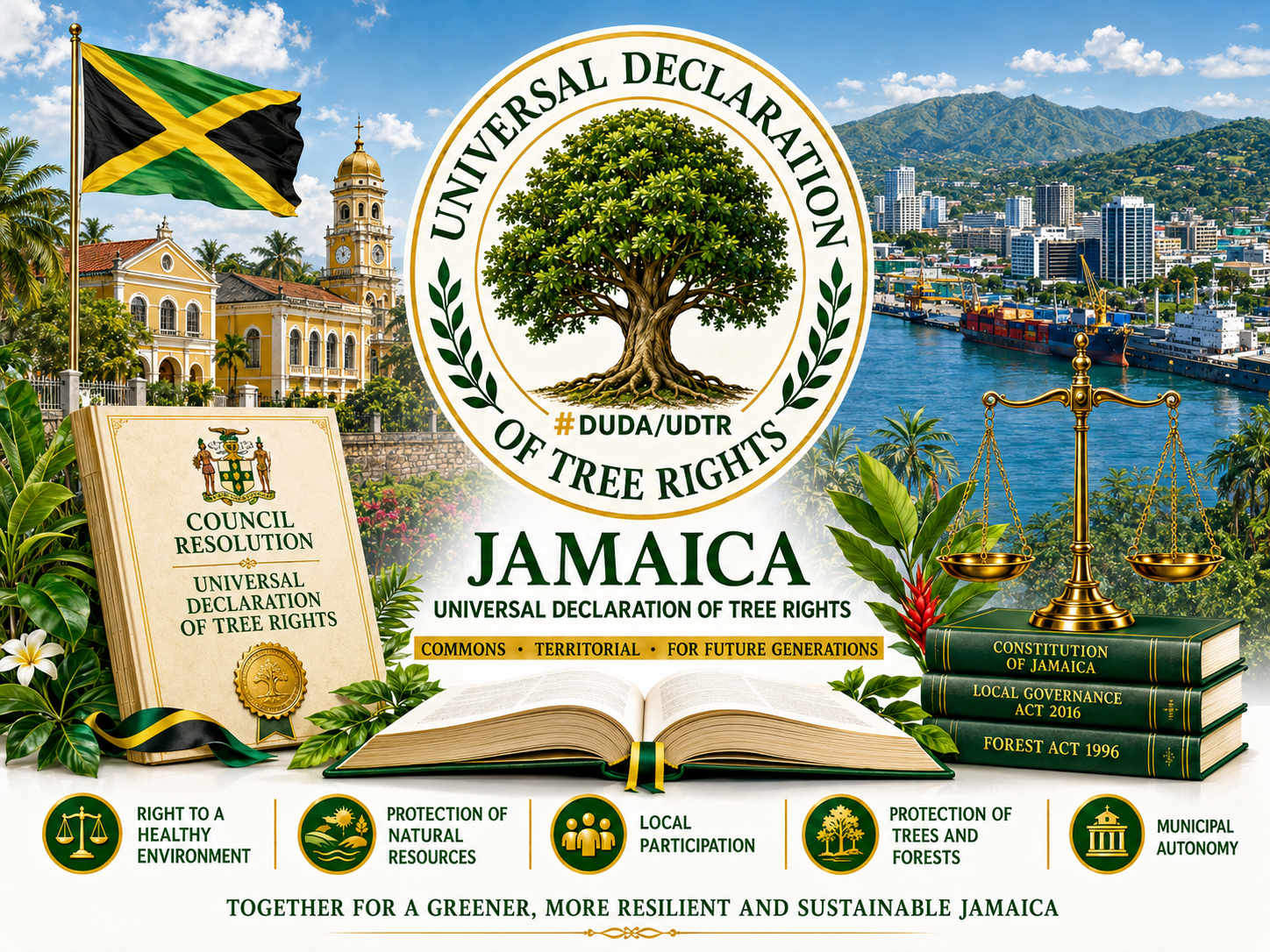
This article examines how a Jamaican local authority may adopt the Universal Declaration of Tree Rights and the Fifteen Commitments of Local and Regional Authorities, and how it may then organize progressive implementation within Jamaica’s constitutional, statutory, environmental, forestry, planning, building and local-government framework.
In Jamaica, a local authority appears to have a legally defensible route to adopt the Universal Declaration of Tree Rights and the Fifteen Commitments simultaneously and in full, provided that the act remains within Jamaican constitutional and statutory powers, respects the authority of national environmental, forestry, planning, building and disaster-risk institutions, and is followed by measure-specific legal implementation.
For the initial, non-regulatory institutional act, a formal Council resolution appears to be the most legally appropriate vehicle, subject to review by the adopting authority. A by-law should be reserved for later measures that are genuinely regulatory, fall within a statutory power, and comply with the approval and procedural requirements applicable under Jamaican law.
Adoption does not, by itself, confer legal personhood or standing on trees, alter ownership, replace permits or environmental assessments, create offences or penalties, or transfer powers held by another public authority.
1Legal and institutional nature of the Declaration
The Universal Declaration of Tree Rights is a founding text setting out principles of recognition, respect, protection and responsibility toward the Tree. It forms part of an ethical, scientific, democratic, cultural, educational and legal architecture developed and institutionally safeguarded by La Compagnie des Papillons Bleus.
The Declaration is not a legal person, a Jamaican public authority, a treaty in force or an intergovernmental organization. It does not itself exercise governmental power. Institutional support, official document transmission and the International Register are managed within the framework stewarded by La Compagnie des Papillons Bleus.
Adoption by a Jamaican local authority does not amount to:
- signature, ratification or accession to a treaty by Jamaica;
- accession by Jamaica to the proposed International Convention on Tree Rights;
- an amendment to the Constitution or to Jamaican environmental, forestry, planning, building, property or land law;
- the conferral of legal personhood or general standing on trees;
- a transfer of public powers to La Compagnie des Papillons Bleus;
- a general prohibition, by itself, on felling or intervention on private land;
- the immediate creation of taxes, fees, easements, offences, penalties or other binding duties without a separate legal basis.
The expression “common good of humanity” has an ethical, scientific, political and interpretive function within the Declaration. It affirms shared responsibility toward trees and the ecological systems to which life is connected; it does not, by itself, create a new category of ownership under Jamaican law.
2Jamaica’s local-government architecture
The Government of Jamaica currently operates a system of local government overseen by the Ministry of Local Government and Community Development. The Ministry states that it oversees fourteen local authorities and assigns them responsibilities including municipal parks and beautification, parochial roads, drains and gullies, markets, cemeteries, planning approvals and local sustainable development planning.
Official Ministry guidance on roles and functions distinguishes the political arm of a local authority, formed by Councillors and headed by the Mayor as chair of the Council, from the administrative arm that advises and implements Council policy.
The exact legal form and terminology of the adopting authority must nevertheless be checked in each case. This article therefore uses “local authority” as the principal legal and institutional expression and uses “Municipal Corporation” where appropriate.
3Local interest and legal authority: the two central conditions
Section 21 of the Local Governance Act, 2016 gives local authorities a particularly relevant statutory foundation. It covers the promotion and coordination of local sustainable development, environmental protection, disaster preparation, mitigation and recovery, coordination with public, private and non-governmental bodies, and the construction and maintenance of parks and local roads, all subject to other applicable law.
A legally robust adoption should therefore identify a concrete connection between the Declaration and the authority’s lawful responsibilities. Relevant matters may include:
- trees in municipal parks, streets, cemeteries, markets, transport facilities and other public assets;
- tree canopy, shade and reduction of heat exposure;
- drains, gullies, runoff, soil stability and watershed protection;
- urban and rural biodiversity and ecological connectivity;
- landscape, community identity and trees of cultural or historic value;
- the quality and resilience of public works and local infrastructure;
- disaster preparedness, hurricane resilience and ecological recovery;
- environmental education and community participation;
- local sustainable development planning and inter-agency coordination.
4Three legal levels that must remain distinct
Level 1 — Institutional adoption
The Council adopts the Declaration and the entire Fifteen Commitments simultaneously and in full, states a public-policy orientation and establishes a roadmap. The initial act need not create direct obligations for third parties.
Level 2 — Internal implementation
The authority acts through its own assets, services, staff, budgets, projects, contracts, inventories, maintenance practices, education programmes and inter-agency cooperation.
Level 3 — Binding legal measures
Any prohibition, permit condition, penalty, fee, easement, private-land restriction or other coercive rule requires its own statutory power, lawful instrument, procedure and competent decision-maker.
This distinction avoids two opposite errors: reducing adoption to a purely symbolic statement, or attributing to a general adoption resolution effects that only later legislation, by-laws, permits, contracts, plans or administrative decisions can lawfully produce.
5Constitutional and statutory foundation: favorable, but distributed
Jamaica’s constitutional entrenchment of local government is a significant starting point. The constitutional reform adopted in 2015 was designed to protect the democratic system of local government and identified purposes including effective participation of local communities, the provision of local public services and facilities, and the exercise of regulatory functions conferred on local authorities by law.
Government explanation of the constitutional local-government reform
The Local Governance Act, 2016 then provides the central modern statutory framework. Its section 21 expressly includes sustainable development and environmental protection among local functions, while section 22 requires appropriate mechanisms for participation, collaboration and networking with relevant stakeholders.
At the same time, environmental and land-use authority remains distributed across several national statutes and institutions. NEPA identifies among its core legislative mandate the Natural Resources Conservation Authority Act, the Town and Country Planning Act, the Land Development and Utilization Act, the Watersheds Protection Act, the Beach Control Act and the Wild Life Protection Act.
6What an adoption resolution may contain
Subject to final review by the adopting authority, a formal Council resolution may:
- officially adopt the Universal Declaration of Tree Rights and the entire Fifteen Commitments simultaneously and in full;
- identify precisely the official English versions and annex them or incorporate them by unambiguous reference;
- state the local public interest and the statutory functions supporting the act;
- confirm expressly that adoption does not alter ownership, legal competence, permits or statutory procedures;
- order a review of existing local policies, assets, projects, maintenance practices and contracts;
- launch a tree inventory or canopy diagnosis within the authority’s lawful sphere;
- establish priorities, responsibilities, indicators and a progressive implementation timetable;
- create or instruct the preparation of a consultative Assembly of the Tree;
- appoint a Defender of the Tree or other advisory mechanism without coercive authority;
- integrate tree-protection criteria into local works, maintenance and procurement where legally permissible;
- request coordination with the Forestry Department, NEPA, planning bodies, ODPEM, utilities, universities and community organizations;
- require any later regulatory, budgetary, contractual or planning measure to return to the competent body and follow the legally required procedure.
7Council, Mayor and administrative arm
Official Ministry guidance describes Jamaican local authorities as having two arms. The political arm is made up of Councillors and headed by the Mayor, who chairs the Council and is responsible for policy direction. The administrative arm advises and implements Council policy.
This division matters for the Declaration. The Council should be the forum for the political and institutional act of adoption. Implementation should then be assigned to the competent administrative officers and technical units, subject to budgets, procurement rules, statutory approvals and professional responsibilities.
Where the exact title or legal status of the head of administration varies by authority, the resolution should use the title applicable to that authority and avoid mechanically importing terminology from another Municipal Corporation.
8The Forest Act, 1996: a central national framework
The Forest Act, 1996 is central to any Jamaican analysis. It establishes and structures national forestry functions involving sustainable management and conservation, forest reserves and forest management areas, reforestation, inventories, research, education, watershed protection and soil conservation, together with licensing and other regulatory mechanisms.
The Forestry Department identifies itself as the lead agency responsible for Jamaica’s forest resources and reports management responsibility for approximately 117,000 hectares of forests.
The Declaration may support local action concerning:
- tree and canopy inventories;
- restoration of municipal green spaces and degraded soils;
- protection of mature trees on local-authority property;
- technical standards for pruning, planting and root protection in local projects;
- urban and peri-urban shade strategies;
- environmental education and community stewardship;
- cooperation with national reforestation and watershed initiatives.
9Planning, building law and tree preservation
The Town and Country Planning Authority is responsible for the orderly and progressive development of land through the planning system and development orders. NEPA also lists the Town and Country Planning (Tree Preservation) Regulations, 1967 among Jamaica’s planning regulations.
The presence of a specific tree-preservation instrument in the planning framework is important, but it should not be overread. Its application to a particular tree, parcel, order, planning area or development proposal must be determined under the applicable planning law and current legal instruments.
The Building Act, 2018, in force since January 15, 2019, makes local authorities local building authorities for the administration of building regulation within their jurisdictions. This creates a relevant point of connection for projects in which tree protection, soil, drainage, building safety and site design interact.
Within lawful planning and building functions, the Declaration may encourage consideration of:
- retention of existing mature trees at the earliest design stage;
- root-zone and soil protection during works;
- permeable soil and stormwater management;
- shade and thermal comfort in public space;
- canopy continuity and ecological connectivity;
- appropriate species and planting conditions;
- post-construction survival and maintenance.
Binding planning or building conditions do not arise merely because the Declaration is cited. They must be imposed through the competent statutory process and within the authority granted by law.
10The local authority can begin with trees it owns or manages
The most immediate and legally controlled field of implementation is generally the authority’s own assets and operations. Depending on the authority’s legal responsibilities, this may include trees associated with:
- municipal parks and beautification programmes;
- parochial roads and roadside public space;
- drains, gullies and local stormwater infrastructure;
- markets, cemeteries, recreational facilities and transport centres;
- municipal buildings and other local public property;
- works and projects financed or procured by the authority.
Initial measures may include tree inventories and mapping, risk assessment, root and soil protection, pruning protocols, conservation before compensation, climate-resilient planting, post-planting maintenance, survival monitoring and publication of reasons for removal where appropriate.
Protection must remain compatible with public safety. Recognition of the value of a tree does not require an authority to maintain an objectively dangerous tree where proportionate intervention is necessary and no reasonable alternative is available.
11Public procurement can incorporate tree protection
Jamaican public procurement operates under the Public Procurement Act, 2015 and the associated procurement framework, as amended from time to time. Adoption of the Declaration does not displace procurement law, financial controls, competition requirements, transparency or value-for-money obligations.
Where connected to the subject matter of a lawful procurement and framed objectively and proportionately, specifications may address:
- tree-protection zones during works;
- protection of roots, trunks, crowns and soils;
- restrictions on storage, traffic and compaction in root zones;
- excavation and trenching methods near trees;
- qualified arboricultural or forestry assessment where justified;
- planting quality, soil volume, drainage and irrigation;
- maintenance periods and replacement of failed plantings;
- traceability and lawful origin of timber or forest products where relevant;
- contractual responsibility for avoidable tree damage.
These clauses must be developed within the procurement rules applicable to the contracting entity and the specific contract.
12Citizen participation, the Assembly of the Tree and the Defender of the Tree
Participation has unusually strong support in Jamaica’s local-governance framework. The constitutional reform protecting local government identifies effective local-community participation as a purpose of the system, while section 22 of the Local Governance Act requires local authorities to promote, establish and use appropriate mechanisms for participation, collaboration and networking with relevant stakeholders.
This provides a credible legal and institutional environment for an Assembly of the Tree conceived as a consultative forum, provided that its mandate is drafted carefully.
The Assembly may include, as appropriate:
- Councillors and local-authority officers;
- the Forestry Department and other public agencies by invitation;
- NEPA and planning expertise where relevant;
- Local Forest Management Committees where relevant;
- universities, scientists and technical professionals;
- community organizations, schools and youth representatives;
- lawyers, planners, landscape professionals, foresters and arboricultural specialists;
- citizens and other stakeholders affected by local tree policy.
Its functions may include reviewing inventories and projects, receiving information, issuing reasoned recommendations, proposing educational priorities, following indicators and facilitating early participation.
A Defender of the Tree may receive concerns, observe implementation and formulate recommendations. Without an additional statutory basis, the Defender cannot suspend permits, impose penalties, annul decisions or exercise a veto.
13The Fifteen Commitments: the roadmap that accompanies adoption
The Fifteen Commitments of Local and Regional Authorities translate the principles of the Declaration into an institutional roadmap. Within the official institutional procedure, adoption of the Declaration is inseparable from the simultaneous and full adoption of the Fifteen Commitments.
Adoption is complete; implementation is progressive and adapted to the authority’s lawful powers, resources and ecological circumstances.
- 1. Establish an Assembly of the Tree
- 2. Appoint a Defender of the Tree
- 3. Recognize Guardian Trees
- 4. Create the Guardian Tree Passport
- 5. Know the Trees of the Authority
- 6. Develop the Canopy
- 7. Involve Citizens
- 8. Preserve the Vital Environment of Trees
- 9. Regulate Felling
- 10. Ensure Ecological Compensation
- 11. Assess the Impact of Projects
- 12. Guarantee the Right to Shade
- 13. Preserve the Living Common Good
- 14. Evaluate Progress Achieved
- 15. Transmit a Strengthened Common Good
14Implementation organized by legal category
Measures that may begin with adoption
- identify and annex the official texts;
- order a diagnosis and inventory;
- establish a working group or begin creating the Assembly of the Tree;
- set indicators, a timetable and accountability arrangements;
- review local practices, assets, projects and contracts;
- request coordination and technical assistance from competent institutions.
Measures requiring budget, procurement, contract or administrative decision
- technical inventories and GIS mapping;
- tree-risk and site assessments;
- nurseries, planting, soil restoration and maintenance;
- training for staff and contractors;
- shade, drainage, resilience or ecological-connectivity works;
- educational and participatory programmes.
Measures requiring another legal instrument, authority or approval
- forest activities subject to licence or permit;
- intervention in forest reserves, forest management areas or protected areas;
- environmental permits or environmental impact assessment;
- planning, development-order or land-use changes;
- binding restrictions imposed on private property;
- new fees, easements, offences or penalties;
- building-control measures requiring statutory procedure;
- measures falling within national disaster-risk or watershed authority.
15Institutional, territorial and disaster-risk coordination
Jamaica’s statutory architecture strongly favors coordination rather than substitution of powers. Section 21 of the Local Governance Act expressly supports collaboration between public, private and non-governmental bodies. The Forest Act provides its own participatory structures. NEPA and the Town and Country Planning Authority exercise national environmental and planning functions. The Disaster Risk Management Act, 2015 and Jamaica’s disaster-management architecture provide another relevant layer for resilience and emergency planning.
Implementation may therefore involve coordination with:
- the Forestry Department;
- NEPA and the Natural Resources Conservation Authority;
- the Town and Country Planning Authority;
- ODPEM and parish/local disaster structures;
- water, infrastructure and public-works bodies;
- universities and scientific institutions;
- community organizations and LFMCs;
- neighboring local authorities where ecological systems cross administrative boundaries.
A local authority’s adoption does not bind another authority. Joint action must rest on each institution’s lawful powers and, where necessary, agreements, approvals or national programmes.
16Official institutional procedure for a Jamaican local authority
- 1 — Initiate the institutional procedure with La Compagnie des Papillons Bleus. Before any deliberation, resolution or signature intended to constitute an official adoption within the institutional framework of the Declaration, the authority contacts La Compagnie directly. This contact opens the institutional procedure and ensures use of the current official texts.
- 2 — Receipt and confirmation of the official texts. La Compagnie provides or confirms the current official versions of the Declaration, the Fifteen Commitments, the Official Framework and the procedural documentation needed for adoption.
- 3 — Preparation of the institutional project. The parties prepare the institutional aspects of the proposed adoption: exact identification of the texts, possible annexes, signature arrangements and initial implementation directions. Official adoption concerns the Declaration and the Fifteen Commitments simultaneously and in full.
- 4 — Jamaican legal, technical and administrative review. The authority’s competent officers and legal advisers verify Council competence, notice and agenda requirements, quorum and voting, administrative responsibilities, budgetary implications, forestry, NEPA, planning, building, procurement, disaster-risk and other statutory requirements.
- 5 — Adoption by the competent Council. Subject to local legal review, the Council adopts the Declaration and the entire Fifteen Commitments by formal resolution under the rules governing the authority. The official texts are unambiguously identified and annexed where appropriate.
- 6 — Documentation and public-law formalities. The authority completes the minutes, signatures, certification, publication, record-keeping and any other formalities required by Jamaican law or its internal governance rules.
- 7 — Institutional formalization and Register. The adopted act and required documentation are transmitted to La Compagnie des Papillons Bleus. Once the institutional procedure is completed and verified, the authority may be entered in the International Register of Signatory Authorities.
- 8 — Progressive implementation. The authority develops implementation through the appropriate budgets, contracts, plans, administrative measures, partnerships, permits or by-laws where legally authorized.
17Validity, documentary record and later by-laws
The adoption record should allow a reviewer to identify:
- the legal identity of the local authority;
- the competence of the Council;
- notice, agenda, quorum and voting compliance;
- the exact official versions of the Declaration and Fifteen Commitments adopted;
- the final wording of the resolution;
- signatures, certification and minutes;
- any required publication or public access;
- budgetary or procurement implications;
- the measures reserved for later statutory instruments or approvals.
Jamaican local authorities are empowered, within the framework provided by law, to make by-laws, rules and regulations for local governance. That power should not be confused with the initial act of institutional adoption.
Before any adoption, the final resolution should be reviewed by the authority’s competent administrative and legal officers or by counsel qualified to advise on Jamaican law.
18A particularly relevant Jamaican precedent: Local Forest Management Committees
The Forest Act, 1996 already provides Jamaica with a legally grounded model of territorial participation in forest governance. The Forestry Department describes Local Forest Management Committees (LFMCs) as institutional bodies established in watershed management units to enable community participation in the co-management of forested areas managed by the Department.
Forestry Department — Local Forest Management Committees
This precedent is valuable for the Declaration because it demonstrates that Jamaican environmental governance already recognizes a principle that is central to the Assembly of the Tree: local knowledge and community participation can be organized without displacing the statutory authority of the national institution.
The Assembly of the Tree should follow the same discipline. It can create a broader consultative space around local tree policy, urban trees, municipal assets, education and implementation of the Commitments, while cooperating with — and never replacing — LFMCs, the Forestry Department, NEPA or any other competent authority.
19Recognition of adoption and status of the International Register
Within the official institutional framework, a Jamaican local authority may be recognized as a signatory where it has:
- initiated the official procedure with La Compagnie des Papillons Bleus before its vote;
- validly adopted the Declaration and the Fifteen Commitments simultaneously and in full;
- completed the applicable Jamaican public-law and internal formalities;
- completed the institutional formalization required for recognition and registration.
The International Register is an institutional international register administered within the official UDTR framework. It is not a Jamaican administrative register, environmental permit, public certification, accreditation, State quality mark or intergovernmental registry.
The Register may record the authority’s name, the date and reference of adoption, the relevant act and links to public documents.
An initiative conducted outside the institutional procedure may have whatever legal effect follows from Jamaican law, but it cannot be recorded or presented by La Compagnie des Papillons Bleus as an official adoption within the institutional framework of the Declaration.
20Institutional support, documents and intellectual property
Nature of institutional support
La Compagnie des Papillons Bleus may provide doctrinal, scientific, methodological, institutional, documentary, educational and coordinating support. That support is not individualized Jamaican legal advice and does not replace the local authority’s legal officers or a lawyer qualified to advise on Jamaican law.
Any paid or material engagement must be defined in writing and comply with the applicable budget, procurement, transparency and financial-management rules.
Trademark and copyright
The names “Déclaration universelle des droits de l’Arbre” and “Universal Declaration of Tree Rights™” are used as distinctive signs within the institutional project. The French designation has been the subject of a trademark filing in France. That French filing does not, by itself, constitute a Jamaican trademark registration.
Jamaican trademark protection is governed by the Trade Marks Act, 1999, as amended, and related legislation administered by the Jamaica Intellectual Property Office (JIPO).
JIPO also explains that Jamaican copyright protects original literary and artistic works and arises automatically for qualifying works once fixed in the required form, while ideas, concepts, processes and principles are not protected merely as such.
21A legally accessible route, provided that competence and drafting remain disciplined
22Official sources and reference texts
Jamaican legal references reviewed in versions accessible on August 13, 2026; institutional framework updated on September 13, 2026.
Universal Declaration of Tree Rights — institutional sources
- Understanding the Universal Declaration of Tree Rights
- Official Framework
- Procedure for local and regional authorities
- The Fifteen Commitments — official English text
- The Three Founding Articles — official English text
Constitution and local government
- Constitutional protection of local government — Government of Jamaica
- Local Governance Act, 2016 No. 8
- Roles and Functions of Local Authorities
- Ministry of Local Government and Community Development — current local-authority framework
- Building Act, 2018 — local building authorities
- Disaster Risk Management Act, 2015 — ODPEM
Forests, environment, watersheds and planning
- Forest Act, 1996
- Forestry Department — Local Forest Management Committees
- RE-LEAF Initiative — January 2026 announcement
- RE-LEAF — official launch and April 2026 update
- NEPA — Acts within the environmental and planning framework
- Natural Resources Conservation Authority — statutory functions
- Town and Country Planning Authority — mandate
- Planning Regulations, including Town and Country Planning (Tree Preservation) Regulations 1967
Procurement and intellectual property
Official institutional text
Publication of La Compagnie des Papillons Bleus
This article is an institutional publication of La Compagnie des Papillons Bleus, the French association responsible for the Universal Declaration of Tree Rights and for its coherence, preservation, development, institutional support and monitoring.
It is published under the authority of its President and of the author and initiator of the Universal Declaration of Tree Rights.
Publication: August 13, 2026 — Updated: September 13, 2026 — Jamaica Version 2.0 — English edition and legal analysis.
This article sets out general principles and institutional analysis concerning Jamaican law. It is not individualized legal advice and should be reviewed by the adopting authority’s legal services or by counsel qualified to advise on Jamaican law before any adoption.
Official contact: presidence@ciedespapillonsbleus.org
Official website: www.declarationuniverselledesdroitsdelarbre.org
© 2026 Ricardo Rey. Institutional publication of La Compagnie des Papillons Bleus. All rights reserved.
Any reproduction, representation, adaptation or distribution, in whole or in part, requires prior written authorization, subject to applicable statutory exceptions. Reading or transmitting this article does not transfer intellectual-property rights.