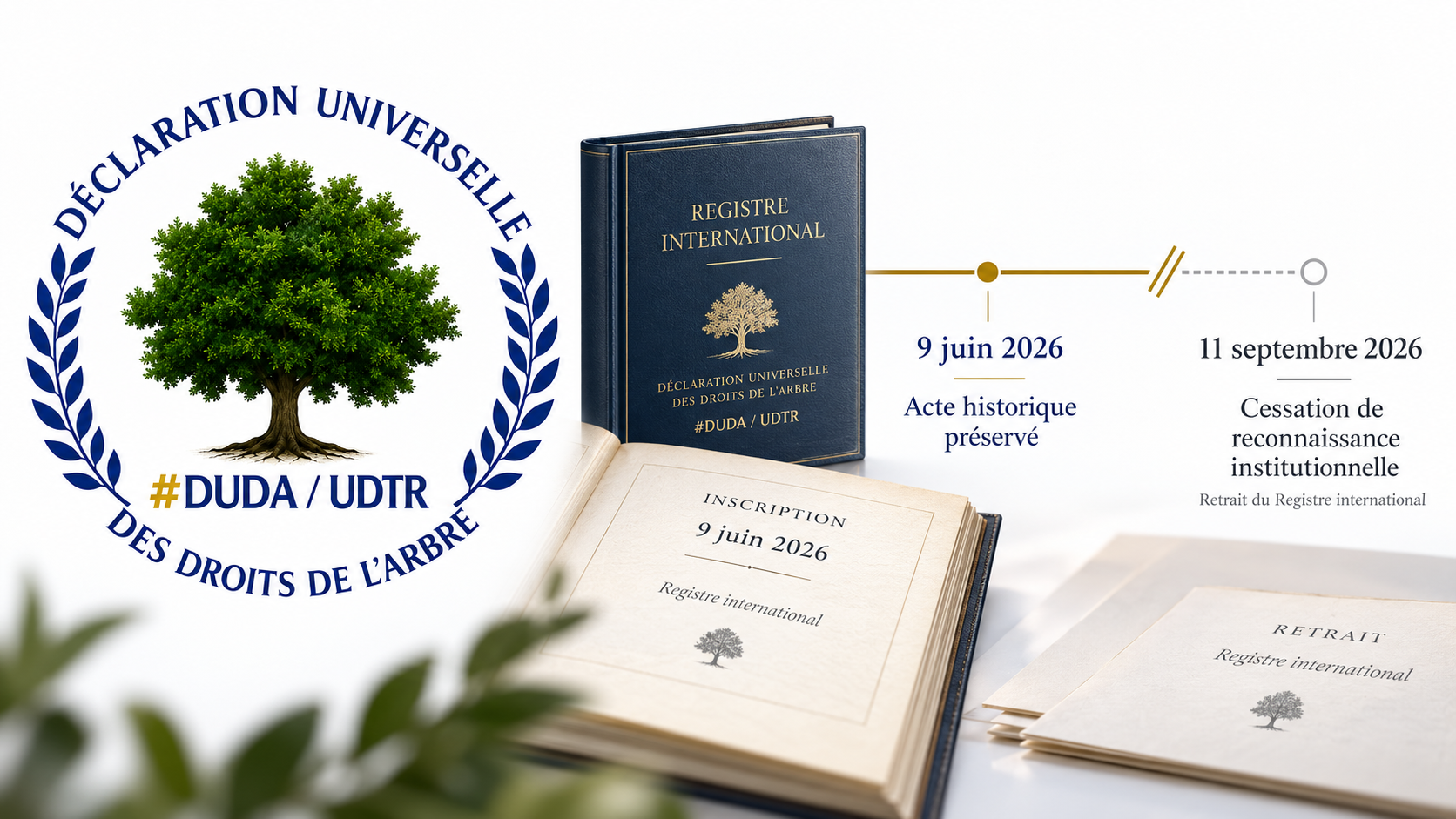
On June 9, 2026, the Municipal Council of Terrasse-Vaudreuil, Quebec, unanimously adopted Resolution No. 2026-06-111, becoming the first municipality in the world to officially adhere to the Universal Declaration of Tree Rights.
This decision demonstrated that a Canadian municipality can recognize the principles of the Declaration and organize their progressive implementation without waiting for prior reform of federal or provincial law.
Consult Resolution No. 2026-06-111 adopted by Terrasse-Vaudreuil
Read the French-language analysis concerning municipal adoption in Canada and Quebec
The same question now arises in British Columbia.
British Columbia municipal law differs from both Quebec and Ontario law. It nevertheless provides most municipalities with broad corporate, service, regulatory, environmental, planning and tree-protection powers under the Community Charter and the Local Government Act.
A British Columbia municipality may therefore, within the limits of its legal powers, officially adopt the Universal Declaration of Tree Rights and the Fifteen Commitments of Local and Regional Authorities. Within the official institutional framework stewarded by La Compagnie des Papillons Bleus, adoption of the Declaration is inseparable from the simultaneous and full adoption of the Fifteen Commitments. Their implementation is then progressive and adapted to the authority’s powers, resources and territorial circumstances.
The District of Saanich provides a particularly instructive territorial example. Its Official Community Plan, Urban Forest Strategy, Biodiversity Conservation Strategy and Tree Protection Bylaw already form a substantial municipal framework for canopy protection, biodiversity, climate resilience, land-use planning, public participation and long-term stewardship.
Saanich is presented as a legally and territorially instructive example, not as a signatory municipality. On July 20, 2026, Saanich Council considered a motion concerning the Universal Declaration of Tree Rights; that motion did not pass. Any future official adoption procedure would therefore have to be initiated under the current institutional framework, including mandatory prior contact and preparation with La Compagnie des Papillons Bleus before any deliberation, resolution or signature.
Any local or regional authority wishing officially to adopt the Universal Declaration of Tree Rights must contact La Compagnie des Papillons Bleus directly before any deliberation, resolution or signature and follow the established institutional procedure.
An authority may not adopt the Declaration independently and subsequently seek retroactive recognition of that act as an official adoption within the institutional framework stewarded by La Compagnie des Papillons Bleus.
Official institutional references:
Understanding the Universal Declaration of Tree Rights
Official Framework of the Universal Declaration of Tree Rights
The Fifteen Commitments of Local and Regional Authorities — Official English Text
1. Why the Declaration Is Universal
The Universal Declaration of Tree Rights is not tied to any particular legal, land-based or territorial mechanism.
It sets out common principles intended to transform the relationship between humanity and the Tree.
It affirms, in particular, that the Tree, a sentient living being and source of Life, is a common good of humanity; that Life on Earth depends upon the existence of the Tree; and that human beings, endowed with reason and conscience, must act with the Tree in a spirit of fraternity and solidarity.
Its universal character does not mean that it would produce the same immediate legal effects everywhere.
It means that its principles can be recognized in different countries, cultures and legal systems, while their implementation is adapted to the powers, institutions, resources, Indigenous relationships and ecological characteristics of each territory.
In British Columbia, municipal implementation may rely upon existing responsibilities and instruments relating to:
- municipal environmental well-being;
- trees and urban forests;
- parks, highways and public places;
- public health and community resilience;
- protection of the natural environment;
- Official Community Plans and land-use planning;
- development permit areas and development permits;
- landscaping, soil, drainage and erosion control;
- natural assets and green infrastructure;
- public participation and advisory bodies;
- climate adaptation and greenhouse-gas reduction.
These instruments are not the Declaration itself. They are the means through which a municipality may progressively translate its principles into public action.
2. An Approach Compatible with Canada’s Constitutional and British Columbia Framework
Municipalities Fall Primarily Under Provincial Jurisdiction
Canada does not have a single, uniform municipal system.
Section 92(8) of the Constitution Act, 1867 assigns jurisdiction over municipal institutions to the provinces. British Columbia municipalities therefore exercise the powers granted to them by provincial legislation, their incorporation instruments and the other legal rules applicable to them.
A British Columbia municipality does not possess an independent constitutional jurisdiction comparable to that of the Parliament of Canada or the Legislative Assembly of British Columbia.
This does not prevent it from adopting environmental orientations, public policies, plans, programs, resolutions or bylaws within its areas of responsibility.
For most municipalities, the principal statutory framework is formed by the Community Charter together with the Local Government Act. The City of Vancouver is governed by the separate Vancouver Charter, and regional districts exercise a different set of powers under the Local Government Act. A Vancouver or regional-district adoption project therefore requires an instrument-specific analysis.
The District of Saanich is a district municipality governed by the general municipal framework of the Community Charter and the planning provisions of the Local Government Act.
3. Adopting the Declaration Is Not the Same as Entering into an International Treaty
Municipal adoption of the Universal Declaration of Tree Rights does not constitute the signing of an international treaty.
The Declaration establishes a common foundation.
The Fifteen Commitments provide the institutional roadmap for progressive implementation. Their adoption is full and inseparable from official adoption of the Declaration; their implementation is progressive.
Subsequent municipal decisions — policies, budgets, programs, bylaws, Official Community Plan amendments, development-permit guidelines and administrative practices — gradually give concrete effect to this orientation.
The proposed International Convention on Tree Rights belongs to a different institutional level. It currently exists as a proposed legal instrument but is not an international treaty in force. A municipality adopting the Declaration therefore does not become a contracting party to that Convention.
4. British Columbia Law Grants Municipalities Broad Powers
The Community Charter
The Community Charter is the principal statute governing the purposes, corporate powers, services, regulatory authority and decision-making of most British Columbia municipalities.
Section 4 provides that municipal powers are to be interpreted broadly in accordance with municipal purposes.
Section 7 states that those purposes include providing good government, providing services and laws for community benefit, stewarding public assets, and fostering the economic, social and environmental well-being of the community.
Section 8 gives a municipality the capacity, rights, powers and privileges of a natural person, authorizes it to provide services that council considers necessary or desirable, and expressly permits a council to regulate, prohibit and impose requirements by bylaw in relation to trees, public places, public health and protection of the natural environment.
These powers are directly relevant to:
- canopy protection and expansion;
- the conservation of significant, mature and ecologically important trees;
- permit systems for altering, cutting, damaging or removing protected trees;
- replacement planting and security requirements;
- public-tree and park management;
- root, soil and construction-site protection;
- urban heat reduction;
- stormwater management and erosion control;
- biodiversity and habitat;
- air quality, public health and neighbourhood well-being;
- the management of trees and ecosystems as natural assets.
Municipal authority remains subject to statutory restrictions, provincial enactments, matters of concurrent jurisdiction and the territorial limits of the municipality. A municipal bylaw has no effect to the extent that it is inconsistent with a provincial enactment.
5. A Resolution to Adopt the Principles, Bylaws to Impose Legal Obligations
The Government of British Columbia distinguishes between municipal decisions made by resolution and those requiring a bylaw.
A resolution is a formal expression of council’s opinion, will or intent. A bylaw is a law that legally implements a municipal decision and is generally required when council directs what persons may, may not or must do.
This distinction corresponds directly to the approach proposed by the Universal Declaration of Tree Rights.
Under section 122 of the Community Charter, a council may exercise its authority only by resolution or bylaw. Where legislation requires or authorizes a power to be exercised by bylaw, a resolution cannot be substituted for that bylaw.
A municipal council may, in principle, institutionally adopt the Declaration and the Fifteen Commitments by resolution as a non-legislative statement of policy, principles and intent, provided that the official institutional procedure has been initiated with La Compagnie des Papillons Bleus before the resolution is brought forward. The resolution cannot itself exercise a power that legislation requires to be exercised by bylaw, and it cannot irrevocably fetter the legislative or discretionary choices of future councils.
What a Resolution Can Do
- institutionally adopt the Declaration and the Fifteen Commitments simultaneously and in full as a non-legislative framework of principles, policy and intent, following the mandatory prior procedure with La Compagnie des Papillons Bleus;
- identify both texts precisely and attach them to the municipal decision;
- authorize the mayor or another duly empowered representative to sign them;
- direct municipal staff to prepare an implementation plan;
- establish priorities, indicators and a progressive timetable;
- initiate or expand a tree inventory and canopy mapping program;
- review existing plans, policies, programs and bylaws;
- establish an Assembly of the Tree or another advisory process;
- request periodic progress reports;
- initiate dialogue with First Nations governments and rights holders, where appropriate and according to their chosen forms of participation; regional public authorities; residents; experts; and other local stakeholders.
What Usually Requires a Bylaw, Permit, Plan Amendment or Other Legal Instrument
- a prohibition on removing or damaging protected trees;
- a permit requirement before altering, cutting or removing specified trees;
- legally defined categories of protected or significant trees;
- mandatory protection distances around trunks and root systems;
- binding tree-protection requirements during construction;
- replacement planting and maintenance obligations, security deposits where authorized, and any fee, cash-in-lieu payment or other monetary requirement only where supported by specific statutory and bylaw authority;
- offences, inspection powers and penalties;
- amendments to an Official Community Plan or zoning bylaw;
- designation or amendment of a development permit area and its guidelines;
- legally enforceable development-permit conditions.
The compensation contemplated by section 50(3) of the Community Charter is legally different from a fee or payment imposed upon an owner or developer. In the exceptional circumstances described by that provision, the municipality may commit by resolution to pay compensation to the affected owner for a reduction in market value, or provide an alternative means of achieving the permitted use or density. Except for section 50(3), section 51 generally excludes compensation for a reduction in land value resulting from a tree bylaw or the issue or refusal of a permit under it.
Adopting the Declaration never exempts a municipality from the ordinary procedures required for readings and adoption of a bylaw, the statutory consultation and public-hearing process applicable to an Official Community Plan, financial-plan approval, development-permit issuance, procurement, enforcement or administrative fairness.
6. The Community Charter Directly Permits Municipal Tree Protection
Section 8(3)(c) of the Community Charter expressly authorizes a council, by bylaw, to regulate, prohibit and impose requirements in relation to trees.
Section 15 allows a municipality, when regulating, to establish systems of licences, permits or approvals, including conditions, refusals, suspensions, cancellations and reconsideration mechanisms.
Sections 50 to 52 establish specific restrictions and safeguards relating to tree-protection bylaws. They address, among other matters, forestry tenures, private managed forest land, utility operations, permitted zoning uses and densities, compensation in limited circumstances, and reconsideration where authority has been delegated.
Within that statutory framework, a municipal tree bylaw may support measures relating to:
- the protection and preservation of designated trees;
- the regulation or prohibition of cutting, removal, alteration or damage;
- permit requirements and arborist reports, environmental assessments or other professional information where authorized by the applicable tree bylaw, development-approval-information bylaw, permit regime or other statutory instrument;
- identification of significant, heritage, habitat or landmark trees;
- protection of roots and soils;
- construction-site barriers and protection zones;
- replacement trees and maintenance requirements;
- security deposits and enforcement;
- inspection and reconsideration procedures.
The statutory power is substantial, but it is not unlimited. A tree-protection bylaw does not apply to certain forestry, private managed forest and utility circumstances identified in section 50. It must also accommodate permitted zoning uses and densities unless council, by resolution, commits the municipality to pay compensation to the affected owner for the resulting reduction in market value or to provide an alternative means of achieving the permitted use or density.
Agricultural Land and Protected Farming Activities
In municipalities containing Agricultural Land Reserve lands, including Saanich, tree-protection measures must also be reconciled with provincial agricultural legislation, protected farming activities and the jurisdiction of the Agricultural Land Commission.
Municipal tree authority cannot be presented as applying uniformly or at full strength to every agricultural activity or parcel. The legal effect of a proposed requirement depends upon the land, the nature of the activity and the applicable provincial agricultural rules.
7. Official Community Plans and Development Permits Provide Additional Means of Action
The Local Government Act provides a second major set of instruments for translating the Declaration into municipal planning and development decisions.
Section 471 defines an Official Community Plan as a statement of objectives and policies guiding planning and land-use management decisions within the area covered by the plan.
Under section 478, an Official Community Plan does not itself authorize or commit the municipality to proceed with a project identified in the plan. Once adopted, however, subsequent municipal bylaws and works must be consistent with it. The OCP therefore provides an important framework for policy direction and legal coherence, but it does not replace the permits, bylaws, budgets or individual decisions required for implementation.
An Official Community Plan can connect tree and canopy objectives with growth management, housing, transportation, public space, climate adaptation, infrastructure, biodiversity and long-term community form.
An OCP or OCP amendment must be adopted by bylaw. During its development or amendment, the local government must provide consultation opportunities it considers appropriate and specifically consider consultation with the regional district, adjacent local governments, First Nations and other affected authorities. If agricultural land may be affected, consultation with the Agricultural Land Commission is required. After first reading, the statutory adoption process also requires consideration alongside the financial plan and a public hearing.
Sections 488 to 491 allow a local government to designate development permit areas for purposes including protection of the natural environment, its ecosystems and biological diversity; protection from hazardous conditions; energy conservation; water conservation; and reduction of greenhouse-gas emissions.
Within a development permit area designated for protection of the natural environment, a development permit may, where authorized by the applicable guidelines:
- specify areas that must remain free of development;
- require natural features or areas to be preserved, protected, restored or enhanced;
- require works protecting or restoring natural watercourses or other natural features;
- require vegetation or trees to be planted or retained for fish habitat, riparian protection, drainage, erosion control or bank protection;
- impose conditions and standards within the limits prescribed by the Act.
Within a natural-environment development permit area, section 491 permits the protection, preservation, restoration or enhancement of specified natural features and allows trees or vegetation to be retained or planted for the particular environmental purposes identified by the Act, including fish habitat, riparian protection, drainage, erosion control and bank protection. Broader screening or landscaping requirements may be available under other statutory planning powers and development-permit-area categories, depending upon the applicable designation and guidelines. Security may be required only in the circumstances and for the purposes authorized by the Act.
Tree Protection Must Be Reconciled with Provincial Housing Requirements
Municipal tree protection and development-permit powers must be exercised consistently with current provincial housing legislation. Under section 457.1 of the Local Government Act, development-permit-area powers, land-use regulation bylaws and land-use permits must not be used in a manner that unreasonably prohibits or restricts the use or density required to be permitted for small-scale multi-family housing.
This does not prevent municipalities from protecting trees. It requires them to integrate tree retention, soil volume, replacement planting, site design, canopy objectives and green infrastructure into housing delivery without using environmental regulation as an indirect means of defeating provincially required housing capacity.
These planning powers must be exercised through the procedures, designations, guidelines and limits established by the Local Government Act. Adoption of the Declaration does not itself create a development permit area or amend an Official Community Plan. It supplies a coherent policy foundation for future lawful amendments and decisions.
8. Trees May Also Be Managed as Natural Assets and Green Infrastructure
Modern local-government management does not need to treat infrastructure as limited to roads, pipes, buildings and engineered structures.
British Columbia’s current local-government climate and asset-management resources expressly recognize natural assets and natural infrastructure. Forests, urban trees, wetlands, soils, streams and other ecosystems can provide services that replace, supplement or protect conventional infrastructure.
Depending upon local circumstances, trees and urban forests may provide essential services by:
- intercepting and infiltrating rainwater;
- reducing surface runoff and pressure on drainage systems;
- lowering neighbourhood temperatures and providing shade;
- storing carbon and supporting climate mitigation;
- stabilizing soils and reducing erosion;
- filtering air and supporting public health;
- providing habitat and ecological connectivity;
- strengthening resilience to drought, heat, storms and flooding;
- supporting cultural, educational, recreational and landscape values.
9. The Fifteen Commitments: A Progressive Method Adapted to British Columbia
The Fifteen Commitments of Local and Regional Authorities are not a collection of obligations that must be fully and immediately implemented.
They constitute a common institutional roadmap structured around five complementary stages. Within the official framework, the Fifteen Commitments are adopted in full and inseparably from the Declaration; their implementation is progressive, evolving and adapted to the authority’s lawful powers, resources and territorial circumstances.
Governing
A municipality may establish an Assembly of the Tree as a permanent consultative body. The legal vehicle should be selected deliberately.
Under section 141 of the Community Charter, the mayor establishes standing committees and at least half of their members must be council members. Under section 142, council may establish a select committee to consider or inquire into a matter and report its findings and opinion; at least one member must be a council member. A municipal commission under section 143 may operate services, undertake operation and enforcement in relation to regulatory authority, or manage municipal property and licences, and is therefore not necessarily the most suitable vehicle for a body intended to remain purely consultative.
For a purely advisory Assembly of the Tree, a select committee or another expressly constituted advisory body may be appropriate. Its establishing instrument should identify its membership, mandate, reporting relationship, meeting rules, access to information, conflict-of-interest safeguards and absence of independent regulatory or veto authority. Municipal procedure, open-meeting, notice and record-keeping rules must be observed where applicable.
Council may not delegate the making of a bylaw or any power or duty that may be exercised only by bylaw. The Assembly may advise, investigate and recommend, but final legislative authority remains with council.
According to local circumstances, the Assembly could bring together:
- members of council;
- municipal departments and public services;
- arborists, foresters, landscape architects and planning professionals;
- scientists and legal experts;
- residents, youth and community organizations;
- representatives designated by First Nations governments or rights holders, where they choose to participate and according to forms of participation acceptable to them;
- regional public authorities, utilities and other stakeholders involved in protecting and managing the territory.
The Assembly of the Tree does not replace the municipal council. It is not a court, a regulatory authority or a body automatically possessing a veto. It formulates observations, recommendations and proposals intended to inform public decision-making.
A Defender of the Tree may likewise be organized as an individual, panel or consultative function responsible for receiving alerts, examining situations and presenting recommendations, subject to a clear mandate and without displacing statutory officers or enforcement procedures.
Knowing
A municipality may establish or strengthen:
- an inventory of its tree heritage;
- canopy mapping and neighbourhood-level equity analysis;
- a municipal tree register;
- a database recording tree condition, health and risk;
- identification of trees of ecological, historical, cultural, scientific or landscape value;
- administrative recognition of Guardian Trees;
- a Guardian Tree Passport bringing together available knowledge concerning each recognized tree;
- an inventory of natural assets and the services they provide.
Administrative, cultural and educational recognition may be undertaken within municipal authority. Where a measure is intended to create obligations for property owners or project proponents, it must be translated into a bylaw, permit condition, covenant, planning instrument, agreement or another legally appropriate mechanism.
Acting
The municipality may establish objectives for preserving, restoring and expanding its canopy and ecological connectivity. It may, in particular:
- review maintenance and pruning practices;
- protect roots, soils and critical rooting volume;
- improve construction-site requirements;
- plan diversified and climate-resilient planting;
- favour species adapted to local ecological conditions;
- address invasive species, pests, disease and wildfire risk;
- strengthen development-review procedures;
- organize public participation and stewardship programs;
- improve tree-removal and reconsideration procedures;
- establish replacement planting and maintenance obligations, security requirements where authorized, and any monetary requirement only where supported by specific statutory and bylaw authority.
Preserving
The right to shade expressed in the Commitments is a public-policy objective. It does not mean that every individual automatically acquires a personal legal right to demand a tree in a particular location.
It invites municipalities to integrate vegetative shade, thermal comfort and canopy equity into the planning of:
- streets and boulevards;
- public squares and civic spaces;
- parks and trails;
- pedestrian and cycling routes;
- schools and public facilities;
- growth areas and redevelopment sites;
- neighbourhoods particularly exposed to heat or lacking canopy.
Transmitting
A signatory municipality is invited to evaluate its progress regularly and to transmit to future generations a living common good that is at least equivalent and, wherever possible, enhanced.
It may publish a periodic report presenting:
- changes in canopy cover and distribution;
- tree planting, survival and losses;
- conservation and restoration measures adopted;
- the condition of Guardian Trees and significant trees;
- investments made and natural-asset values considered;
- results achieved and indicators monitored;
- difficulties, trade-offs and legal constraints encountered;
- future priorities and timetable revisions.
This monitoring requirement helps prevent official adoption from remaining an isolated declaration without lasting implementation.
10. Saanich: A Concrete Example of British Columbia’s Municipal Possibilities
The District of Saanich already possesses several complementary policies, strategies and bylaws that could provide a substantial foundation for progressive implementation of the Declaration.
Its framework demonstrates that recognition of the rights and intrinsic value of the Tree need not begin with the creation of an entirely new municipal system. It may begin by connecting, clarifying and strengthening instruments that already exist.
A Current Official Community Plan
Saanich adopted an updated Official Community Plan on May 7, 2024. The current municipal page states that the version in force includes amendments through February 2026.
The OCP provides the primary framework for growth and change and contains policies intended to manage land use, protect the natural environment, address climate change and guide infrastructure. It also designates development permit areas and guidelines dealing with, among other matters, protection of the natural environment.
An Urban Forest Strategy and a Measurable Canopy Target
Saanich Council approved an updated Urban Forest Strategy in 2024. The strategy establishes a long-term vision and a target of 44 per cent canopy cover by 2064.
The strategy is designed to operate in concert with the Official Community Plan, the Biodiversity Conservation Strategy, climate action and other municipal priorities. It supplies a structured basis for protecting, renewing and managing the urban forest over time.
Saanich has stated that its Urban Forest Strategy and Biodiversity Conservation Strategy were informed through engagement with the W̱SÁNEĆ Leadership Council. This institutional context matters: any future municipal process concerning the Declaration should preserve government-to-government respect and should not treat First Nations governments or rights holders as ordinary stakeholders.
A Biodiversity Conservation Strategy
On June 17, 2024, Saanich Council endorsed an Environmental Policy Framework and a Biodiversity Conservation Strategy.
The municipal presentation states that the strategy contains seven theme areas and more than 130 actions to be implemented incrementally over ten years, with monitoring and reporting back to Council.
This provides an existing method of progressive implementation closely compatible with the logic of the Fifteen Commitments: a long-term roadmap, staged action, monitoring, public stewardship and regular institutional reporting.
A Detailed Tree Protection Bylaw
Saanich’s Tree Protection Bylaw, 2014, No. 9272 expressly relies upon sections 8(3)(c) and 50 to 52 of the Community Charter.
The bylaw regulates the alteration, cutting, damaging and removal of protected trees through a permit process. It identifies protected and significant trees, governs tree-cutting permits, provides for replacement trees and security, establishes tree-protection measures, authorizes inspection and creates offences.
The bylaw therefore already demonstrates many of the legal instruments through which several Commitments may be implemented: identification, permits, protection zones, arboricultural assessment, replacement, security, enforcement and recognition of significant trees.
Saanich Tree Protection Bylaw — current information and update page
A Bylaw Update Underway in 2026
As of June 10, 2026, Saanich’s official page states that the municipality is updating its Tree Protection Bylaw. The update is intended to simplify and clarify administration, sustain the urban forest, retain high-value trees, address regulatory gaps and align the bylaw with the Urban Forest Strategy and Official Community Plan.
Saanich also explains that the review is driven in part by provincial housing legislation associated with Bills 44, 46 and 47, which changes how housing is planned and built and therefore affects how trees can be managed on development sites. This illustrates the need to reconcile canopy protection with the housing uses and densities that provincial law requires municipalities to permit.
The municipality further recognizes that a tree bylaw cannot apply at full strength to all activities on Agricultural Land Reserve lands and cannot override provincial forestry, utility or agricultural regimes. These jurisdictional limits must remain visible in any future implementation framework.
The same page states that the project is moving toward canopy-cover-based outcomes associated with the 44 per cent target, and that drafting, testing and legal review are expected to continue through fall 2026.
What Adoption Could Add to Saanich’s Existing Framework
Saanich would not be starting from nothing. The Declaration and the Fifteen Commitments could provide a common framework through which existing instruments are connected and made more legible to residents, decision-makers and future councils.
In particular, official adoption could:
- place the intrinsic value of the Tree alongside its ecological and infrastructure functions;
- connect the Official Community Plan, Urban Forest Strategy, Biodiversity Conservation Strategy and Tree Protection Bylaw within a single institutional roadmap;
- support a formal implementation timetable and periodic public reporting;
- provide a framework for recognizing Guardian Trees while preserving the existing category of Significant Trees;
- create an Assembly of the Tree to organize ongoing dialogue among council, staff, professionals and residents, while arranging any participation by First Nations governments or rights holders through invitation, consent and forms acceptable to them;
- strengthen the intergenerational dimension of canopy, biodiversity and natural-asset management;
- make clear that progressive implementation uses existing legal instruments rather than claiming that a resolution alone rewrites municipal law.
The Saanich example nevertheless demonstrates that a British Columbia municipality can possess the legal powers, planning instruments, administrative structures and policy maturity needed to consider official adoption seriously and implement it progressively.
11. Official Adoption Requires the Declaration to Be Named and Identified
A municipality remains entirely free to draft and adopt its own principles concerning tree protection.
General ideas concerning the value of trees, canopy protection, biodiversity, natural assets or climate adaptation are not reserved exclusively to the Universal Declaration of Tree Rights.
However, two different approaches must be distinguished.
An Independent Municipal Policy
A municipality may freely develop its own principles and draft them independently in its own language.
Such a policy does not constitute adoption of the Universal Declaration of Tree Rights and does not entitle the municipality to be entered in the International Register as an official signatory authority.
Official Adoption of the Declaration
To adopt the Declaration officially within the institutional framework, a municipality must:
- contact La Compagnie des Papillons Bleus directly before any deliberation, resolution or signature;
- receive and use the current official texts and institutional procedure;
- prepare the proposed adoption jointly with La Compagnie;
- mention the full title of the Declaration and identify precisely the texts being adopted;
- preserve their attribution and integrity;
- adopt the Declaration and the Fifteen Commitments simultaneously and in full;
- complete the institutional formalization, signature and Register process with La Compagnie after the competent municipal body has adopted the texts and applicable public-law formalities have been completed;
- begin progressive implementation.
Canada’s Copyright Act reserves to the copyright owner, among other rights, the right to reproduce the work or any substantial part of it.
It also recognizes the author’s right to the integrity of the work and, where reasonable in the circumstances, the right to be associated with the work by name.
Removing the name of the Declaration while retaining its official wording cannot therefore be regarded as a normal procedure for officially adopting it.
The legal characterization of any particular reproduction depends upon the exact wording used, its extent and the surrounding circumstances.
Regardless of the intellectual-property question, wording detached from the Declaration’s title and official framework does not constitute a recognized official adoption of the Declaration.
Names and Distinctive Signs
The names “Déclaration universelle des droits de l’Arbre” and “Universal Declaration of Tree Rights™” have been claimed and used as trademarks and distinctive signs since 2018. The French name has been the subject of a trademark filing in France.
12. Official Adoption Procedure for British Columbia Municipalities
-
1 — Mandatory Prior Contact with La Compagnie des Papillons Bleus
Before any deliberation, resolution or signature, the municipality must contact La Compagnie des Papillons Bleus directly. This contact is the mandatory starting point of the official institutional procedure.
-
2 — Receive the Official Texts and Institutional Procedure
La Compagnie provides or confirms the current official versions of the Universal Declaration of Tree Rights, the Fifteen Commitments of Local and Regional Authorities, the Official Framework and the documents and procedural information required for adoption.
-
3 — Jointly Prepare Adoption with La Compagnie des Papillons Bleus
The municipality and La Compagnie jointly prepare the institutional adoption project, including the precise identification of the texts, the proposed resolution or other competent instrument, any attachments, signature arrangements and initial implementation directions. Official adoption concerns the Declaration and the Fifteen Commitments simultaneously and in full.
-
4 — Complete Municipal, Legal and Administrative Review
Municipal staff and legal counsel review the proposal under the Community Charter, Local Government Act, municipal procedure rules and any other applicable instruments. The review identifies the competent body, the appropriate form of decision, existing OCP, bylaw and policy relationships, First Nations and territorial relationships requiring appropriate engagement, and any later implementation measures requiring a bylaw, public hearing, permit, provincial approval, budgetary decision or additional consultation.
-
5 — Adoption by the Competent Municipal Body
Council or the legally competent body adopts the Universal Declaration of Tree Rights and the entire Fifteen Commitments of Local and Regional Authorities in accordance with the applicable municipal procedure. The adopted versions are precisely identified and may be attached to the instrument where appropriate. The municipality then completes any public-law formalities applicable to the decision.
-
6 — Institutional Formalization, Signature, Register and Progressive Implementation
After adoption and completion of the applicable municipal formalities, the institutional formalization prepared in advance is completed directly with La Compagnie des Papillons Bleus. The relevant documents are signed by duly authorized representatives, the adoption is verified, the municipality may be entered in the International Register of Signatory Authorities, and a realistic timetable for progressive implementation is established.
13. A Legally Accessible and Politically Ambitious Path
A British Columbia municipality governed by the Community Charter does not need to wait for Canada or the Province to recognize a new general legal status for trees before adopting the Universal Declaration of Tree Rights.
It may act today to:
- initiate the official procedure with La Compagnie des Papillons Bleus before any deliberation, resolution or signature;
- adopt the Declaration and the entire Fifteen Commitments simultaneously within that procedure;
- organize progressive implementation;
- mobilize its existing powers relating to trees and environmental well-being;
- connect its Official Community Plan, development-permit system and tree-protection framework;
- inventory its tree heritage and natural assets;
- engage First Nations governments and rights holders appropriately and involve residents, professionals and other participants through distinct and respectful processes;
- strengthen administrative practices and public reporting;
- prepare or amend bylaws where legally necessary.
The relative legal accessibility of adoption does not make the commitment superficial.
On the contrary, it avoids two opposing errors.
The first would be to wait for comprehensive constitutional or provincial reform before beginning to act.
The second would be to claim that a single municipal resolution could immediately transform the entire legal framework applicable to trees.
The Declaration sets out the principles.
The Fifteen Commitments establish the method for progressive implementation; their adoption is full and inseparable from official adoption of the Declaration.
The Assembly of the Tree creates a space for knowledge, dialogue and participation.
Municipal policies, programs, budgets, Official Community Plans, development permits and bylaws then ensure progressive implementation.
The precedent established by Terrasse-Vaudreuil has opened the way in Canada.
British Columbia’s municipal framework provides a particularly explicit statutory basis for action because the Community Charter directly identifies trees and protection of the natural environment among municipal regulatory spheres.
Saanich demonstrates how an advanced municipality can already possess many of the instruments needed to continue along that path: a modern Official Community Plan, an Urban Forest Strategy, a measurable canopy target, a Biodiversity Conservation Strategy, a detailed Tree Protection Bylaw and a current regulatory review process.
It is politically ambitious.
A British Columbia municipality wishing to pursue official adoption must begin by contacting La Compagnie des Papillons Bleus and following the established institutional procedure.
14. Official Sources and Reference Texts
Universal Declaration of Tree Rights and Municipal Adoption
- Understanding the Universal Declaration of Tree Rights
- Official Framework of the Universal Declaration of Tree Rights
- Local Authorities and the Universal Declaration of Tree Rights: Principles, Procedure and Legal Scope
- The Fifteen Commitments of Local and Regional Authorities — Official English Text
- Resolution No. 2026-06-111 adopted by Terrasse-Vaudreuil
Canadian and British Columbia Law
- Constitution Act, 1867 — Section 92
- Community Charter
- Local Government Act
- Local government council and board procedures
- Local government bylaw adoption process
- Official community plans for local governments
- Development permit areas
- Climate-action and natural-asset resources for local governments
- Canada’s Copyright Act — Section 3
- Canada’s Copyright Act — Section 14.1
District of Saanich
- Saanich Official Community Plan
- Saanich Urban Forest Strategy and Biodiversity Conservation Strategy — official page
- Saanich Urban Forest Strategy
- Saanich Biodiversity Conservation Strategy
- Saanich Tree Protection Bylaw and 2026 update
- Tree Protection Bylaw, 2014, No. 9272
- Saanich tree-cutting permit information
Legal notice: This article presents the general principles of British Columbia municipal law and the institutional framework of the Universal Declaration of Tree Rights. It does not constitute individualized legal advice. Each municipality is encouraged to have its proposed resolution and contemplated implementation measures reviewed by its corporate officer, legal department or legal counsel. The City of Vancouver, regional districts, treaty lands, Crown lands and particular forestry, utility, agricultural or Indigenous-rights contexts may require additional legal analysis.
Official institutional text
Issued by La Compagnie des Papillons Bleus
This article is an official institutional text of La Compagnie des Papillons Bleus, the French non-profit organization that officially represents, carries, safeguards and develops the Universal Declaration of Tree Rights and its international institutional framework.
It is published under the authority of its President and of the author and initiator of the Universal Declaration of Tree Rights.
Institutional update: August 13, 2026 — British Columbia version 2.0.
Ricardo Rey
Author and initiator of the Universal Declaration of Tree Rights
Founder of the Assembly of the Tree
President of La Compagnie des Papillons Bleus
Official contact: presidence@ciedespapillonsbleus.org
Official website: www.declarationuniverselledesdroitsdelarbre.org