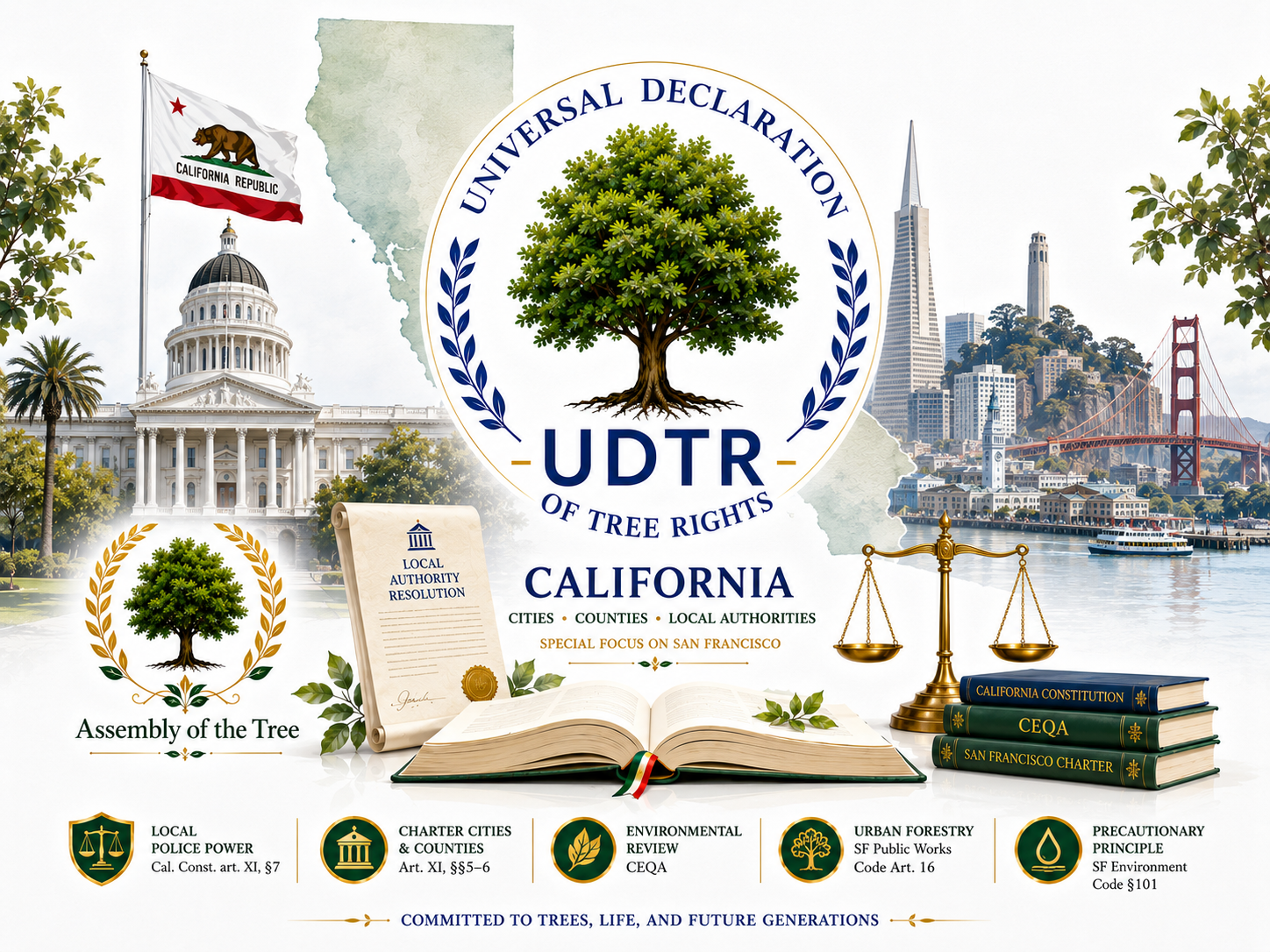
This article examines how a California city, county, city and county, or other local authority may formally adopt the Universal Declaration of Tree Rights together with the Fifteen Commitments of Local and Regional Authorities, and progressively implement that framework through lawful public policy, tree management, land-use planning, public works, procurement, and democratic governance.
The legal question is therefore whether such an adoption can be structured within California local-government law while preserving the distinction between institutional recognition, internal administration, and any later binding regulation of third parties.
As a matter of general legal architecture, the answer is yes for an institutional adoption of the Declaration and the Fifteen Commitments, subject to the authority’s legal status, the scope of its powers, federal and California preemption, procedural requirements, and the precise content of any later binding measure. A resolution, ordinance, permit condition, ballot measure, charter amendment, procurement rule, and administrative program do not have the same legal effect and cannot be treated as interchangeable instruments.
The case of San Francisco deserves particular attention. The City and County has a home-rule charter, a developed Urban Forestry Ordinance, an Urban Forest Plan, and a Precautionary Principle embedded in its Environment Code. Until June 30, 2026, San Francisco also had an Urban Forestry Council, a specialized advisory body that has now ceased to exist following the City’s commission-streamlining process. This recent institutional change makes San Francisco an especially important setting in which the Fifteen Commitments and a territorial Assembly of the Tree can be examined against existing law and the City’s evolving governance architecture rather than introduced as an isolated or purely symbolic initiative. Official City confirmation — Urban Forestry Council ceased to exist on June 30, 2026
The Universal Declaration of Tree Rights is developed and institutionally stewarded by La Compagnie des Papillons Bleus, which is responsible for the official framework, current versions, institutional guidance, documentary continuity, and the International Register of Signatory Authorities associated with the initiative.
Mandatory institutional procedure
For an adoption to be recognized and recorded by La Compagnie des Papillons Bleus as an official adoption within the institutional framework of the Universal Declaration of Tree Rights, the local or regional authority must contact La Compagnie directly before any deliberation, resolution or signature intended to form part of that official procedure.
An authority remains free, within the powers conferred on it by applicable law, to adopt resolutions, policies, or other measures. However, an initiative conducted outside the institutional procedure cannot be recorded or presented by La Compagnie des Papillons Bleus as an official adoption within the institutional framework it stewards.
1. Legal and institutional nature of the Declaration
The Universal Declaration of Tree Rights is the foundational text of an initiative that connects science, law, ethics, democracy, culture, education, and public action. It states principles of recognition, respect, protection, and human responsibility toward the Tree.
The Declaration is not a legal person, public agency, court, certifying authority, or intergovernmental organization. Its institutional stewardship is exercised by La Compagnie des Papillons Bleus.
The three articles — official English version
For any California initiative, the official English wording should be reproduced without paraphrase. The three articles are:
Article I
The Tree, a sentient living being and source of Life, is a common good of humanity.
Article II
Life on Earth depends upon the existence of the Tree.
Article III
Human beings, endowed with reason and conscience, must act with the Tree in a spirit of fraternity and solidarity.
The Three Founding Articles — official English text
Local adoption of the Declaration does not, by itself, constitute:
- signature or ratification of an international treaty;
- accession by the United States, the State of California, or the local authority to the proposed International Convention on Tree Rights;
- an amendment to the U.S. Constitution or the California Constitution;
- legal personhood for Trees;
- standing, a private cause of action, or a right to sue in the name of a Tree;
- a change, by itself, to title, easements, vested rights, compensation rules, or other property-law interests;
- a transfer of governmental authority to La Compagnie des Papillons Bleus, the Assembly of the Tree, or the Defender of the Tree;
- or the immediate creation of binding duties for property owners, businesses, developers, utilities, or public agencies.
Within the Declaration, the expression “common good of humanity” is a principle of collective responsibility toward the living world and future generations. It is not, by itself, a rule transferring ownership or converting privately owned Trees into public property.
2. Legal architecture: United States, California, and local government
In the United States, a local adoption must be situated within a layered legal structure: the U.S. Constitution and federal law; the California Constitution and statutes; the local charter, if any; municipal or county codes; and the administrative powers of the relevant local bodies.
Article XI, section 7 of the California Constitution provides that a county or city may make and enforce within its limits local police, sanitary, and other ordinances and regulations that do not conflict with general laws. California Constitution, article XI, section 7
That provision supplies a general local-government foundation for matters closely connected with Tree policy: public property, streets, parks, public works, land-use administration, public health and safety, stormwater, urban heat, climate adaptation, biodiversity, contracting, and local infrastructure. The precise reach of local authority must nevertheless be examined issue by issue against federal and state law.
3. Charter cities and general law cities: two frameworks that must be distinguished
Charter cities
Article XI, section 5 of the California Constitution authorizes a charter city to make and enforce ordinances and regulations with respect to municipal affairs, subject to the limitations of its charter. In that sphere, a charter provision or local enactment may displace inconsistent state legislation; outside that sphere, general state laws remain applicable. California Constitution, article XI, section 5
The California Supreme Court has repeatedly emphasized that “municipal affairs” is not a fixed category. The home-rule analysis depends upon the subject matter, whether there is an actual conflict, whether the state law addresses a matter of statewide concern, and whether the state rule is reasonably related and appropriately tailored to that concern. See California Fed. Savings & Loan Assn. v. City of Los Angeles (1991) 54 Cal.3d 1 and State Building & Construction Trades Council v. City of Vista (2012) 54 Cal.4th 547. California Fed. Savings — California Supreme Court resource City of Vista — California Supreme Court resource
General law cities
General law cities operate within authority conferred by the California Constitution and statutes. Government Code section 37100 provides that the legislative body may pass ordinances not in conflict with the Constitution and laws of California or the United States. California Government Code section 37100
For purposes of the Declaration, this difference primarily affects the legal foundation and drafting of implementation measures. It does not create a categorical rule that only charter cities may adopt the Declaration. A general law city can adopt a policy resolution and progressively implement the Fifteen Commitments within its lawful powers; it must simply ground each binding measure in the authority conferred by state law.
4. Counties, special districts, and territorial cooperation
California counties possess local powers under article XI of the California Constitution and statutes, but their authority differs from that of cities and varies by subject. Charter counties may structure certain aspects of county government through a charter, while all counties remain subject to state law in the fields assigned to them.
A county may have significant responsibilities relating to county-owned land, parks, roads, unincorporated territory, planning, fire safety, watershed protection, public health, and environmental review. Those responsibilities can support a county-level adoption, provided the instrument is carefully tied to county powers and does not purport to regulate incorporated cities beyond lawful authority.
Special districts and joint powers authorities require a different analysis. They are creatures of statute and may act only within the powers conferred by their enabling law, formation documents, and agreements. A parks district, water district, transit authority, or joint powers authority may support or operationalize parts of the framework where those actions fall within its mission, but it should not be presented as possessing the general legislative authority of a city or county.
Regional cooperation may nonetheless be especially valuable for canopy connectivity, watersheds, wildfire resilience, habitat corridors, data standards, procurement specifications, and public education. The Declaration can therefore operate as a common reference even where implementation is distributed among several legally distinct authorities.
5. Three legal levels that must remain distinct
The distinction is critical. Adoption of the Declaration and the Fifteen Commitments does not eliminate the need to use the legal instruments required for each subsequent measure. A local authority should therefore resist drafting a single resolution as if it could simultaneously perform the work of a policy statement, zoning ordinance, permit code, budget appropriation, adjudicative decision, and ballot measure.
6. CEQA, environmental law, and limits of integration
The California Environmental Quality Act (CEQA), Public Resources Code section 21000 et seq., establishes California’s environmental-review framework for activities subject to the Act. The threshold question is not whether a measure has an environmental purpose, but whether the activity is a CEQA “project” and, if so, what review or exemption applies.
Public Resources Code section 21065 defines a “project” as an activity that may cause a direct physical change in the environment or a reasonably foreseeable indirect physical change and that is undertaken by a public agency, supported by public-agency assistance, or involves a public-agency lease, permit, license, certificate, or other entitlement for use. California Public Resources Code section 21065
A resolution limited to institutional recognition, policy direction, and a request for future study may present a different CEQA question from an ordinance, capital project, land-use decision, or program that commits the authority to physical changes. The responsible local agency should therefore determine the CEQA status of the instrument actually proposed and document any applicable exemption or review pathway rather than assuming either that CEQA necessarily applies or that the environmental purpose of the measure necessarily removes it from CEQA.
The Declaration and the Fifteen Commitments do not replace CEQA, enlarge CEQA jurisdiction by themselves, or alter statutory exemptions. They can, however, improve the substance and timing of local decision-making by encouraging earlier consideration of Trees, soils, root systems, future canopy, ecological continuity, alternatives, cumulative loss, and long-term effects before formal project review is complete.
A city or county may also use the framework in general plans, urban forest plans, climate-adaptation strategies, capital planning, internal design standards, procurement, and public participation. Where any later policy, ordinance, plan, or physical undertaking constitutes a CEQA project, the authority must follow the applicable CEQA process.
7. What a local act of adoption may contain
A carefully drafted California adoption instrument may, depending upon the authority and its rules:
- formally adopt the Universal Declaration of Tree Rights and the Fifteen Commitments of Local and Regional Authorities simultaneously and in full, using the current official texts;
- identify the exact versions of both documents and attach them where local procedure permits;
- authorize the appropriate officer to complete the institutional formalities required for registration;
- state that adoption does not confer legal personhood, standing, a private cause of action, or new coercive authority for the Assembly of the Tree or Defender of the Tree;
- direct staff to prepare a baseline assessment of existing tree law, plans, inventories, budgets, procurement rules, and public works practices;
- launch or update an inventory of public Trees and, where lawful, broader territorial tree data;
- direct preparation of an implementation plan with priorities, costs, responsible departments, indicators, and a timetable;
- establish or adapt a consultative mechanism consistent with the first Commitment and applicable open-meeting law;
- provide for periodic public reporting and evaluation;
- and reserve any new enforceable rule for a later ordinance, regulation, permit rule, or other legally appropriate instrument.
Within the official institutional procedure of the Declaration, official adoption of the Declaration is inseparable from the simultaneous and full adoption of the Fifteen Commitments. A California authority remains free to study the Declaration or adopt independent local policies under applicable law. For an adoption to be recognized and recorded by La Compagnie des Papillons Bleus as official within the institutional framework, however, the institutional procedure — including prior contact — must be followed.
8. Public property and direct tree management: the first implementation lever
The most legally straightforward implementation often begins with property and operations directly controlled by the public authority. A city or county can evaluate Trees located in parks, civic campuses, rights-of-way under its jurisdiction, libraries, public buildings, fire or public safety facilities, public housing sites under its control, and other public land, subject to the powers of the relevant department and any special statutory regime.
Possible measures include:
- building and maintaining a georeferenced inventory;
- recording species, size, condition, risk, ecological context, irrigation needs, and management history;
- protecting soil volume, root zones, and water access;
- establishing pruning, construction-protection, and maintenance standards based on qualified arboricultural practice;
- favoring retention of established Trees before relying on replacement planting;
- establishing lifecycle planning for planting, establishment, maintenance, and eventual replacement;
- integrating urban heat, public health, biodiversity, stormwater, carbon, habitat, landscape, and cultural value into management decisions;
- and publishing reasons, alternatives considered, and follow-up measures for major public removals when lawful and appropriate.
Because public property is not legally homogeneous, agencies should still identify jurisdiction over each site. Streets, parks, ports, schools, utilities, transit property, state lands, and federal lands may be governed by different entities even when they lie within the same city boundaries.
9. Private trees, land use, preemption, and property rights
Trees on private property require more careful legal calibration. California local governments commonly regulate land use, development, hazards, heritage resources, and certain tree removals, but local rules can be constrained or preempted by state housing law, utility law, wildfire rules, vested-rights doctrines, constitutional protections, and other statewide regimes.
A binding local tree ordinance should define with precision:
- which Trees and properties are covered;
- objective thresholds or categories triggering protection;
- activities requiring a permit, notice, or administrative review;
- legally recognized grounds for removal, including public safety, disease, emergency conditions, infrastructure conflicts, and other applicable criteria;
- notice, hearing, decision, and appeal procedures where required;
- lawful replacement or mitigation requirements;
- coordination with zoning, housing obligations, infrastructure, easements, utility rights, and state-mandated development standards;
- and due-process, takings, exaction, and compensation constraints.
10. Procurement, contracts, and public works: an immediately usable lever
Procurement, contracts, capital projects, and construction specifications are powerful implementation tools because a public authority may define how its own projects and contractors must protect Trees, subject to procurement law, funding conditions, labor rules, technical standards, and competitive requirements.
Public contracts and specifications can address:
- root, trunk, and canopy protection zones;
- prohibitions on storage, compaction, staging, or vehicle circulation within protected root areas;
- excavation methods and utility crossings near roots;
- required involvement of a qualified arborist or other Tree professional;
- pruning standards consistent with Tree physiology and recognized professional standards;
- minimum soil volume, water, drainage, and establishment conditions for new plantings;
- documentation of damage and corrective obligations;
- post-construction monitoring;
- species and structural diversity, site suitability, and climate resilience;
- and survival and establishment metrics rather than simple planting counts.
The Fifteen Commitments can therefore influence public contracting immediately, even where the authority has not yet amended its general regulatory code. This is one of the clearest ways to move from principle to measurable institutional practice.
11. The Fifteen Commitments: operational implementation of the Declaration
The Fifteen Commitments of Local and Regional Authorities — official English text are the operational roadmap associated with local adoption of the Declaration. Within the official framework, their adoption is full, simultaneous, and inseparable from official adoption of the Declaration. Their implementation is progressive and evolving, and may be adapted to the powers, resources, applicable law, and ecological realities of each territory.
GOVERNING — establishing the institutions that will bring Tree Rights to life
- 1. Establish an Assembly of the Tree. Create or adapt a permanent consultative body bringing together elected officials, public services, experts, associations, residents, and relevant stakeholders, with powers defined by local law.
- 2. Appoint a Defender of the Tree. Establish an independent alert, recommendation, and oversight function whose role, access to information, ethics rules, and institutional limits are clearly specified.
KNOWING — identifying, understanding, and enhancing tree heritage
- 3. Recognize Guardian Trees. Identify Trees of particular ecological, historical, cultural, scientific, or landscape interest and connect recognition to appropriate protection mechanisms.
- 4. Create the Guardian Tree Passport. Maintain a public record describing each Guardian Tree’s history, characteristics, significance, and applicable protective measures.
- 5. Know the Trees of the Authority. Build and regularly update a territorial tree inventory capable of informing management, planning, and public decision-making.
ACTING — translating principles into concrete public policies
- 6. Develop the Canopy. Set measurable objectives for preserving, restoring, and expanding tree cover, calibrated to soils, water availability, neighborhood conditions, heat vulnerability, and long-term survival.
- 7. Involve Citizens. Establish accessible channels through which residents can report threats, participate in Tree-related initiatives, and receive meaningful feedback, consistent with California transparency law.
- 8. Preserve the Vital Environment of Trees. Address root systems, soils, water, compaction, construction impacts, growing space, and the conditions necessary for healthy development.
- 9. Regulate Felling. Ensure that removal of protected or otherwise significant Trees is examined under transparent criteria and through procedures authorized by local law.
- 10. Ensure Ecological Compensation. Where removal occurs, use lawful and ecologically meaningful mitigation or replacement measures tailored to the site rather than treating every loss as a purely numerical one-for-one exchange.
- 11. Assess the Impact of Projects. Integrate existing Trees and future canopy into project design, alternatives analysis, local review, and CEQA where CEQA applies.
PRESERVING — making the living world a common good to be protected
- 12. Guarantee the Right to Shade. Develop tree-covered public spaces that advance thermal comfort, public health, and climate adaptation; in California implementation, this should be framed through lawful planning and public-space policy rather than assumed to create an automatic private cause of action.
- 13. Preserve the Living Common Good. Identify, connect, and enhance the principal elements of the living world within the territory, with particular attention to Guardian Trees and ecological continuity.
TRANSMITTING — embedding action in the long term
- 14. Evaluate Progress Achieved. Publish recurring reports on actions, indicators, results, gaps, and the follow-up given to recommendations.
- 15. Transmit a Strengthened Common Good. Organize Tree policy around intergenerational responsibility so that the living common good passed to future generations is at least equivalent and, where possible, enhanced.
These fifteen headings reproduce the structure of the official English roadmap. The explanatory language above is a California implementation analysis and should not be confused with a substitute text for the official Commitments. The official PDF should be attached or precisely identified in any formal adoption instrument.
12. Assembly of the Tree, Defender of the Tree, and California local-democracy rules
The Assembly of the Tree is conceived as a consultative, scientific, democratic, territorial, and interdisciplinary body. It does not replace a city council, the San Francisco Board of Supervisors, a mayor, commissions, public departments, administrative agencies, or courts.
In California, a city or county establishing an Assembly must consider the Ralph M. Brown Act. Government Code section 54952 includes within the definition of a “legislative body” specified commissions, committees, boards, and other bodies — including certain advisory bodies — created by charter, ordinance, resolution, or other formal action. Government Code section 54953 establishes the general rule of open and public meetings for covered bodies. Government Code section 54952 Government Code section 54953
Depending upon how the Assembly is created and structured, meeting notices, agendas, public access, remote participation, deliberation, voting, records, conflicts of interest, and local sunshine requirements should be addressed at the design stage. A city may also be subject to transparency rules that exceed the Brown Act.
The Defender of the Tree
The Defender of the Tree may receive alerts, request information within the framework established by the authority, formulate recommendations, track responses, and issue reports. The role does not automatically include a power to fine, veto, annul, enjoin, prosecute, or litigate on behalf of Trees. If a local authority creates a formal public office or appointive function, it should specify appointment, independence, ethical duties, access to records, resources, reporting lines, and legal limits.
13. Guardian Trees and the Guardian Tree Passport: coordination with local legal categories
The recognition of Guardian Trees and the creation of a Guardian Tree Passport are components of the Declaration’s institutional framework. They may interact with existing California or local categories such as heritage Trees, landmark Trees, significant Trees, protected Trees, or historic landscape resources, but those categories should not be treated as legally identical without a local legal analysis.
A local authority may determine that a Tree already protected under local law also meets the criteria for Guardian Tree recognition, or may recognize a Guardian Tree institutionally without immediately changing its regulatory status. The Passport can document history, ecological function, condition, scientific characteristics, cultural significance, management history, threats, and applicable legal protections.
Institutional recognition and legally enforceable protection are distinct operations. If a city or county wants the designation “Guardian Tree” to carry mandatory legal consequences, those consequences must be created through the competent local legal instrument and coordinated with existing categories, procedures, and property rights.
14. Official institutional procedure for California authorities
-
1 — Initiate the institutional procedure with La Compagnie des Papillons Bleus
Before any deliberation, resolution or signature intended to constitute an official adoption within the institutional framework of the Declaration, the city, county, city and county, or other authority contacts La Compagnie des Papillons Bleus directly. This contact opens the institutional procedure and ensures use of the current official texts.
-
2 — Receive the official texts and institutional procedure
La Compagnie provides or confirms the current official versions of the Universal Declaration of Tree Rights, the Fifteen Commitments of Local and Regional Authorities, the Official Framework, and the documents and procedural information required for adoption.
-
3 — Jointly prepare adoption with La Compagnie des Papillons Bleus
The authority and La Compagnie jointly prepare the institutional adoption project: precise identification of the texts, the proposed resolution, ordinance or other competent instrument, any attachments, signature arrangements, and initial implementation directions. Official adoption concerns the Declaration and the Fifteen Commitments simultaneously and in full.
-
4 — Complete local legal and administrative review
The authority identifies its legal status and powers, maps existing tree law, plans, procurement rules, CEQA procedures, governance mechanisms and relevant state or federal constraints, and has the proposed instrument reviewed by the City Attorney, County Counsel or other qualified U.S. legal counsel. The review distinguishes institutional adoption from later ordinances, permit rules, budget decisions, staffing measures, CEQA actions or ballot measures.
-
5 — Adoption by the competent governing body
The competent governing body adopts the Universal Declaration of Tree Rights and the entire Fifteen Commitments of Local and Regional Authorities in accordance with applicable local procedure. The official versions are precisely identified and may be attached where appropriate. The authority then completes any agenda, notice, hearing, fiscal, CEQA, publication, voting, signature and recordkeeping requirements applicable to the chosen instrument.
-
6 — Institutional formalization, signature, Register and progressive implementation
After adoption and completion of the applicable public-law formalities, the institutional formalization prepared in advance is completed directly with La Compagnie des Papillons Bleus. The relevant documents are signed by duly authorized representatives, the adoption is verified, the authority may be entered in the International Register of Signatory Authorities, and a realistic implementation architecture is established, including responsibilities, timetable, resources, indicators, public reporting and periodic review.
15. Recognition of adoption and the International Register of Signatory Authorities
The Register is intended to:
- maintain a traceable institutional record of signatory authorities;
- identify the jurisdiction, category of authority, date, and reference of the adoption instrument;
- link, where appropriate, to the public adoption record;
- facilitate cooperation and exchange of experience among authorities;
- and document the territorial development of the initiative.
The legal effects of the local adoption remain those conferred by applicable federal, California, and local law and by the wording of the instrument actually adopted.
16. Institutional guidance, official versions, and intellectual property
Nature of institutional guidance
La Compagnie des Papillons Bleus may provide doctrinal, scientific, methodological, institutional, documentary, and educational guidance concerning the Declaration and its implementation framework.
Such guidance is not individualized legal advice under California law and does not replace review by a City Attorney, County Counsel, or attorney authorized to practice in the relevant U.S. jurisdiction.
Official versions and local adaptations
The three articles, the Fifteen Commitments, the Assembly of the Tree, Guardian Trees, the Guardian Tree Passport, and the other instruments of the initiative must be distinguished from local implementation documents. A local authority may adapt implementation methods to its legal system; it should not present an unapproved rewrite as an official version of the Declaration or the Fifteen Commitments.
Intellectual property and the United States
The names “Déclaration universelle des droits de l’Arbre” and “Universal Declaration of Tree Rights™” have been claimed and used as trademarks and distinctive signs since 2018. The French name has been the subject of a trademark filing in France. These facts should not be described as constituting a U.S. federal trademark registration.
Public availability of the documents does not authorize third parties to present themselves as official representatives, institutional partners, or authorized adoption intermediaries without the required written mandate. Nor does it authorize altered texts to be represented as official versions.
17. Focus on San Francisco: a charter city and county
San Francisco occupies a distinctive position in California local government. Article XI, section 6 of the California Constitution provides that a charter city and county is both a charter city and a charter county, and that its charter city powers supersede conflicting charter county powers. California Constitution, article XI, section 6
San Francisco’s Charter functions as its foundational local governmental instrument. The Board of Supervisors exercises the City and County’s legislative authority, subject to the Charter, state and federal law, voter-enacted measures, and the distribution of powers among city officers, commissions, departments, and agencies.
This dual city-and-county status does not give San Francisco unlimited legal autonomy. Statewide concerns, preemptive statutes, constitutional rules, housing mandates, environmental law, public employment law, election law, and other statewide regimes may constrain local action. But San Francisco possesses substantial institutional capacity to adopt a policy framework and integrate it through its existing urban-forestry governance.
18. San Francisco: existing urban forest law and policy
San Francisco already has a developed legal framework for its urban forest. Article 16 of the Public Works Code is the Urban Forestry Ordinance. It addresses Street Trees, Significant Trees, Landmark Trees, planting, removal, maintenance, protection during construction, enforcement, and an Urban Forest Management Plan. San Francisco Public Works Code — Article 16
Section 808 protects specified Street Trees, City Trees, Significant Trees, Landmark Trees, and landscape material and establishes construction-protection requirements, including measures directed at excavation, soil compaction, and work near protected Trees. Public Works Code section 808
Section 810A defines “Significant Trees” through specified location and size criteria and subjects removal to established procedures and decision factors. Public Works Code section 810A
The 2026 commission-streamlining reform also altered the institutional references embedded in the Urban Forestry Ordinance. Ordinance No. 99-26 (File No. 260217) deletes the former Urban Forestry Council provisions and removes references to that body from relevant portions of the Public Works Code; in the Landmark Tree designation process, functions formerly assigned to the Council are reassigned to the Department. Formal drafting should therefore use the post-streamlining legal framework rather than pre-June 2026 descriptions of Article 16. San Francisco Ordinance No. 99-26 — official enacted text
San Francisco also has an Urban Forest Plan. The adopted first phase focuses on street Trees, while the City’s planning materials identify broader work concerning Trees in parks and open spaces and on private property. Public Works describes the urban forest as a living system involving Trees, plants, wildlife, soils, air, water, and the people who care for and benefit from it. San Francisco Public Works — Urban Forest Plan
These instruments matter because adoption of the Declaration should not be presented as if San Francisco had no Tree law or urban-forest policy. The correct exercise is a gap analysis: which Commitments are already substantially reflected in local law or practice, which are only partly addressed, and which would require new institutional, administrative, budgetary, or normative steps?
19. San Francisco: the Precautionary Principle as a point of articulation
San Francisco’s Environment Code contains a citywide Precautionary Principle. Section 101 directs city officers, boards, commissions, and departments to implement a policy requiring broad consideration of alternatives, reliance on the best available science, open and transparent decision-making, public participation, and preventive action where serious or irreversible harm is threatened even in the absence of full scientific certainty. San Francisco Environment Code section 101
This principle creates a particularly strong conceptual bridge with the Declaration. The Declaration emphasizes responsibility toward Trees and the living world; the Precautionary Principle already provides San Francisco with an operative municipal decision-making doctrine centered on science, alternatives, transparency, and prevention.
The connection should nevertheless be made with legal precision. The Declaration does not amend section 101, and section 101 does not automatically incorporate the Declaration. A Board resolution could expressly request that departments analyze how the Fifteen Commitments interact with the existing Precautionary Principle and identify implementation measures that can be adopted without duplicating established procedures.
20. After the Urban Forestry Council: Assembly of the Tree and post-2026 governance
San Francisco formerly maintained an Urban Forestry Council under Chapter 12 of the Environment Code. The Council served as an advisory and educational body and historically performed functions involving public participation, urban-forest policy, standards, funding, application of the Precautionary Principle, and reporting. That institutional description is now historical, not current.
The City has officially confirmed that the Urban Forestry Council ceased to exist on June 30, 2026. Ordinance No. 99-26 (File No. 260217), adopted through San Francisco’s commission-streamlining process, deletes Environment Code Chapter 12 and removes references to the Council from relevant provisions of the Public Works Code. Mayor’s Office and City departments — official confirmation dated August 3, 2026 Ordinance No. 99-26 — official enacted text
The Commission Streamlining Task Force explained the policy rationale for elimination by finding that the Council’s functions overlapped with City staff and that care and oversight of the urban canopy had become integrated into ongoing City operations. The Task Force also recommended that the Commission on the Environment be able to hear reports on urban-canopy policy and activities so that a public forum for input and information-sharing could continue. That recommendation is relevant to the institutional analysis, but it should not be treated as proof that every former statutory function of the Urban Forestry Council has automatically transferred to the Commission on the Environment. Commission Streamlining Task Force — Final Report Commission on the Environment — current official page
This change materially affects the analysis of Commitment 1, Establish an Assembly of the Tree. There is no longer an existing Urban Forestry Council that can simply be designated as the Assembly. Nor should the Declaration be used as a reason automatically to recreate, under another name, a body that San Francisco has deliberately eliminated. The correct first step is a post-2026 function-and-gap analysis: which relevant functions are now exercised by Public Works and its Bureau of Urban Forestry, the Environment Department, the Planning Department, Recreation and Parks, the Commission on the Environment, other commissions or agencies, and which functions — if any — remain insufficiently organized?
Three institutional pathways can then be examined with the City’s legal and administrative authorities and, as to the official institutional meaning of the Declaration, with La Compagnie des Papillons Bleus:
- Functional integration: determine whether existing departments, commissions, reporting systems, and public-participation mechanisms can collectively perform the functions contemplated by an Assembly of the Tree without creating a new public body;
- Adapted consultative mechanism: if coordination, interdisciplinary expertise, continuity, or public participation is insufficient, establish a structured mechanism using existing lawful institutions and clearly assigned responsibilities;
- A distinct Assembly: create a separate consultative body only if a demonstrated institutional gap justifies it, with a precise mandate and a clear relationship to existing departments, commissions, and decision-makers.
The former Council’s reporting arrangements remain useful as a historical benchmark for Commitment 14, Evaluate Progress Achieved, but they are no longer an available current reporting vehicle. Any San Francisco implementation plan should identify a legally competent current body or coordinated mechanism responsible for recurring public evaluation of the Fifteen Commitments.
Any institutional option must comply with the Charter, applicable ordinances, the Brown Act, San Francisco’s own open-government requirements, appointment and ethics rules, and the allocation of powers among existing departments, commissions, officers, and the Board of Supervisors.
21. San Francisco: reading the Fifteen Commitments against existing law and institutions
The following matrix does not declare San Francisco “compliant” with the Fifteen Commitments. It identifies potential points of correspondence and questions that should be examined by City departments, the City Attorney, relevant commissions or advisory mechanisms, and La Compagnie des Papillons Bleus before any formal implementation design. The matrix reflects the fact that the Urban Forestry Council ceased to exist on June 30, 2026.
| Commitment | Existing San Francisco point of reference | Question for implementation |
|---|---|---|
| 1 — Establish an Assembly of the Tree | Former Urban Forestry Council (ceased June 30, 2026); current urban-forest functions distributed among City departments, existing commissions, and other public-governance mechanisms. | Conduct a post-2026 function-and-gap analysis before deciding whether Commitment 1 can be fulfilled through existing institutions, an adapted consultative mechanism, or a distinct Assembly. |
| 2 — Appoint a Defender of the Tree | No complete equivalent is assumed from the sources reviewed. | Examine an independent alert, recommendation, and follow-up function without automatic veto or enforcement power. |
| 3 — Recognize Guardian Trees | Existing Landmark Tree and Significant Tree categories. | Do not equate categories automatically; determine whether Guardian Tree recognition should supplement existing legal protection. |
| 4 — Create the Guardian Tree Passport | Existing inventories and public Tree data can provide a foundation. | Develop a standardized public record linked to verified scientific, historical, and regulatory data. |
| 5 — Know the Trees of the Authority | Urban Forest Plan, inventories, and urban-forest monitoring. | Identify data gaps involving private Trees, soils, mortality, condition, ecological connectivity, and climate vulnerability. |
| 6 — Develop the Canopy | Urban Forest Plan and local planting/replacement programs. | Set measurable neighborhood-sensitive objectives that include survival, water, soil, and environmental-justice considerations. |
| 7 — Involve Citizens | Public meetings, local notice and participation procedures, departmental engagement mechanisms, and the continuing Commission on the Environment; the former Urban Forestry Council is no longer a current forum. | Preserve accessible Tree-specific participation after the 2026 reform, with traceability of recommendations and public feedback on how input influenced decisions. |
| 8 — Preserve the Vital Environment of Trees | Public Works Code section 808 and construction-protection requirements. | Extend analysis to soil volume, compaction, water, root-zone continuity, and long-term site conditions. |
| 9 — Regulate Felling | Article 16 procedures for Street, Significant, and Landmark Trees. | Review transparency, criteria, alternatives, notice, and follow-up without displacing existing due-process rules. |
| 10 — Ensure Ecological Compensation | Replacement and in-lieu mechanisms exist in parts of the Urban Forestry Ordinance. | Evaluate ecological equivalence, site context, survival, and cumulative loss rather than relying only on numerical replacement. |
| 11 — Assess the Impact of Projects | Existing project review, departmental urban-forestry functions, the Precautionary Principle, and CEQA where triggered. | Create a Tree/soil/canopy review framework integrated into existing procedures rather than duplicating CEQA. |
| 12 — Guarantee the Right to Shade | Shade is an identifiable public benefit of urban Trees and a planning/public-health concern. | Translate the Commitment into public-space, heat-resilience, and equity objectives without implying an automatic private easement or cause of action. |
| 13 — Preserve the Living Common Good | Precautionary Principle, urban forest policy, biodiversity and climate programs. | Connect Tree heritage to water, soil, habitat, climate, health, culture, and future generations. |
| 14 — Evaluate Progress Achieved | Existing planning, monitoring, departmental reporting, and public-governance mechanisms; the former Urban Forestry Council’s annual-reporting role is now historical rather than current. | Assign recurring Fifteen-Commitment evaluation to a legally competent current body or coordinated mechanism, and disclose implementation gaps and responses to recommendations. |
| 15 — Transmit a Strengthened Common Good | Long-term Urban Forest Plan and recurring management cycles. | Make intergenerational balance explicit: the living Tree heritage passed forward should be maintained or improved, not merely replanted numerically. |
This matrix is an institutional analytical tool, not a final finding of equivalence or legal compliance. Any formal position should be validated against current municipal law and practice and, as to the official meaning of the Declaration and its instruments, with La Compagnie des Papillons Bleus.
22. San Francisco Board of Supervisors: resolution or ordinance
Section 2.105 of the San Francisco Charter provides that the Board of Supervisors acts by ordinance or resolution and that legislative acts are enacted by ordinance. The two forms are therefore not interchangeable. San Francisco Charter section 2.105
For a first step limited to formal adoption of the Declaration and Fifteen Commitments, policy findings, institutional direction, and a request for staff analysis, a resolution is a form that should be examined. If the measure amends municipal law or creates new generally binding rules, an ordinance may be required. The City Attorney should determine the proper instrument based on the final text and intended legal effect.
This staged architecture prevents the first vote from being burdened with legal consequences that have not yet been analyzed and makes it possible to build a scientifically, administratively, and legally documented implementation process.
23. San Francisco: ballot measure, Declaration of Policy, and citizen initiative
A proposal to “put the Declaration on the San Francisco ballot” is legally conceivable, but the phrase is incomplete. The legal instrument must first be defined: are voters being asked to approve a Declaration of Policy, an initiative ordinance, a Charter amendment, or another measure within the lawful authority of the City and County?
Board, four Supervisors, or Mayor: submission to the voters
Charter section 2.113(a) authorizes the Board of Supervisors, or four or more of its members, to submit declarations of policy and matters the Board is empowered to pass to the voters. If the voters approve a Declaration of Policy, the Board must, within 90 days, take such actions within its powers as are necessary to carry the declaration into effect. San Francisco Charter section 2.113
The Mayor also has a Charter role. Section 3.100(16), subject to section 2.113, authorizes the Mayor to submit to the voters a Declaration of Policy or ordinance on a matter the Board of Supervisors is empowered to pass. San Francisco Charter — see section 3.100(16)
Section 2.113(b) adds a preliminary public process when a proposed initiative is submitted by the Mayor or by four or more Supervisors: the proposal must be submitted to the Board no later than 45 days before the Department of Elections submission deadline, and the Board must hold a public hearing no later than 15 days before that deadline. The final route and timing should be checked against the Charter, the Municipal Elections Code, and the Department of Elections calendar then in force.
Citizen initiative
Charter section 14.101 provides that an initiative may be proposed by a petition signed by voters equal to at least 2% of the number of registered voters in the City and County, subject to the qualification, form, timing, subject-matter, and election requirements imposed by the Charter and Municipal Elections Code. San Francisco Charter section 14.101
The 2% figure is a percentage, not a permanently fixed signature count. The actual requirement must be calculated from the official registration data applicable under the election rules at the relevant time, and the Department of Elections’ current initiative guide and calendar should be consulted before circulation begins.
San Francisco Department of Elections — November 3, 2026 consolidated general election calendar
This does not block the project. It removes the pressure to draft a ballot initiative prematurely. The official institutional procedure with La Compagnie des Papillons Bleus, the legal gap analysis, the local coalition, and dialogue with the Board, Mayor, relevant departments, and existing advisory bodies can be built first; the appropriate electoral route and date can then be chosen under the official rules in force at that time.
A citywide vote can carry substantial democratic value, but it is not legally necessary for San Francisco to begin institutional consideration. A Board-led adoption followed by a structured implementation report may be the more disciplined first step, while preserving the option of a later voter measure if a genuinely voter-level legal decision becomes useful.
24. A legally accessible path, built in stages
25. Primary and Authoritative Legal Sources and Reference Materials
Sources and reference materials reviewed in versions accessible on August 9, 2026; institutional framework updated September 13, 2026.
Universal Declaration of Tree Rights — primary institutional sources
- Understanding the Universal Declaration of Tree Rights
- Official Framework of the Universal Declaration of Tree Rights
- Local Authorities and the Universal Declaration of Tree Rights: Principles, Procedure and Legal Scope
- The Three Founding Articles — official English PDF
- The Fifteen Commitments of Local and Regional Authorities — official English PDF
- The Assembly of the Tree
California Constitution and statutes — primary legal sources
- California Constitution — Article XI, section 5: charter cities and municipal affairs
- California Constitution — Article XI, section 6: charter city and county
- California Constitution — Article XI, section 7: local police power
- California Government Code section 37100 — general powers of city legislative bodies
- Government Code section 54952 — Brown Act definition of legislative bodies
- Government Code section 54953 — open and public meetings
- CEQA — Public Resources Code section 21000
- CEQA — Public Resources Code section 21065: definition of “project”
California case law — authoritative decisions; linked through accessible repositories
- California Federal Savings & Loan Assn. v. City of Los Angeles (1991) 54 Cal.3d 1 — accessible opinion repository
- State Building & Construction Trades Council v. City of Vista (2012) 54 Cal.4th 547 — accessible opinion repository
San Francisco Charter, elections, and municipal code
- San Francisco Charter — current online codification
- Charter section 2.105 — Ordinances and Resolutions
- Charter section 2.113 — Legislative Initiative and Declarations of Policy
- Charter section 3.100(16) — Mayor’s submission authority, subject to section 2.113
- Charter section 14.101 — Initiatives
- San Francisco Department of Elections — November 3, 2026 consolidated general election calendar
- Public Works Code — Article 16, Urban Forestry Ordinance
- Public Works Code section 808 — Protection of Trees and Landscape Material
- Public Works Code section 810A — Significant Trees
- Environment Code section 101 — Precautionary Principle
- Ordinance No. 99-26 (File No. 260217) — Commission Streamlining; deletion of Environment Code Chapter 12 and removal of Urban Forestry Council references
- Mayor’s Office and City departments — August 3, 2026 official confirmation that the Urban Forestry Council ceased to exist on June 30, 2026
San Francisco 2026 governance reform — official City sources
- Commission Streamlining Task Force — Final Report: Urban Forestry Council recommendation and post-reform public-input rationale
- San Francisco Commission on the Environment — current official institutional page
San Francisco urban-forest policy — City sources
- San Francisco Public Works — Urban Forest Plan
- San Francisco Public Works — StreetTreeSF
- CAL FIRE — Urban and Community Forestry
Source-status note: The California Legislature and official City or agency pages are primary governmental sources. The Stanford links above are convenient repositories for authoritative California Supreme Court decisions. San Francisco Code links are provided through the City’s online codification service hosted by American Legal Publishing; that service cautions that online text is informational and not the definitive official copy. For the 2026 Urban Forestry Council transition, the article relies on enacted Ordinance No. 99-26 and the City’s August 3, 2026 official confirmation of cessation; superseded or lagging codification text should not be read as evidence that the former Council remains in existence.
Legal notice: This article presents general legal principles and an institutional analysis. Every California city, county, special district, or other public authority should have its proposed adoption instrument and any contemplated administrative, contractual, land-use, regulatory, CEQA, or electoral measures reviewed by its legal counsel and checked against the law, Charter provisions, enacted ordinances, and election rules in force at the time of action.
Official institutional text
Publication of La Compagnie des Papillons Bleus
This article is an institutional text of La Compagnie des Papillons Bleus, the French nonprofit organization that stewards the Universal Declaration of Tree Rights and is responsible for its coherence, preservation, development, institutional guidance, and follow-up.
It is published under the authority of its President and of the author and initiator of the Universal Declaration of Tree Rights.
Publication: August 7, 2026 — institutional update September 13, 2026 — California Version 3.0 — with a legal and institutional focus on San Francisco.
This article presents general principles of California law and San Francisco municipal law as reviewed through August 9, 2026, with the Declaration’s institutional framework updated on September 13, 2026. It is not individualized legal advice and does not replace review by the City Attorney, County Counsel, or an attorney authorized to practice in the relevant U.S. jurisdiction.
Ricardo Rey
Author and initiator of the Universal Declaration of Tree Rights
Founder of the Assembly of the Tree
President of La Compagnie des Papillons Bleus
Official contact: presidence@ciedespapillonsbleus.org
Official website: www.declarationuniverselledesdroitsdelarbre.org
© 2026 Ricardo Rey. Institutional publication of La Compagnie des Papillons Bleus. All rights reserved.
Any reproduction, representation, adaptation, or distribution, in whole or in part, is subject to prior written authorization, except as otherwise permitted by applicable law. Access to or transmission of this article does not constitute any transfer of intellectual property rights.