FRANÇAIS · Doctrine officielle
Qualification juridique, fondement scientifique et conséquence normative
Introduction
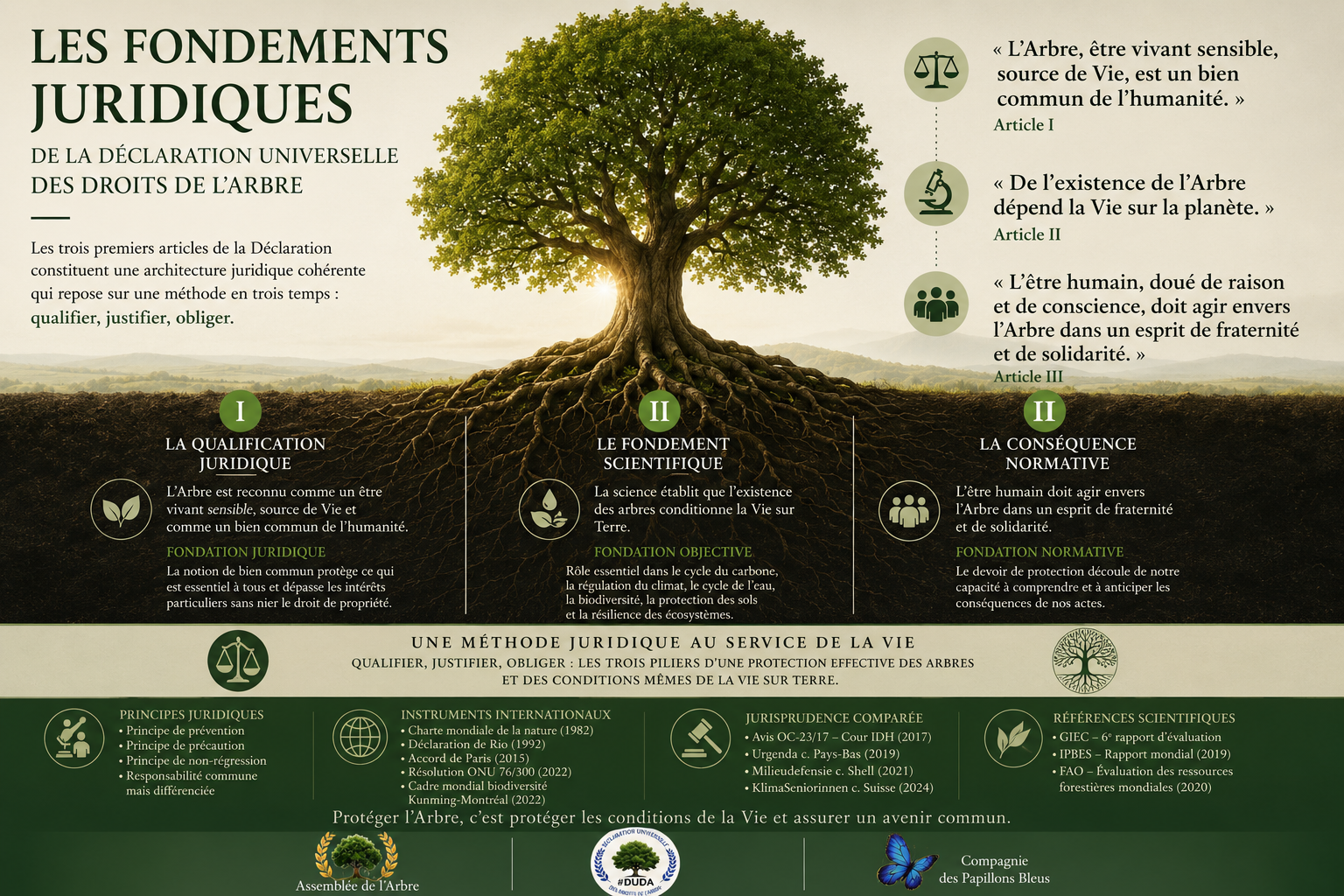
Les trois articles de la Déclaration universelle des droits de l’Arbre constituent bien davantage qu’une déclaration de principes. Ils proposent une méthode juridique fondée sur une exigence essentielle : le droit ne crée pas la réalité ; il la reconnaît, l’interprète et en tire les conséquences.
Cette distinction est fondamentale. Une construction normative à vocation juridique gagne en légitimité et en robustesse lorsqu’elle s’appuie sur une réalité objectivable. C’est précisément cette articulation entre la science, le droit et l’éthique qui fonde la Déclaration.
Loin de se limiter à proclamer des droits, elle construit successivement une qualification à vocation juridique, un fondement scientifique, puis une prescription normative susceptible d’être traduite en obligations juridiquement contraignantes par les ordres juridiques compétents.
1. LA QUALIFICATION JURIDIQUE DE L’ARBRE
En droit, toute construction normative commence par une qualification juridique.
Qualifier consiste à déterminer la nature d’une réalité afin de lui appliquer un régime juridique adapté.
La Déclaration refuse ainsi de réduire l’Arbre à une simple chose, à un bien économique ou à un objet de propriété. Elle reconnaît son existence propre en tant qu’être vivant sensible et souligne sa fonction indispensable au maintien de la Vie.
La notion de bien commun de l’humanité revêt ici une portée particulière. Elle ne remet nullement en cause le droit de propriété, mais rappelle que certains biens présentent une valeur si essentielle qu’ils intéressent l’ensemble de la communauté humaine.
Dans la Déclaration, l’expression bien commun de l’humanité constitue une qualification normative propre au texte. Elle ne doit pas être confondue avec une catégorie technique de droit positif telle que le patrimoine commun de l’humanité, ni être interprétée comme opérant, par elle-même, un transfert de propriété ou de compétence.
De même, le terme sensible qualifie ici l’Arbre comme organisme vivant capable de percevoir des variations de son environnement et d’y répondre. Il n’emporte pas, à lui seul, d’affirmation relative à une conscience subjective, à la douleur ou à une sentience de type animal.
Cette approche rejoint l’évolution contemporaine du droit international de l’environnement, qui reconnaît de manière croissante l’existence d’intérêts communs dépassant les seuls intérêts nationaux ou privés1.
2. LE FONDEMENT SCIENTIFIQUE DE LA NORME
Cette disposition constitue le fondement objectif de toute la Déclaration.
Elle ne relève ni de la poésie ni d’une affirmation philosophique.
L’article II doit être lu dans sa portée générique et écologique : il exprime l’interdépendance fondamentale entre les arbres, les systèmes arborés et les conditions d’habitabilité, d’équilibre et de continuité de la vie terrestre contemporaine. Il ne signifie pas que toute forme de vie existante dépend individuellement et directement de chaque arbre.
Elle renvoie aux connaissances aujourd’hui acquises concernant le rôle déterminant des arbres dans :
- le cycle du carbone ;
- la régulation du climat ;
- le cycle de l’eau ;
- la protection des sols ;
- la préservation de la biodiversité ;
- la résilience des écosystèmes.
Les rapports successifs du GIEC, de l’IPBES et de la FAO convergent tous vers un même constat : la disparition des forêts compromet directement les conditions d’habitabilité de la Terre2.
En fondant la norme sur une réalité scientifiquement établie, la Déclaration s’inscrit dans une logique proche de celle qui inspire les principes de prévention, de précaution et de non-régression du droit de l’environnement3.
3. LA RESPONSABILITÉ NORMATIVE DE L’HUMANITÉ ET SA TRADUCTION JURIDIQUE
Avec cet article apparaît le véritable caractère normatif de la Déclaration.
Le verbe doit marque le passage du constat à la prescription normative.
Cette prescription ne constitue pas, par la seule force de la Déclaration, une obligation de droit positif directement contraignante ou opposable. Elle formule une exigence à vocation juridique, dont la force obligatoire dépend de sa réception et de sa mise en œuvre par les autorités, normes et instruments compétents selon le droit applicable.
Parce que l’être humain est capable d’anticiper les conséquences de ses actes, il assume une responsabilité particulière envers ce dont dépend sa propre existence.
Cette responsabilité dépasse le seul registre moral.
Elle rejoint l’évolution du droit contemporain, qui tend à reconnaître des obligations positives de prévention, de protection et de réparation des atteintes portées à l’environnement4.
4. UNE MÉTHODE JURIDIQUE
Les trois articles de la Déclaration suivent ainsi une progression logique :
- ils qualifient ;
- ils justifient ;
- ils obligent.
Cette progression constitue l’ossature normative et la méthode juridique proposées par l’ensemble du texte.
La Déclaration ne cherche pas à créer artificiellement une nouvelle catégorie de droits.
Elle procède à l’inverse.
Elle part d’une réalité biologique, écologique et scientifique, lui attribue une portée normative à vocation juridique, puis formule une prescription dont la traduction en obligations juridiquement contraignantes dépend de sa réception par les ordres juridiques compétents.
Cette méthode correspond à l’une des exigences fondamentales de la pensée juridique contemporaine : faire reposer la norme sur une connaissance objective du réel plutôt que sur une simple affirmation de volonté.
À cet égard, la Déclaration participe d’un mouvement plus large du droit international, qui voit progressivement émerger une responsabilité de l’humanité envers les conditions mêmes de la vie.
5. CONCLUSION
La force de la Déclaration universelle des droits de l’Arbre ne réside pas uniquement dans les droits qu’elle proclame.
Elle réside dans la méthode qu’elle adopte.
Le droit n’y est jamais présenté comme un instrument capable de transformer la réalité par sa seule volonté.
Il apparaît au contraire comme un instrument qui reconnaît et interprète une réalité préexistante afin d’organiser juridiquement les conséquences qui peuvent en être tirées.
L’Arbre est d’abord reconnu pour ce qu’il est.
La science rappelle ensuite pourquoi son existence conditionne celle de l’humanité.
La Déclaration formule enfin une prescription de responsabilité ; sa traduction en devoirs juridiquement contraignants appartient aux ordres juridiques compétents, selon les instruments et procédures qui leur sont propres.
Cette articulation entre la réalité, la connaissance scientifique et une normativité à vocation juridique constitue le fondement intellectuel de la Déclaration universelle des droits de l’Arbre.
6. NOTES ET BIBLIOGRAPHIE SÉLECTIVE
1.
Elinor Ostrom, Governing the Commons (1990) ; Edith Brown Weiss, In Fairness to Future Generations (1989) ; Michel Prieur, travaux relatifs au droit international de l’environnement et au patrimoine commun.
2.
GIEC, Sixth Assessment Report ; IPBES, Global Assessment Report (2019) ; FAO, Global Forest Resources Assessment 2025.
3.
Déclaration de Rio sur l’environnement et le développement, principes 15 et 17 ; Convention d’Aarhus ; doctrine et instruments relatifs au principe de non-régression.
4.
David R. Boyd, The Environmental Rights Revolution (2012) et The Right to a Healthy Environment (2012) ; Nations Unies, rapport A/HRC/43/53 (2020) ; John H. Knox, Constructing the Human Right to a Healthy Environment (2020).
Bibliographie sélective
- Boyd, David R., The Environmental Rights Revolution, UBC Press, 2012.
- Boyd, David R., The Right to a Healthy Environment, UBC Press, 2012.
- Brown Weiss, Edith, In Fairness to Future Generations, United Nations University, 1989.
- Jonas, Hans, Le Principe responsabilité, Éditions du Cerf.
- Knox, John H., “Constructing the Human Right to a Healthy Environment”, Annual Review of Law and Social Science, 2020.
- Leopold, Aldo, A Sand County Almanac, Oxford University Press.
- Ostrom, Elinor, Governing the Commons, Cambridge University Press, 1990.
- Stone, Christopher D., “Should Trees Have Standing? — Toward Legal Rights for Natural Objects”, Southern California Law Review, vol. 45, 1972, pp. 450–501.
Références institutionnelles
Cadre officiel de la Déclaration universelle des droits de l’Arbre
Texte doctrinal officiel
Ricardo Rey
Auteur et initiateur de la Déclaration universelle des droits de l’Arbre
Fondateur de l’Assemblée de l’Arbre
Président de La Compagnie des Papillons Bleus
ENGLISH · Official doctrine
Legal characterization, scientific foundation and normative consequence
Introduction
The three articles of the Universal Declaration of Tree Rights amount to far more than a declaration of principles. They establish a legal method founded upon an essential requirement: law does not create reality; it recognizes it, interprets it and draws the consequences that follow.
This distinction is fundamental. A normative construction with legal purpose gains legitimacy and robustness when it rests upon an objectively ascertainable reality. This articulation between science, law and ethics is precisely what grounds the Declaration.
Far from merely proclaiming rights, the Declaration successively develops a characterization with legal purpose, a scientific foundation and then a normative prescription capable of being translated into legally binding obligations by the competent legal orders.
1. THE LEGAL CHARACTERIZATION OF THE TREE
In law, every normative construction begins with a legal characterization.
To characterize is to determine the nature of a reality in order to apply an appropriate legal regime to it.
The Declaration therefore refuses to reduce the Tree to a mere thing, an economic asset or an object of ownership. It recognizes the Tree’s independent existence as a sentient living being and emphasizes its indispensable function in sustaining Life.
The concept of a common good of humanity has a particular significance here. It does not call property rights into question, but affirms that certain goods possess such essential value that they concern the whole human community.
In the Declaration, the expression common good of humanity is a normative characterization specific to the text. It must not be confused with a technical category of positive law such as the common heritage of humankind, nor interpreted as effecting, by itself, any transfer of ownership or competence.
Likewise, the term sentient describes the Tree here as a living organism capable of perceiving changes in its environment and responding to them. It does not, by itself, assert subjective consciousness, pain or animal-like sentience.
This approach reflects the contemporary development of international environmental law, which increasingly recognizes common interests extending beyond exclusively national or private interests1.
2. THE SCIENTIFIC FOUNDATION OF THE NORM
This provision constitutes the objective foundation of the entire Declaration.
It is neither poetry nor a philosophical assertion.
Article II must be read in its generic and ecological sense: it expresses the fundamental interdependence between trees, tree-based systems and the conditions that sustain the habitability, balance and continuity of contemporary terrestrial life. It does not mean that every existing form of life depends individually and directly on each tree.
It refers to established scientific knowledge concerning the determining role of trees in:
- the carbon cycle;
- climate regulation;
- the water cycle;
- soil protection;
- the preservation of biodiversity;
- ecosystem resilience.
Successive reports of the IPCC, IPBES and FAO converge upon the same conclusion: the loss of forests directly compromises the conditions that make the Earth habitable2.
By grounding the norm in scientifically established reality, the Declaration follows a logic closely related to the principles of prevention, precaution and non-regression in environmental law3.
3. THE NORMATIVE RESPONSIBILITY OF HUMANKIND AND ITS LEGAL IMPLEMENTATION
This article reveals the Declaration’s genuinely normative character.
The word must marks the transition from factual recognition to normative prescription.
This prescription does not, by the force of the Declaration alone, constitute a directly binding or enforceable rule of positive law. It expresses a requirement with legal purpose whose binding force depends on its reception and implementation by the competent authorities, norms and legal instruments under the applicable law.
Because human beings are capable of anticipating the consequences of their actions, they bear a particular responsibility toward that upon which their own existence depends.
This responsibility extends beyond the moral sphere alone.
It reflects the development of contemporary law, which increasingly recognizes positive obligations to prevent, protect against and remedy environmental harm4.
4. A LEGAL METHOD
The three articles of the Declaration therefore follow a logical progression:
- they characterize;
- they justify;
- they oblige.
This progression forms the normative structure and proposed legal method of the text as a whole.
The Declaration does not seek artificially to create a new category of rights.
It proceeds in the opposite direction.
It begins with biological, ecological and scientific reality, gives that reality normative significance with legal purpose, and then formulates a prescription whose translation into legally binding obligations depends on its reception by the competent legal orders.
This method corresponds to a fundamental requirement of contemporary legal thought: the norm should rest upon objective knowledge of reality rather than upon a mere assertion of will.
In this respect, the Declaration forms part of a broader development in international law through which a responsibility of humankind toward the very conditions of Life is progressively emerging.
5. CONCLUSION
The strength of the Universal Declaration of Tree Rights does not lie solely in the rights it proclaims.
It also lies in the method it adopts.
Law is never presented as an instrument capable of transforming reality through will alone.
It appears, on the contrary, as an instrument that recognizes and interprets a pre-existing reality in order to organize the legal consequences that may be drawn from it.
The Tree is first recognized for what it is.
Science then explains why the Tree’s existence conditions the existence of humankind.
The Declaration finally formulates a prescription of responsibility; its translation into legally binding duties belongs to the competent legal orders, through their own instruments and procedures.
This articulation between reality, scientific knowledge and normativity with legal purpose constitutes the intellectual foundation of the Universal Declaration of Tree Rights.
6. NOTES AND SELECTIVE BIBLIOGRAPHY
1.
Elinor Ostrom, Governing the Commons (1990); Edith Brown Weiss, In Fairness to Future Generations (1989); Michel Prieur, works relating to international environmental law and the common heritage.
2.
IPCC, Sixth Assessment Report; IPBES, Global Assessment Report (2019); FAO, Global Forest Resources Assessment 2025.
3.
Rio Declaration on Environment and Development, Principles 15 and 17; Aarhus Convention; doctrine and instruments relating to the principle of non-regression.
4.
David R. Boyd, The Environmental Rights Revolution (2012) and The Right to a Healthy Environment (2012); United Nations, report A/HRC/43/53 (2020); John H. Knox, Constructing the Human Right to a Healthy Environment (2020).
Selective bibliography
- Boyd, David R., The Environmental Rights Revolution, UBC Press, 2012.
- Boyd, David R., The Right to a Healthy Environment, UBC Press, 2012.
- Brown Weiss, Edith, In Fairness to Future Generations, United Nations University, 1989.
- Jonas, Hans, Le Principe responsabilité, Éditions du Cerf.
- Knox, John H., “Constructing the Human Right to a Healthy Environment”, Annual Review of Law and Social Science, 2020.
- Leopold, Aldo, A Sand County Almanac, Oxford University Press.
- Ostrom, Elinor, Governing the Commons, Cambridge University Press, 1990.
- Stone, Christopher D., “Should Trees Have Standing? — Toward Legal Rights for Natural Objects”, Southern California Law Review, vol. 45, 1972, pp. 450–501.
Institutional references
Official Framework of the Universal Declaration of Tree Rights
Official doctrinal text
Ricardo Rey
Author and initiator of the Universal Declaration of Tree Rights
Founder of the Assembly of the Tree
President of La Compagnie des Papillons Bleus
ESPAÑOL · Doctrina oficial
Calificación jurídica, fundamento científico y consecuencia normativa
Introducción
Los tres artículos de la Declaración Universal de los Derechos del Árbol constituyen mucho más que una declaración de principios. Proponen un método jurídico basado en una exigencia esencial: el Derecho no crea la realidad; la reconoce, la interpreta y extrae de ella las consecuencias correspondientes.
Esta distinción es fundamental. Una construcción normativa con vocación jurídica gana legitimidad y solidez cuando se apoya en una realidad objetivamente comprobable. Esta articulación entre la ciencia, el Derecho y la ética es precisamente la que fundamenta la Declaración.
Lejos de limitarse a proclamar derechos, la Declaración construye sucesivamente una calificación con vocación jurídica, un fundamento científico y, finalmente, una prescripción normativa susceptible de traducirse en obligaciones jurídicamente vinculantes por los ordenamientos competentes.
1. LA CALIFICACIÓN JURÍDICA DEL ÁRBOL
En Derecho, toda construcción normativa comienza por una calificación jurídica.
Calificar consiste en determinar la naturaleza de una realidad para aplicarle un régimen jurídico adecuado.
La Declaración rechaza así reducir el Árbol a una simple cosa, a un bien económico o a un objeto de propiedad. Reconoce su existencia propia como ser vivo sensible y subraya su función indispensable para el mantenimiento de la Vida.
La noción de bien común de la humanidad posee aquí un alcance particular. No cuestiona el derecho de propiedad, sino que recuerda que determinados bienes presentan un valor tan esencial que interesan al conjunto de la comunidad humana.
En la Declaración, la expresión bien común de la humanidad constituye una calificación normativa propia del texto. No debe confundirse con una categoría técnica de Derecho positivo, como el patrimonio común de la humanidad, ni interpretarse como si produjera, por sí sola, una transferencia de propiedad o de competencia.
Asimismo, el término sensible califica aquí al Árbol como organismo vivo capaz de percibir variaciones de su entorno y responder a ellas. No implica, por sí solo, una afirmación relativa a una conciencia subjetiva, al dolor o a una sentiencia de tipo animal.
Este planteamiento coincide con la evolución contemporánea del Derecho internacional ambiental, que reconoce de forma creciente la existencia de intereses comunes que trascienden los intereses exclusivamente nacionales o privados1.
2. EL FUNDAMENTO CIENTÍFICO DE LA NORMA
Esta disposición constituye el fundamento objetivo de toda la Declaración.
No pertenece al ámbito de la poesía ni constituye una mera afirmación filosófica.
El artículo II debe leerse en su alcance genérico y ecológico: expresa la interdependencia fundamental entre los árboles, los sistemas arbolados y las condiciones de habitabilidad, equilibrio y continuidad de la vida terrestre contemporánea. No significa que toda forma de vida existente dependa individual y directamente de cada árbol.
Remite a los conocimientos científicos actualmente establecidos acerca de la función determinante de los árboles en:
- el ciclo del carbono;
- la regulación del clima;
- el ciclo del agua;
- la protección de los suelos;
- la preservación de la biodiversidad;
- la resiliencia de los ecosistemas.
Los sucesivos informes del IPCC, la IPBES y la FAO convergen en una misma conclusión: la desaparición de los bosques compromete directamente las condiciones de habitabilidad de la Tierra2.
Al fundamentar la norma en una realidad científicamente establecida, la Declaración se inscribe en una lógica próxima a la que inspira los principios de prevención, precaución y no regresión del Derecho ambiental3.
3. LA RESPONSABILIDAD NORMATIVA DE LA HUMANIDAD Y SU TRADUCCIÓN JURÍDICA
Con este artículo aparece el verdadero carácter normativo de la Declaración.
El verbo debe marca el paso de la constatación a la prescripción normativa.
Esta prescripción no constituye, por la sola fuerza de la Declaración, una norma de Derecho positivo directamente vinculante u oponible. Expresa una exigencia con vocación jurídica cuya fuerza obligatoria depende de su recepción y aplicación por las autoridades, normas e instrumentos competentes conforme al Derecho aplicable.
Dado que el ser humano puede anticipar las consecuencias de sus actos, asume una responsabilidad particular respecto de aquello de lo que depende su propia existencia.
Esta responsabilidad trasciende el ámbito estrictamente moral.
Se inscribe en la evolución del Derecho contemporáneo, que tiende a reconocer obligaciones positivas de prevención, protección y reparación de los daños causados al medio ambiente4.
4. UN MÉTODO JURÍDICO
Los tres artículos de la Declaración siguen así una progresión lógica:
- califican;
- justifican;
- obligan.
Esta progresión constituye la estructura normativa y el método jurídico propuestos por el conjunto del texto.
La Declaración no pretende crear artificialmente una nueva categoría de derechos.
Procede en sentido inverso.
Parte de una realidad biológica, ecológica y científica, le atribuye un alcance normativo con vocación jurídica y formula después una prescripción cuya traducción en obligaciones jurídicamente vinculantes depende de su recepción por los ordenamientos competentes.
Este método responde a una de las exigencias fundamentales del pensamiento jurídico contemporáneo: fundamentar la norma en un conocimiento objetivo de la realidad, y no en una simple manifestación de voluntad.
A este respecto, la Declaración forma parte de una evolución más amplia del Derecho internacional, en la que surge progresivamente una responsabilidad de la humanidad respecto de las propias condiciones de la Vida.
5. CONCLUSIÓN
La fuerza de la Declaración Universal de los Derechos del Árbol no reside únicamente en los derechos que proclama.
Reside también en el método que adopta.
El Derecho nunca se presenta como un instrumento capaz de transformar la realidad por su sola voluntad.
Aparece, por el contrario, como un instrumento que reconoce e interpreta una realidad preexistente para organizar jurídicamente las consecuencias que pueden extraerse de ella.
El Árbol es reconocido, en primer lugar, por lo que es.
La ciencia recuerda después por qué su existencia condiciona la de la humanidad.
La Declaración formula finalmente una prescripción de responsabilidad; su traducción en deberes jurídicamente vinculantes corresponde a los ordenamientos competentes, mediante sus propios instrumentos y procedimientos.
Esta articulación entre la realidad, el conocimiento científico y una normatividad con vocación jurídica constituye el fundamento intelectual de la Declaración Universal de los Derechos del Árbol.
6. NOTAS Y BIBLIOGRAFÍA SELECTIVA
1.
Elinor Ostrom, Governing the Commons (1990); Edith Brown Weiss, In Fairness to Future Generations (1989); Michel Prieur, trabajos relativos al Derecho internacional ambiental y al patrimonio común.
2.
IPCC, Sixth Assessment Report; IPBES, Global Assessment Report (2019); FAO, Global Forest Resources Assessment 2025.
3.
Declaración de Río sobre el Medio Ambiente y el Desarrollo, principios 15 y 17; Convenio de Aarhus; doctrina e instrumentos relativos al principio de no regresión.
4.
David R. Boyd, The Environmental Rights Revolution (2012) y The Right to a Healthy Environment (2012); Naciones Unidas, informe A/HRC/43/53 (2020); John H. Knox, Constructing the Human Right to a Healthy Environment (2020).
Bibliografía selectiva
- Boyd, David R., The Environmental Rights Revolution, UBC Press, 2012.
- Boyd, David R., The Right to a Healthy Environment, UBC Press, 2012.
- Brown Weiss, Edith, In Fairness to Future Generations, United Nations University, 1989.
- Jonas, Hans, Le Principe responsabilité, Éditions du Cerf.
- Knox, John H., “Constructing the Human Right to a Healthy Environment”, Annual Review of Law and Social Science, 2020.
- Leopold, Aldo, A Sand County Almanac, Oxford University Press.
- Ostrom, Elinor, Governing the Commons, Cambridge University Press, 1990.
- Stone, Christopher D., “Should Trees Have Standing? — Toward Legal Rights for Natural Objects”, Southern California Law Review, vol. 45, 1972, pp. 450–501.
Referencias institucionales
Marco Oficial de la Declaración Universal de los Derechos del Árbol
Texto doctrinal oficial
Ricardo Rey
Autor e iniciador de la Declaración Universal de los Derechos del Árbol
Fundador de la Asamblea del Árbol
Presidente de La Compagnie des Papillons Bleus
ITALIANO · Dottrina ufficiale
Qualificazione giuridica, fondamento scientifico e conseguenza normativa
Introduzione
I tre articoli della Déclaration universelle des droits de l’Arbre costituiscono molto più di una dichiarazione di principi. Propongono un metodo giuridico fondato su un’esigenza essenziale: il diritto non crea la realtà; la riconosce, la interpreta e ne trae le conseguenze.
Questa distinzione è fondamentale. Una costruzione normativa a vocazione giuridica acquista legittimità e solidità quando si fonda su una realtà oggettivamente accertabile. È precisamente questa articolazione tra scienza, diritto ed etica a fondare la Dichiarazione.
Lungi dal limitarsi a proclamare diritti, la Dichiarazione costruisce successivamente una qualificazione a vocazione giuridica, un fondamento scientifico e infine una prescrizione normativa suscettibile di essere tradotta in obblighi giuridicamente vincolanti dagli ordinamenti competenti.
1. LA QUALIFICAZIONE GIURIDICA DELL’ALBERO
In diritto, ogni costruzione normativa comincia da una qualificazione giuridica.
Qualificare consiste nel determinare la natura di una realtà al fine di applicarle un regime giuridico adeguato.
La Dichiarazione rifiuta così di ridurre l’Albero a una semplice cosa, a un bene economico o a un oggetto di proprietà. Ne riconosce l’esistenza propria in quanto essere vivente sensibile e sottolinea la sua funzione indispensabile al mantenimento della Vita.
La nozione di bene comune dell’umanità assume qui una portata particolare. Non mette in discussione il diritto di proprietà, ma ricorda che determinati beni presentano un valore così essenziale da interessare l’intera comunità umana.
Nella Dichiarazione, l’espressione bene comune dell’umanità costituisce una qualificazione normativa propria del testo. Non deve essere confusa con una categoria tecnica di diritto positivo quale il patrimonio comune dell’umanità, né interpretata come se producesse, di per sé, un trasferimento di proprietà o di competenza.
Allo stesso modo, il termine sensibile qualifica qui l’Albero come organismo vivente capace di percepire variazioni del proprio ambiente e di rispondervi. Non implica, di per sé, un’affermazione relativa a una coscienza soggettiva, al dolore o a una senzienza di tipo animale.
Questo approccio si inserisce nell’evoluzione contemporanea del diritto internazionale dell’ambiente, che riconosce in misura crescente l’esistenza di interessi comuni che superano i soli interessi nazionali o privati1.
2. IL FONDAMENTO SCIENTIFICO DELLA NORMA
Questa disposizione costituisce il fondamento oggettivo dell’intera Dichiarazione.
Non appartiene né alla poesia né a una semplice affermazione filosofica.
L’articolo II deve essere letto nella sua portata generica ed ecologica: esprime l’interdipendenza fondamentale tra gli alberi, i sistemi arborati e le condizioni di abitabilità, equilibrio e continuità della vita terrestre contemporanea. Non significa che ogni forma di vita esistente dipenda individualmente e direttamente da ciascun albero.
Rinvia alle conoscenze scientifiche oggi acquisite riguardo al ruolo determinante degli alberi in:
- il ciclo del carbonio;
- la regolazione del clima;
- il ciclo dell’acqua;
- la protezione dei suoli;
- la preservazione della biodiversità;
- la resilienza degli ecosistemi.
I successivi rapporti dell’IPCC, dell’IPBES e della FAO convergono su una stessa constatazione: la scomparsa delle foreste compromette direttamente le condizioni di abitabilità della Terra2.
Fondando la norma su una realtà scientificamente accertata, la Dichiarazione si inserisce in una logica vicina a quella che ispira i principi di prevenzione, precauzione e non regressione del diritto dell’ambiente3.
3. LA RESPONSABILITÀ NORMATIVA DELL’UMANITÀ E LA SUA TRADUZIONE GIURIDICA
Con questo articolo emerge il vero carattere normativo della Dichiarazione.
Il verbo deve segna il passaggio dalla constatazione alla prescrizione normativa.
Questa prescrizione non costituisce, per la sola forza della Dichiarazione, una norma di diritto positivo direttamente vincolante o opponibile. Formula un’esigenza a vocazione giuridica, la cui forza obbligatoria dipende dalla sua ricezione e dalla sua attuazione da parte delle autorità, delle norme e degli strumenti competenti secondo il diritto applicabile.
Poiché l’essere umano è capace di anticipare le conseguenze dei propri atti, assume una responsabilità particolare nei confronti di ciò da cui dipende la sua stessa esistenza.
Questa responsabilità supera il solo ambito morale.
Si inserisce nell’evoluzione del diritto contemporaneo, che tende a riconoscere obblighi positivi di prevenzione, protezione e riparazione dei danni arrecati all’ambiente4.
4. UN METODO GIURIDICO
I tre articoli della Dichiarazione seguono così una progressione logica:
- qualificano;
- giustificano;
- obbligano.
Questa progressione costituisce l’ossatura normativa e il metodo giuridico proposti dall’insieme del testo.
La Dichiarazione non cerca di creare artificialmente una nuova categoria di diritti.
Procede in senso inverso.
Parte da una realtà biologica, ecologica e scientifica, le attribuisce una portata normativa a vocazione giuridica e formula poi una prescrizione la cui traduzione in obblighi giuridicamente vincolanti dipende dalla sua ricezione da parte degli ordinamenti competenti.
Questo metodo corrisponde a una delle esigenze fondamentali del pensiero giuridico contemporaneo: fondare la norma su una conoscenza oggettiva della realtà piuttosto che su una semplice manifestazione di volontà.
A questo riguardo, la Dichiarazione si inserisce in un’evoluzione più ampia del diritto internazionale, nella quale emerge progressivamente una responsabilità dell’umanità nei confronti delle condizioni stesse della Vita.
5. CONCLUSIONE
La forza della Déclaration universelle des droits de l’Arbre non risiede unicamente nei diritti che proclama.
Risiede anche nel metodo che adotta.
Il diritto non vi è mai presentato come uno strumento capace di trasformare la realtà mediante la sola volontà.
Appare, al contrario, come uno strumento che riconosce e interpreta una realtà preesistente al fine di organizzare giuridicamente le conseguenze che possono esserne tratte.
L’Albero è anzitutto riconosciuto per ciò che è.
La scienza ricorda poi perché la sua esistenza condiziona quella dell’umanità.
La Dichiarazione formula infine una prescrizione di responsabilità; la sua traduzione in doveri giuridicamente vincolanti spetta agli ordinamenti competenti, attraverso gli strumenti e le procedure loro propri.
Questa articolazione tra la realtà, la conoscenza scientifica e una normatività a vocazione giuridica costituisce il fondamento intellettuale della Déclaration universelle des droits de l’Arbre.
6. NOTE E BIBLIOGRAFIA SELETTIVA
1.
Elinor Ostrom, Governing the Commons (1990); Edith Brown Weiss, In Fairness to Future Generations (1989); Michel Prieur, lavori relativi al diritto internazionale dell’ambiente e al patrimonio comune.
2.
IPCC, Sixth Assessment Report; IPBES, Global Assessment Report (2019); FAO, Global Forest Resources Assessment 2025.
3.
Dichiarazione di Rio sull’ambiente e lo sviluppo, principi 15 e 17; Convenzione di Aarhus; dottrina e strumenti relativi al principio di non regressione.
4.
David R. Boyd, The Environmental Rights Revolution (2012) e The Right to a Healthy Environment (2012); Nazioni Unite, rapporto A/HRC/43/53 (2020); John H. Knox, Constructing the Human Right to a Healthy Environment (2020).
Bibliografia selettiva
- Boyd, David R., The Environmental Rights Revolution, UBC Press, 2012.
- Boyd, David R., The Right to a Healthy Environment, UBC Press, 2012.
- Brown Weiss, Edith, In Fairness to Future Generations, United Nations University, 1989.
- Jonas, Hans, Le Principe responsabilité, Éditions du Cerf.
- Knox, John H., “Constructing the Human Right to a Healthy Environment”, Annual Review of Law and Social Science, 2020.
- Leopold, Aldo, A Sand County Almanac, Oxford University Press.
- Ostrom, Elinor, Governing the Commons, Cambridge University Press, 1990.
- Stone, Christopher D., “Should Trees Have Standing? — Toward Legal Rights for Natural Objects”, Southern California Law Review, vol. 45, 1972, pp. 450–501.
Riferimenti istituzionali
Quadro ufficiale della Déclaration universelle des droits de l’Arbre
Testo dottrinale ufficiale
Ricardo Rey
Autore e iniziatore della Déclaration universelle des droits de l’Arbre
Fondatore dell’Assemblée de l’Arbre
Presidente di La Compagnie des Papillons Bleus