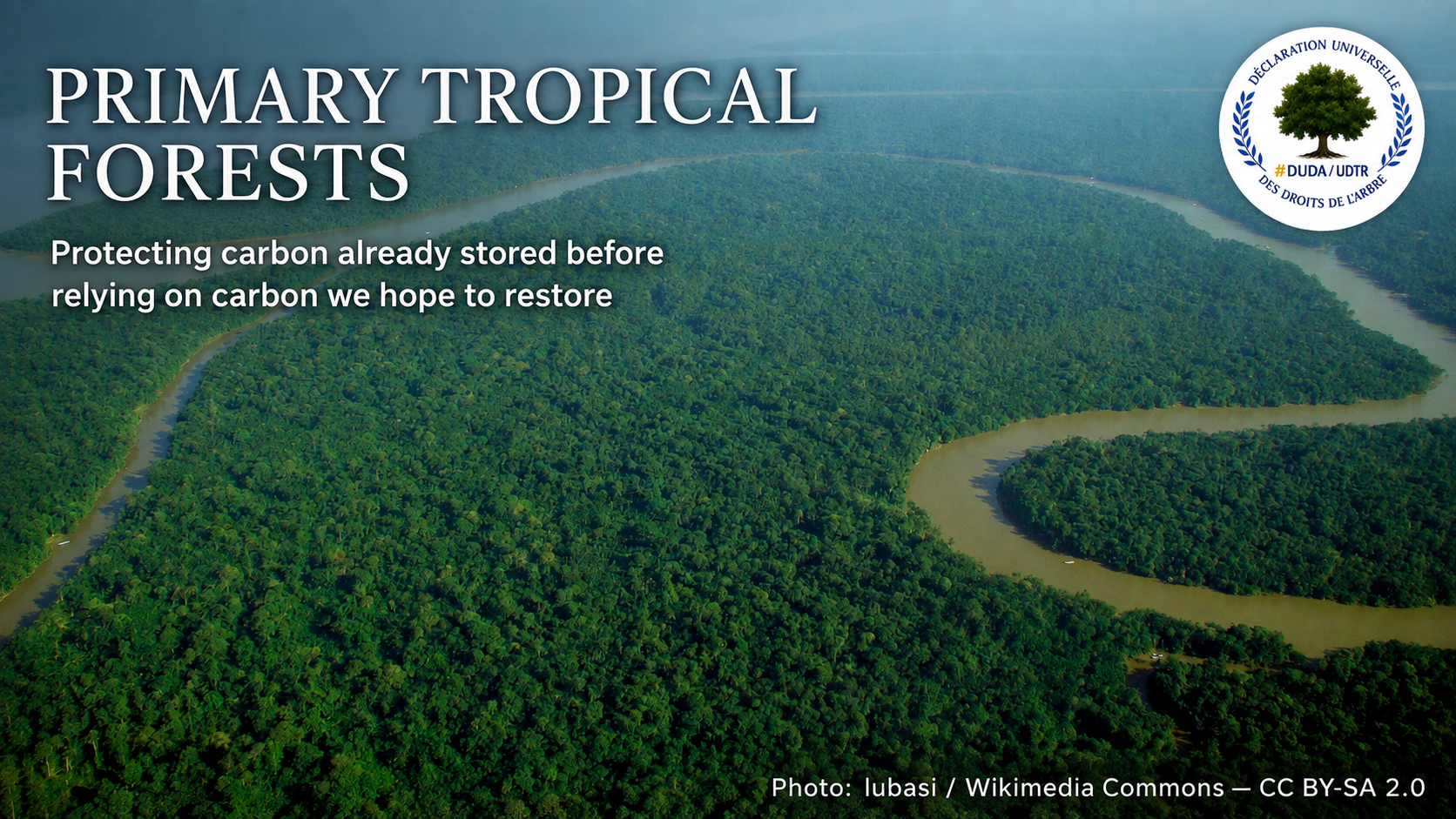
Primary tropical forests hold close to half of tropical forest carbon, continue to absorb CO₂, and may require more than a century to recover biomass after logging. Their protection must precede offsetting or restoration strategies.
With the remaining climate window now severely constrained, forest actions are not equivalent in speed, certainty, or in the quantity of carbon they genuinely preserve.
Climate mitigation can no longer rely on the simple addition of restoration promises, tree-planting pledges, or future improvements in forest management. It requires a rigorous hierarchy of action. When a primary tropical forest is destroyed or severely degraded, carbon accumulated over decades or centuries is released, displaced, or made vulnerable over a short period. Rebuilding that stock, where ecological recovery remains possible, takes decades and sometimes centuries.
The first climate priority is therefore to avoid losing carbon that is already stored while maintaining the capacity of intact forests to continue absorbing carbon. This priority does not make restoration unnecessary; it gives restoration its proper place. Restoration repairs a loss that has already occurred. Protection prevents that loss from occurring.
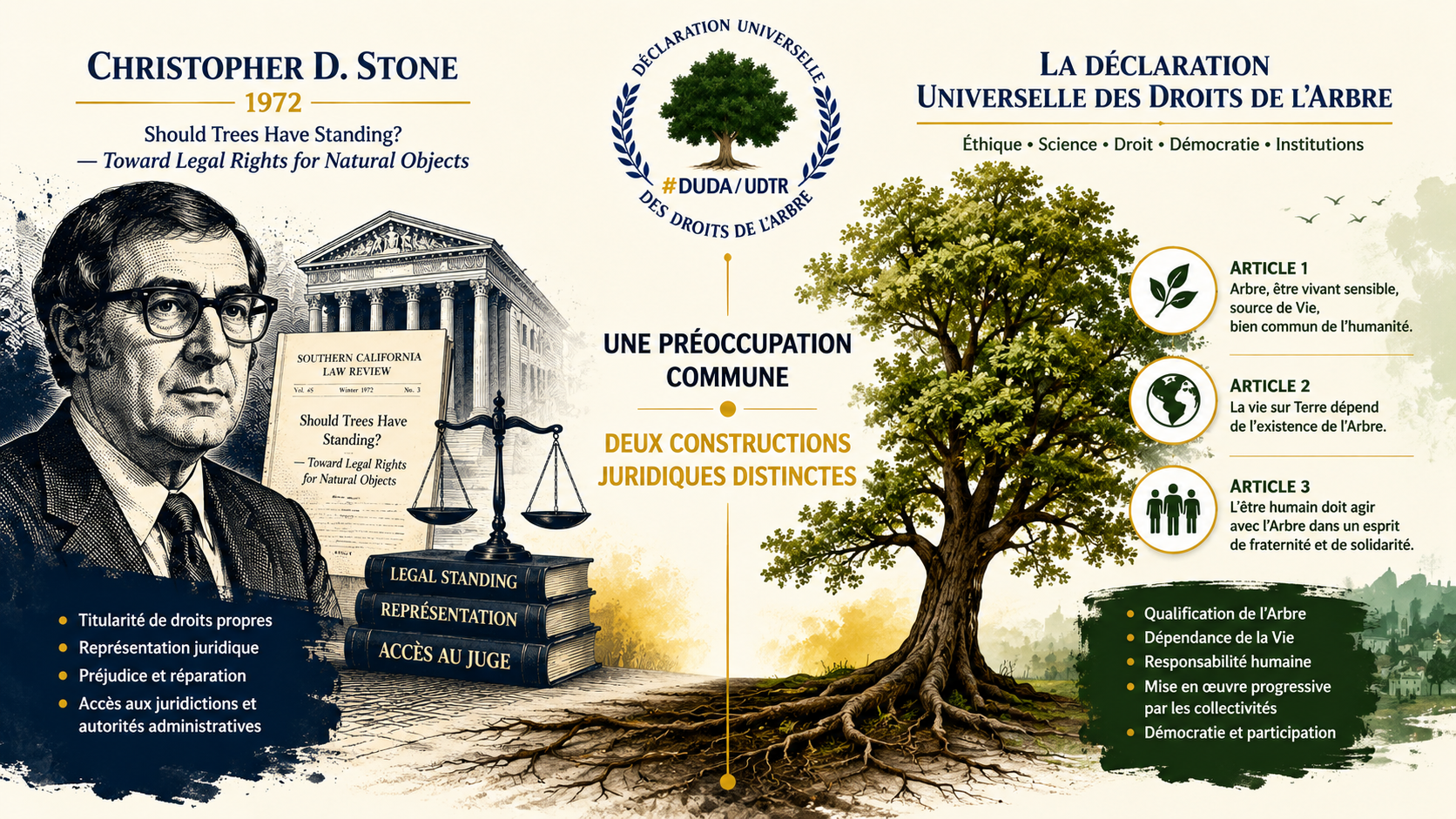
Read in light of the Universal Declaration of Tree Rights, this hierarchy is not merely a technical optimization of carbon. Article 1 prevents the Tree and the forest from being reduced to a replaceable stock; Article 2 places their climate, water, soil, and biological functions within the conditions of Life; and Article 3 requires human action to be guided by fraternity and solidarity. In operational terms, that means avoiding destruction before organizing repair, preserving living continuity before calculating compensation, and restoring without pretending that the original loss has disappeared.
This article synthesizes the magnitudes and distinctions developed in the cited scientific literature, in particular Mackey et al. (2020). It is a scientific, policy, and doctrinal synthesis. Citation of these publications does not imply personal or institutional endorsement of this article by their authors or affiliated institutions.
Prepared on August 4, 2026. Synthesis based on the cited scientific and institutional corpus. Citation does not imply endorsement by the authors or their institutions.
I. Not All Forest Actions Are Equivalent
Forest policy frequently combines, under a single climate heading, actions that differ fundamentally in effect, timing, and uncertainty: avoiding conversion, protecting an intact forest, restoring degraded land, planting trees, or changing practices in a production forest.
This aggregation can create the illusion that one hectare protected today and one hectare planted tomorrow are interchangeable. They are not. Protecting an existing stock avoids an immediate emission or loss of stability. Restoration gradually builds a future stock. Tree planting may serve productive, landscape, or climate purposes, but it does not automatically recreate the structures, soils, ecological networks, and history of a primary forest.
The governing principle should therefore be real climate effectiveness: first prioritize actions that prevent rapid and certain losses; then restore functions that have already been damaged; and finally reduce the footprint of production systems.
II. A Primary Forest Is Not an Old Plantation
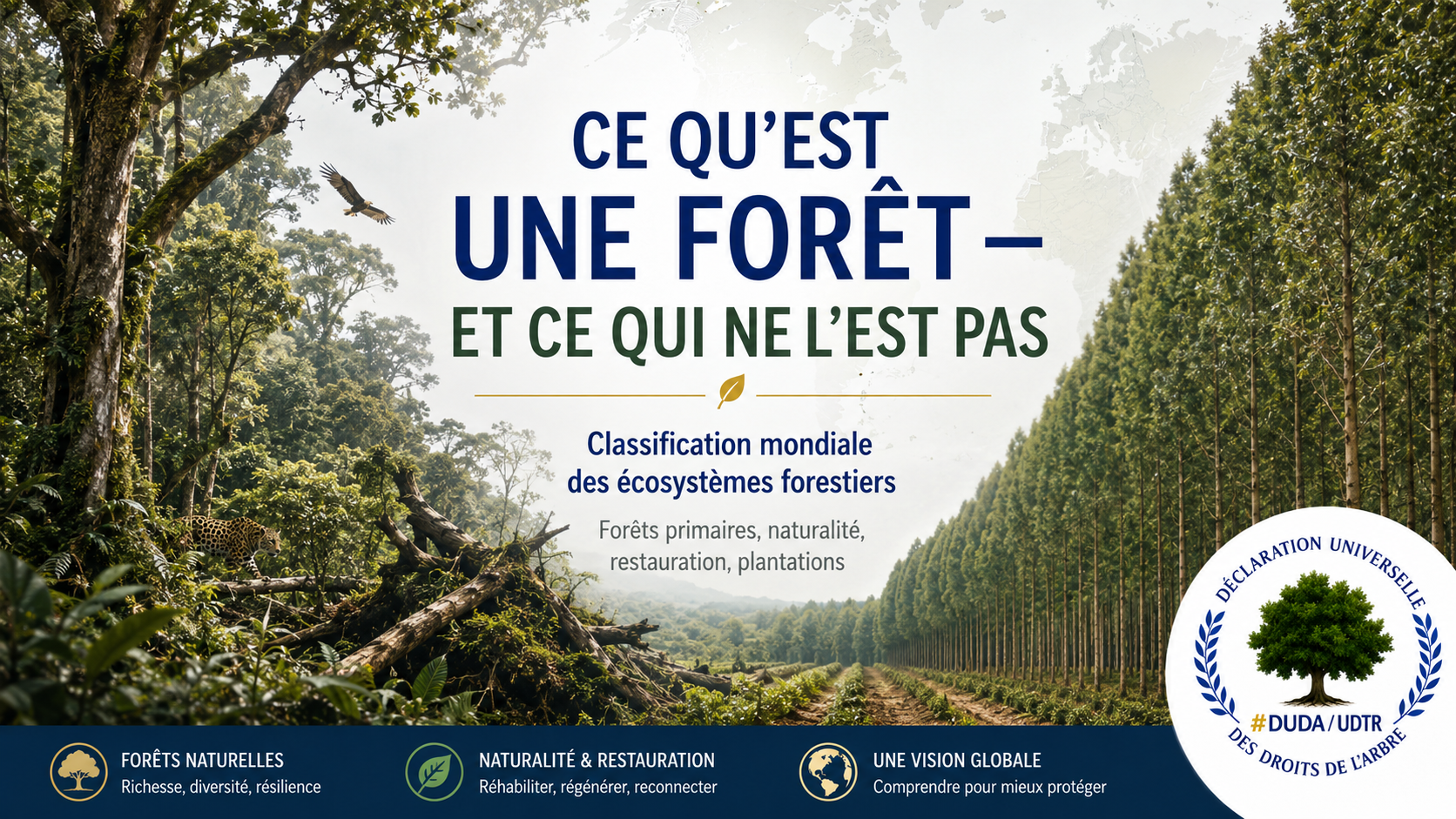
The word “forest” covers realities that are too different to be used without qualification. A primary tropical forest, a degraded natural forest, a secondary forest, a logged forest, an industrial plantation, and land under restoration may all carry tree cover. Yet they do not possess the same carbon stock, biodiversity, structural complexity, ecological stability, or replacement value.
For purposes of this article, a primary tropical forest is a naturally regenerated forest dominated by native species and natural ecological and evolutionary processes, largely free from significant industrial land uses, whose composition, structure, functions, disturbance regimes, and trajectory remain primarily determined by the ecosystem’s own dynamics. This is consistent with distinctions developed by Kormos et al. (2017) and with the broader doctrine on the global classification of forest ecosystems.
This definition does not require the absence of all human presence. Indigenous Peoples and local communities may live in, govern, and use primary forests without interrupting their fundamental processes. The relevant boundary is not between nature “without people” and nature “with people,” but between relationships compatible with continuity of the living world and uses that persistently simplify, fragment, drain, convert, or deplete the ecosystem.
| Category | Dominant characteristic | Climate and ecological value |
|---|---|---|
| Primary tropical forest | Ecological continuity, natural regeneration, complex structure, old soils and networks. | Ancient stock, full functions, very high irreplaceability. |
| Degraded natural forest | Forest cover remains, but biomass, structure, fauna, or hydrology have been depleted. | Persistent value, but reduced integrity and increased risk. |
| Secondary forest | Natural regeneration after a major disturbance. | Increasing value with maturity; recovery trajectory. |
| Production forest | Organized removals, rotations, infrastructure, and variable simplification. | Stocks and functions strongly dependent on management. |
| Plantation | Deliberate establishment, often regular, even-aged, and production-oriented. | May store carbon and provide wood, without equivalence to primary forest. |
| Restoration area | Land engaged in recovering soils, water, structure, and processes. | Progressive benefits conditioned by trajectory and permanence. |
Terminological principle
Counting a primary forest, a single-species plantation, and recently reforested land indiscriminately as “forest” creates an accounting equality that corresponds to no ecological equality.
III. A Vast Carbon Stock and an Active Sink
1. The stock: carbon already removed from the atmosphere
Primary tropical forests retain carbon in trunks, branches, leaves, roots, deadwood, litter, and soils. This stock results from long accumulation. Conserving it creates an immediate climate benefit because it prevents that carbon from being released, oxidized, or made more vulnerable to disturbance.
Destroying a primary forest does not only remove carbon held in felled trees. It may damage soils, dry forest edges, increase residual mortality, elevate fire risk, and fragment the continuities that support stability across the wider landscape.
2. The flow: continuing carbon uptake
Primary forests are not merely passive reservoirs. At the scale assessed in the cited literature, they continue to absorb carbon. Protection therefore maintains both an existing stock and a future sequestration capacity.
Their destruction creates a double loss: it releases or destabilizes an ancient stock and removes part or all of a future sink. Accounting limited to visible emissions at the time of clearing therefore understates the full climate cost when it ignores the sequestration the ecosystem would otherwise have continued to provide.
IV. Ecological Time Is Not Climate Time
A restored forest may gradually recover tree cover, part of its biomass, some hydrological functions, habitat, and carbon-storage capacity. It does not instantly reconstruct ancient trees, soils, food webs, vertical diversity, microhabitats, ecological memory, or the evolutionary continuities of a primary forest.
Carbon and integrity can be lost in days, months, or years. Biomass recovery may take several decades. Rebuilding complex structure, deadwood stocks, senescent trees, and functioning soils may require a century or more. Some historical attributes cannot be fully reproduced.
Indicative timeline
Restoration is therefore necessary where degradation has already occurred. But it is neither an immediate equivalence nor prior authorization to destroy. This principle reflects the requirement developed by Brancalion and Chazdon (2017) to move beyond hectares and assess ecological quality, location, permanence, and the actual trajectory of interventions.
| Protection of a primary forest | Restoration of a degraded forest |
|---|---|
| Immediately avoids emissions and losses | Gradually sequesters carbon |
| Preserves an ancient stock | Rebuilds a future stock |
| Maintains complex functions already present | Gradually recovers selected functions |
| Provides an immediate benefit | Provides delayed benefits |
| Reduces risk of irreversibility | Repairs a loss that has already occurred |
| Conserves ecological history | Builds a new trajectory without erasing historical loss |
Governing formulation
Restoration is necessary where degradation has already occurred. But restoration is neither an immediate equivalence nor prior authorization to destroy.
V. Three Necessary but Non-Equivalent Strategies
1. Halt deforestation and degradation
The first strategy is to prevent conversion of primary forests, fragmentation, opening by new infrastructure, induced fires, incompatible industrial use, agricultural or mining conversion, and other pressures that persistently alter their integrity.
This strategy provides the fastest and most certain benefit: the stock remains in place, soils stay protected, landscape continuity is maintained, and the carbon sink can continue to function.
2. Expand ecological restoration
Restoration is indispensable for repairing already degraded territories, re-establishing ecological continuity, restoring soils and water, reconnecting forest fragments, and progressively increasing carbon stocks. It must be understood as recovery of ecosystem functions, not merely a statistical increase in tree numbers.
Depending on context, restoration may use natural regeneration, assisted natural regeneration, hydrological repair, reconnection of edges and corridors, targeted invasive-species control, or limited enrichment planting.
3. Improve management of production forests
The third strategy applies to forests allocated to production: reduced-impact logging, canopy retention, soil protection, longer rotations where ecologically appropriate, retention of habitat trees and deadwood, road limitation, reduction of extensive clear-cutting, and more resilient landscape mosaics.
These improvements may reduce emissions and biodiversity loss. They must not, however, be presented as equivalent to protecting a primary forest. All three strategies are needed, but their outcomes must be reported separately, with their respective timeframes, uncertainties, and purposes.
VI. What Policy Calls a “Forest” Determines What It Claims to Have Protected
Definitions are not merely terminological. They determine legal objects, statistics, finance, and reported outcomes. A forest may remain in inventories while losing its largest trees, substantial biomass, fauna, continuity, and resilience. Degradation must therefore be distinguished from deforestation.
Likewise, planting trees does not necessarily restore a forest. Plantation, reforestation, natural regeneration, functional restoration, and gradual reconstruction of a forest ecosystem must be distinguished. As Chazdon et al. (2016) showed, no single forest definition can simultaneously serve every statistical, legal, productive, climate, and ecological purpose.
1. The baseline problem
A policy may claim an emissions reduction without reducing actual emissions if it compares observed results with a highly adverse future scenario. Slowing projected deforestation does not necessarily mean avoiding real deforestation. Baselines must therefore be public, verifiable, and tested against observed gross emissions.
2. The temporal compensation problem
An emission avoided today and a tonne of carbon that may be sequestered several decades later are not climatically equivalent. Time delay, fire, drought, land-use change, mortality, and harvesting risk must be included in the assessment.
3. The net-balance problem
A net balance can conceal destruction of irreplaceable ecosystems. A State that loses 100,000 hectares of natural forest and establishes 120,000 hectares of plantations should not report only a “net gain” of 20,000 hectares. It should disclose separately the natural loss, plantation gain, ecological qualities involved, and associated emissions.
Transparency principle
Reducing projected deforestation is not always the same as avoiding real deforestation. A net area cannot replace information on gross losses and the ecological nature of the systems involved.
VII. A Coherent Strategy Requires Four Families of Action
I. Protect
- prohibit or strictly limit conversion of primary forests and natural forests of very high integrity;
- prevent fragmentation and reduce incompatible infrastructure;
- provide independent monitoring and effective enforcement;
- recognize the rights, territories, knowledge, and representative institutions of Indigenous Peoples and local communities;
- secure durable finance for effective protection, not merely formal designation.
II. Advance proforestation, restoration, and reconnection
Proforestation means allowing existing forests to continue growing, maturing, and accumulating ecological functions. It should be combined with natural regeneration, repair of soils and water, reconnection of fragments, restoration of edges, and recovery of corridors.
III. Reform definitions and accounting rules
- distinguish primary forests, other natural forests, secondary forests, degraded forests, forests under restoration, and plantations;
- include degradation in reporting even where tree cover remains visible;
- report existing stocks, avoided emissions, new removals, and foregone sequestration separately;
- disclose recovery time, uncertainty, and non-permanence risk;
- prevent double counting and compensation based on fictitious ecological equivalence.
IV. Plan at landscape scale
Forests cannot be managed parcel by parcel without considering watersheds, ecological corridors, elevational gradients, climate continuities, fire regimes, human uses, and community territories. Integrity operates at landscape scale, as emphasized by Rogers et al. (2022).
VIII. Avoid, Preserve, Restore, Produce Differently
A coherent forest policy must state a hierarchy of action. The hierarchy does not exclude any useful strategy. It prevents slower and more uncertain actions from being used to justify the loss of more effective ones.
Hierarchy of forest climate priorities
Rapid and direct reduction of fossil-fuel emissions remains indispensable at every level: forests cannot substitute for it.
Tree planting should therefore not sit at the top of climate strategy. It comes after the primary duty not to destroy what already exists. Planting may contribute to restoration or renewable-material production, but its benefit depends on location, composition, use, permanence, and the ecosystem it may replace.
Synthesis
Protect before compensating. Preserve before rebuilding. Restore without erasing the loss. Produce without confusing production and conservation.
IX. From Compensation to an Obligation of Non-Degradation
1. Recognize a duty of forest due diligence
States, financial institutions, and companies should verify that their decisions do not directly or indirectly contribute to deforestation, degradation, fragmentation, land conversion, or displacement of pressure to other territories. This duty should cover supply chains, infrastructure, finance, concessions, land-use plans, and offset mechanisms.
2. Give priority to real avoidance
Law and public policy should require prior demonstration of avoidance: the authority or operator must establish that lower-impact alternatives were assessed, that the project’s necessity is demonstrated, and that irreplaceable ecosystems are excluded from ordinary offsetting.
3. Reform climate finance
Finance should prioritize effective protection of intact forests, land and territorial security for Indigenous Peoples and local communities, ecological restoration, transformation of production systems, and independent monitoring. Outcomes should be measured through verified gross losses avoided and ecological improvement, not only through hectares enrolled or credits issued.
4. Limit the fungibility of forest carbon
Conservation of a primary forest must not become an interchangeable unit permitting continued fossil emissions elsewhere. Terrestrial carbon is vulnerable, finite, and reversible, while fossil carbon adds geological carbon to the atmosphere–ocean–biosphere system. Forest protection is an indispensable complement to fossil-fuel phase-out, not permission to delay it.
Fundamental limit
Forest carbon cannot become an alibi for postponing reductions in emissions from fossil fuels.
X. Protecting Primary Forests Means Recognizing That the Tree Is Not a Replaceable Stock
The Universal Declaration of Tree Rights provides an ethical and interpretive framework that complements scientific analysis without replacing it. Its three founding articles require primary forest to be understood as a living community rather than a substitutable volume of biomass.
The Declaration is therefore not an appendix added to the climate argument at the end of the article. It supplies the normative thread running through the entire analysis: what science identifies as an ancient stock, an active sink, a slow recovery trajectory, and an irreplaceable ecological system becomes, under the Declaration, an obligation to protect before compensating and to preserve living continuity before calculating replacement.
Article 1
“The Tree, a sentient living being, source of Life, is a common good of humanity.”
A primary forest cannot be reduced to a commercial reserve of carbon or timber. It is a living community whose value exceeds its climate function.
Article 2
“Life on the planet depends on the existence of the Tree.”
The climate, water, biological, and cultural functions of primary forests directly sustain the conditions of Life.
Article 3
“Human beings, endowed with reason and conscience, must act with the Tree in a spirit of fraternity and solidarity.”
This responsibility requires protection before compensation, avoidance before restoration, and maintenance of the living world’s regenerative capacity.
From the three Articles to concrete forest policy
| Declaration principle | Scientific meaning in primary forests | Policy consequence |
|---|---|---|
| Article 1 — living being and common good | A primary forest is an organized living community with history, soils, species, and processes—not a homogeneous carbon reserve. | Reject substitution by plantations or offset units; protect ecological identity and continuity. |
| Article 2 — Life depends on the Tree | Forest carbon, water, soils, biodiversity, and regional climate form an interdependent life-support system. | Assess climate policy through ecosystem integrity, not carbon alone; prevent degradation even where canopy remains. |
| Article 3 — fraternity and solidarity | Loss is rapid, while recovery is delayed, uncertain, and sometimes incomplete across generations. | Apply avoidance, precaution, restoration, and intergenerational stewardship in that order. |
This connection does not, by itself, confer legal personality on trees or forests, create an automatic cause of action, or transfer public authority. It illuminates duties of protection, prudence, solidarity, and intergenerational continuity within the Declaration’s official framework. Consult the Official Framework of the Universal Declaration of Tree Rights.
Editorial formulation
Solidarity with the Tree does not consist in promising to replant after destruction. It begins with preserving the ecosystems that continue today to sustain climate, water, soils, and the diversity of life.
XI. Essential Scientific Qualifications
A credible doctrine must state both what it affirms and what it does not. Forests are dynamic systems subject to disturbance, climate change, and differing biogeographic trajectories. Their climate role cannot be reduced to a single formula.
| The article must not claim | It should state precisely |
|---|---|
| That every primary forest remains indefinitely a carbon sink of the same intensity. | That conserving existing stocks provides an immediate benefit and, where the sink remains active, preserves additional uptake capacity. |
| That restoration is useless. | That protection and restoration are complementary but not substitutable. |
| That all logged forests are ecologically identical. | That impacts vary with intensity, frequency, retained structure, landscape context, and trajectory. |
| That forest protection removes the need to reduce fossil emissions. | That both imperatives must be pursued simultaneously. |
| That carbon is the only value of forests. | That biodiversity, water, soils, cultures, health, climate, and continuity of life are interdependent. |
| That all estimates are universal. | That results depend on methods, scope, data, and temporal baselines. |
Natural events must also be distinguished from disturbances imposed or amplified by human activity. A primary forest may experience fire, storms, floods, windthrow, or insects without automatically losing primary status where those processes belong to its characteristic ecological regime. The decisive questions concern frequency, intensity, extent, retained biological legacies, and capacity for recovery.
Protection must not become an instrument of exclusion. The territorial, cultural, and political rights of Indigenous Peoples and local communities must be fully recognized. The United Nations Declaration on the Rights of Indigenous Peoples provides an essential international framework.
XII. The First Tree to Save Is the One That Still Exists
Protection of primary tropical forests is not a secondary option placed alongside restoration or improved silviculture. It is the first line of defense against immediate, large-scale, and sometimes irreversible emissions within the climate time that remains.
Restoring degraded forests remains indispensable. Reforming production forests is also necessary. But neither can rapidly compensate for the disappearance of ecosystems that accumulated carbon, structured soils, organized water, and sustained living communities for decades or centuries.
The hierarchy must therefore be clear: protect what remains intact; allow existing forests to continue growing; restore what has been degraded; transform production practices; and directly reduce fossil-fuel emissions.
Climate policy can no longer be satisfied with slowing loss relative to a destruction scenario. It must organize real emissions avoidance, preserve existing stocks, and maintain future sequestration capacity.
Under the Universal Declaration of Tree Rights, this hierarchy gives concrete effect to all three founding Articles. It recognizes the Tree and the forest as living realities that cannot be reduced to replaceable units; it protects the ecological conditions on which Life depends; and it translates fraternity and solidarity into a duty to prevent avoidable destruction, preserve regenerative capacity, and pass living forests—not merely accounting balances—to future generations.
Conclusion
Protect before compensating. Preserve before rebuilding. The first tree to save is the one that still exists.
Principal References
The following references form the article’s principal scientific and methodological basis. Their inclusion does not imply endorsement of this article by the authors or institutions concerned.
- Mackey, B. et al. (2020). Understanding the Importance of Primary Tropical Forest Protection as a Mitigation Strategy. Mitigation and Adaptation Strategies for Global Change, 25, 763–787.
- Mackey, B. et al. (2013). Untangling the Confusion Around Land Carbon Science and Climate Change Mitigation Policy. Nature Climate Change, 3, 552–557.
- Mackey, B. et al. (2015). Policy Options for the World’s Primary Forests in Multilateral Environmental Agreements. Conservation Letters, 8(2), 139–147.
- Chazdon, R. L. et al. (2016). When Is a Forest a Forest? Forest Concepts and Definitions in the Era of Forest and Landscape Restoration. Ambio, 45, 538–550.
- Brancalion, P. H. S. and Chazdon, R. L. (2017). Beyond Hectares: Four Principles to Guide Reforestation in the Context of Tropical Forest and Landscape Restoration. Restoration Ecology, 25(4), 491–496.
- Kormos, C. F. et al. (2017). Primary Forests: Definition, Status and Future Prospects for Global Conservation. Encyclopedia of the Anthropocene.
- Rogers, B. M. et al. (2022). Using Ecosystem Integrity to Maximize Climate Mitigation and Minimize Risk in International Forest Policy. Frontiers in Forests and Global Change, 5, 929281.
- Convention on Biological Diversity — Kunming–Montreal Global Biodiversity Framework, Target 2: restoration.
- Convention on Biological Diversity — Kunming–Montreal Global Biodiversity Framework, Target 3: conservation.
By Ricardo Rey
Author and Founder of the Universal Declaration of Tree Rights
President of La Compagnie des Papillons Bleus
Prepared and published within the framework of the work of La Compagnie des Papillons Bleus, the official steward organization of the Universal Declaration of Tree Rights.
Official website: www.declarationuniverselledesdroitsdelarbre.org