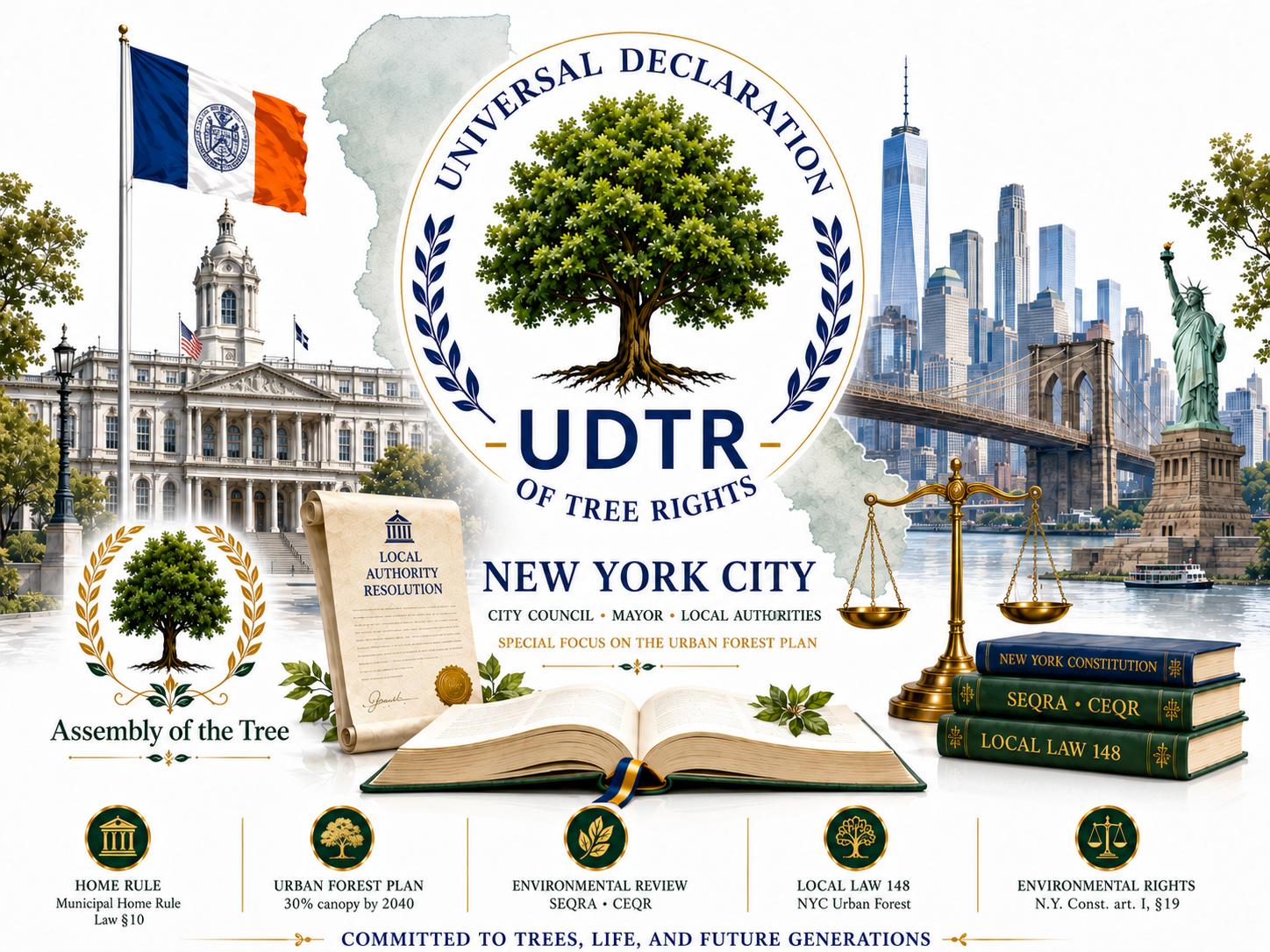
This article examines how New York City may formally adopt the Universal Declaration of Tree Rights together with the Fifteen Commitments of Local and Regional Authorities, and progressively translate that framework into urban-forest policy, tree management, land-use planning, public works, procurement, climate adaptation, public participation, and long-term governance.
The legal question is whether such an adoption can be structured within New York State and New York City law while preserving the distinction between institutional recognition, internal municipal administration, and any later binding regulation of third parties.
As a matter of general legal architecture, the answer is yes for an institutional adoption of the Declaration and the Fifteen Commitments, subject to the New York Constitution, the Municipal Home Rule Law, applicable state and federal preemption, the New York City Charter and Administrative Code, procedural requirements, and the precise legal effect of each later measure. A Council resolution, local law, agency rule, zoning provision, permit condition, budget appropriation, procurement specification, administrative program, Charter amendment, and voter proposition do not have the same legal effect and cannot be treated as interchangeable instruments.
New York City deserves particular attention because it already possesses an unusually strong urban-forest foundation. Local Law 148 of 2023 defines the urban forest as all trees within New York City, including trees outside City ownership and outside the jurisdiction of the Parks Commissioner. It requires a recurring Urban Forest Plan to identify strategies and goals to protect, care for, and expand the urban forest canopy, with an overall objective of equitably expanding canopy to 30 percent of the City’s land area. The City released its first Urban Forest Plan in 2026; the most recent citywide canopy figure published by the Plan is 23.4 percent, based on 2021 data.
This means that the Universal Declaration would not arrive in a legal or policy vacuum. The relevant task for New York City is a structured equivalence-and-gap analysis: identify where the Fifteen Commitments already converge with municipal law and practice, where they can be implemented administratively, and where a later local law, rule, budgetary measure, land-use action, or other legally appropriate instrument would be required.
The Universal Declaration of Tree Rights is developed and institutionally stewarded by La Compagnie des Papillons Bleus, which is responsible for the official framework, current versions, institutional guidance, documentary continuity, and the International Register of Signatory Authorities associated with the initiative.
Mandatory institutional procedure
For an adoption to be recognized and recorded by La Compagnie des Papillons Bleus as an official adoption within the institutional framework of the Universal Declaration of Tree Rights, the local or regional authority must contact La Compagnie directly before any deliberation, resolution or signature intended to form part of that official procedure.
An authority remains free, within the powers conferred on it by applicable law, to adopt resolutions, policies, or other measures. However, an initiative conducted outside the institutional procedure cannot be recorded or presented by La Compagnie des Papillons Bleus as an official adoption within the institutional framework it stewards.
1. Legal and institutional nature of the Declaration
The Universal Declaration of Tree Rights is the foundational text of an initiative that connects science, law, ethics, democracy, culture, education, and public action. It states principles of recognition, respect, protection, and human responsibility toward the Tree.
The Declaration is not a legal person, public agency, court, certifying authority, or intergovernmental organization. Its institutional stewardship is exercised by La Compagnie des Papillons Bleus.
The three articles — official English version
For any New York City initiative, the official English wording should be reproduced without paraphrase. The three articles are:
Article I
The Tree, a sentient living being and source of Life, is a common good of humanity.
Article II
Life on Earth depends upon the existence of the Tree.
Article III
Human beings, endowed with reason and conscience, must act with the Tree in a spirit of fraternity and solidarity.
The Three Founding Articles — official English text
Local adoption of the Declaration does not, by itself, constitute:
- signature or ratification of an international treaty;
- accession by the United States, the State of New York, or the City of New York to the proposed International Convention on Tree Rights;
- an amendment to the U.S. Constitution, the New York Constitution, or the New York City Charter;
- legal personhood for Trees;
- standing, a private cause of action, or a right to sue in the name of a Tree;
- a change, by itself, to title, easements, vested rights, compensation rules, zoning rights, or other property-law interests;
- a transfer of governmental authority to La Compagnie des Papillons Bleus, the Assembly of the Tree, or the Defender of the Tree;
- or the immediate creation of binding duties for property owners, businesses, developers, utilities, contractors, public authorities, or City agencies beyond duties already imposed by applicable law.
Within the Declaration, the expression “common good of humanity” is a principle of collective responsibility toward the living world and future generations. It is not, by itself, a rule transferring ownership or converting privately owned Trees into public property.
2. Legal architecture: United States, New York State, and New York City
In the United States, a New York City adoption must be situated within a layered legal structure: the U.S. Constitution and federal law; the New York Constitution and state statutes; the New York City Charter, Administrative Code, Zoning Resolution, and Rules of the City of New York; and the powers allocated among the City Council, Mayor, agencies, boards, commissions, and other public entities.
Article IX of the New York Constitution supplies the constitutional architecture of local government. Section 2 recognizes local lawmaking powers, subject to the Constitution and general laws, and expressly includes matters such as the acquisition, care, management and use of streets and municipal property, together with the government, protection, safety, health, and well-being of persons and property.
New York Constitution — Article IX, section 2
The Municipal Home Rule Law then develops those powers. Section 10 authorizes local laws concerning, among other matters, municipal streets and property, the protection and enhancement of the physical and visual environment, and the safety, health, and well-being of persons or property, while preserving constitutional and statutory limits.
3. New York home rule, municipal environmental powers, and preemption
Home rule is substantial, but it is not unlimited
New York home rule does not create an island of municipal sovereignty. A City measure must be consistent with the New York Constitution and, where applicable, with general state laws. Express preemption, field preemption, conflict preemption, state statutory restrictions, and Charter allocations of power can limit the form or substance of local action.
Municipal Home Rule Law § 11 contains specific restrictions on local laws, and § 10 itself preserves limits imposed by the Constitution, general laws, and the powers of other public corporations. The relevant legal inquiry is therefore not whether “New York City has home rule” in the abstract, but which City institution is acting, through which instrument, on what subject, with what legal effect, and against which potentially controlling state or federal rule.
New York Municipal Home Rule Law § 11 — restrictions on local laws
Court of Appeals guidance: home rule and preemption are subject-specific
The New York Court of Appeals provides an important doctrinal reference in Matter of Wallach v Town of Dryden, 23 N.Y.3d 728 (2014). The Court expressly situated local authority within article IX of the New York Constitution and Municipal Home Rule Law § 10, including the powers to protect and enhance the physical and visual environment and to protect the safety, health, and well-being of persons and property. At the same time, it reaffirmed that municipal legislation must yield where state law preempts local action.
In Wallach, the Court declined to read a state oil-and-gas supersession clause as eliminating traditional local land-use authority absent a sufficiently clear expression of legislative intent. The decision does not mean that every local Tree rule is immune from preemption. Its relevance here is methodological: environmental and land-use powers are genuine municipal powers, but the validity of each binding measure depends on its subject, purpose, legal effect, and the particular state or federal law said to control.
Matter of Wallach v Town of Dryden, 23 N.Y.3d 728 (2014) — New York State Law Reporting Bureau
Why tree policy fits naturally within municipal subject matter
Trees intersect with municipal property and streets, parks, land-use regulation, construction, stormwater, public health, heat resilience, biodiversity, urban design, capital planning, contracting, data systems, and community participation. New York law therefore offers multiple municipal points of entry. Each binding implementation measure must nevertheless be grounded in the specific authority that supports that measure, rather than deriving coercive force from the Declaration alone.
4. City Council, Mayor, agencies, and municipal legal instruments
The New York City Council
The City Council is New York City’s legislative body. Its official legislative materials distinguish between local laws, which can amend the Charter or Administrative Code and create enforceable municipal law within the City’s competence, and resolutions, which allow the Council to state an official collective position and can play a role in public policy.
New York City Council — legislative process
The Charter sharpens that distinction. Charter § 28 supplies the Council’s general power to adopt local laws within the constitutional and statutory limits applicable to the City. Charter § 34 provides, except where another rule applies, that a local law or resolution requires at least the affirmative vote of a majority of all Council members. Charter § 37 governs mayoral action on local laws after Council passage.
New York City Charter § 28 — Powers of Council
New York City Charter § 34 — Vote required for local law or resolution
New York City Charter § 37 — Local laws; action by Mayor
The Mayor and executive agencies
The Mayor and mayoral agencies are central to implementation because the urban forest is administered through executive departments and interagency systems. Local Law 148 itself uses this architecture: it requires an agency or office designated by the Mayor to develop the Urban Forest Plan in consultation with NYC Parks and the Mayor’s long-term planning and sustainability office or successor office, and permits collaboration with other agencies, state agencies, public authorities, and persons with relevant expertise.
Where implementation requires an agency rule rather than a purely internal management protocol, the City Administrative Procedure Act is directly relevant. Charter § 1043 empowers agencies to adopt rules necessary to carry out delegated powers and duties, but requires the applicable notice, public-comment, hearing, publication, and adoption procedures. A Declaration-related policy should therefore distinguish internal operational guidance from a rule of general applicability that must proceed through CAPA.
New York City Charter § 1043 — City Administrative Procedure Act rulemaking
The instrument must match the intended legal effect
- Resolution: suitable for consideration as an initial vehicle for institutional recognition, policy findings, adoption of the common texts, and requests for study or cooperation, but it should not be represented as automatically amending municipal law or compelling executive action beyond the Council’s lawful authority.
- Local law: required where the City intends to amend the Charter or Administrative Code or create enforceable legislative duties within local competence.
- Agency rule or administrative protocol: appropriate where an agency possesses delegated rulemaking or management authority and follows the applicable rulemaking procedure.
- Zoning text or land-use action: required where implementation operates through land-use controls governed by the Charter, Zoning Resolution, and applicable review procedures.
- Budget and capital instruments: required for appropriations, staffing, capital commitments, or expenditure decisions that cannot be created by a policy declaration alone.
- Contract specifications and procurement instruments: available for City purchasing, construction, and services, subject to procurement law, the Charter, Administrative Code, and Procurement Policy Board rules.
- Charter amendment or referendum: a distinct constitutional and statutory route that should be reserved for questions genuinely requiring Charter-level or voter-level action.
5. Three legal levels that must remain distinct
The distinction is critical. Adoption of the Declaration and the Fifteen Commitments does not eliminate the need to use the legal instrument required for each subsequent measure. A New York City adoption should therefore resist drafting a single resolution as if it could simultaneously perform the work of a policy statement, local law, zoning text amendment, budget appropriation, agency rule, contract specification, permit decision, and Charter amendment.
6. SEQRA, CEQR, environmental review, and limits of integration
New York’s State Environmental Quality Review Act (SEQRA), Environmental Conservation Law article 8, requires state and local agencies to assess the environmental effects of discretionary actions before undertaking, funding, or approving them, subject to statutory and regulatory exclusions and classifications.
Within New York City, City Environmental Quality Review (CEQR) is the City’s process for implementing SEQRA. The Mayor’s Office of Environmental Coordination explains that CEQR can be no less stringent than SEQRA and applies to proposed discretionary actions within New York City. Its technical areas include land use and zoning, open space, shadows, natural resources, infrastructure, greenhouse-gas emissions, public health, neighborhood character, and construction impacts.
New York City — CEQR general guidance
The threshold question for a particular Declaration-related measure is therefore not whether it has an environmental purpose. The question is whether the action being undertaken, funded, or approved is an action subject to SEQRA/CEQR and, if so, what classification, documentation, lead-agency process, environmental assessment, impact statement, mitigation, or exemption is required.
A Council resolution limited to institutional recognition, policy direction, and requests for future analysis may present a different environmental-review question from a rezoning, capital project, permit program, land acquisition, regulatory amendment, or physical undertaking. The responsible City institution should determine the status of the actual action proposed rather than assuming either that environmental review necessarily applies or that an environmental purpose necessarily removes an action from review.
7. What an initial New York City act of adoption may contain
A carefully drafted initial New York City adoption instrument may, depending upon the chosen legal vehicle and the powers of the acting body:
- formally adopt the Universal Declaration of Tree Rights and the Fifteen Commitments of Local and Regional Authorities simultaneously and in full, using the current official texts;
- identify the exact versions of both documents and attach or incorporate them by precise reference where procedure permits;
- recognize the relationship between the Declaration, Local Law 148 of 2023, the 2026 Urban Forest Plan, and New York City’s existing tree, climate, public-health, and land-use policies without claiming legal equivalence where none has been established;
- confirm that the act itself does not confer legal personhood, standing, a private cause of action, property transfer, or coercive powers for the Assembly of the Tree or Defender of the Tree;
- request or direct, within the acting body’s lawful competence, a baseline assessment of existing laws, rules, plans, inventories, procurement standards, public-works practices, budgets, staffing, and interagency responsibilities against the Fifteen Commitments;
- establish a process for identifying which commitments are already substantially implemented, partly implemented, or not yet addressed;
- request a legally reviewed implementation plan with priorities, costs, responsible bodies, indicators, milestones, and a timetable;
- examine a consultative structure corresponding to the first Commitment without duplicating existing institutions unnecessarily;
- provide for periodic public reporting and evaluation;
- and reserve any new enforceable rule for a later local law, zoning action, agency rule, permit regime, contract specification, budget measure, or other competent instrument.
Within the official institutional procedure of the Declaration, official adoption of the Declaration is inseparable from the simultaneous and full adoption of the Fifteen Commitments. New York City remains free to study the Declaration or adopt independent municipal policies under applicable law. For an adoption to be recognized and recorded by La Compagnie des Papillons Bleus as official within the institutional framework, however, the institutional procedure — including prior contact — must be followed.
8. Public property, street trees, park trees, and direct City management
The most legally direct implementation lever is City-controlled property and operations. NYC Parks has direct responsibility for extensive park and street-tree systems, while other City agencies and public entities control additional land, facilities, rights-of-way, campuses, infrastructure, and capital projects. Jurisdiction must be identified site by site because “the City” is not a single homogeneous property manager.
NYC Parks requires a Tree Work Permit for construction on or near trees under City jurisdiction, including work within 50 feet of a City tree, and requires compliance with Tree Protection Protocols. This existing system provides a concrete municipal foundation for Commitment 8, preservation of the vital environment of Trees, and for construction-related implementation of the Declaration.
NYC Parks — Tree Work Permit and Building Plan Review
Possible implementation measures on City-controlled land and projects include:
- maintaining and expanding georeferenced inventories and condition records;
- recording species, size, condition, risk, ecological context, maintenance history, soil conditions, and long-term management needs;
- protecting soil volume, root zones, water access, and canopy space during construction and maintenance;
- establishing pruning, excavation, utility, compaction, staging, and construction-protection standards based on qualified arboricultural practice;
- favoring retention and long-term care of established Trees before relying on numerical replacement planting;
- integrating urban heat, public health, biodiversity, stormwater, carbon, habitat, landscape, cultural value, and neighborhood equity into management decisions;
- using lifecycle planning for planting, establishment, watering, pruning, inspection, and eventual replacement;
- and publishing reasons, alternatives, mitigation, and follow-up for major removals where lawful and appropriate.
Local Law 148 is especially important here because its definition of the “urban forest” is broader than the trees directly controlled by Parks. At the same time, the law expressly states that it does not require or authorize the Parks Commissioner to take control of a tree not already within the Commissioner’s jurisdiction. This statutory distinction between citywide planning and direct management jurisdiction should be preserved in any Declaration-related instrument.
9. Private trees, land use, zoning, preemption, and property rights
Trees on private and institutional property require more careful legal calibration. Local Law 148 deliberately includes such trees within the citywide concept of the urban forest and requires an outreach strategy for property owners and other stakeholders. It does not, however, automatically place those trees under Parks jurisdiction or create a citywide private-tree preservation code.
The New York City Comptroller’s April 2026 implementation analysis reports that approximately one-third of citywide canopy is located on private property and identifies limited broad preservation or replacement requirements outside particular zoning, waterfront, natural-area, and development contexts. That gap is directly relevant to the Declaration, but it cannot be closed by implication. Any new enforceable private-land rule would require separate legal authority and careful drafting.
NYC Comptroller — New York City’s Living Infrastructure (April 23, 2026)
Existing zoning already uses trees as part of development regulation. Section 26-41 of the Zoning Resolution, for example, establishes street-tree planting requirements in applicable contexts, generally using a one-tree-per-25-feet-of-street-frontage standard subject to the applicable district rules and specified alternatives where planting is infeasible.
New York City Zoning Resolution § 26-41 — Street Tree Planting
10. Procurement, public works, construction, and capital projects
Procurement, contracts, capital projects, and construction specifications are powerful implementation tools because New York City can define how its own projects and contractors must protect Trees, soils, root zones, and future canopy, subject to procurement law, funding conditions, labor rules, technical standards, competitive requirements, and the allocation of authority among City agencies.
The Mayor’s Office of Contract Services states that City procurement is governed by New York State law, the New York City Charter, the Administrative Code, the Rules of the City of New York, and the Procurement Policy Board Rules, among other authorities.
Mayor’s Office of Contract Services — procurement regulations
City contracts, design standards, construction documents, and public-works specifications can address:
- root, trunk, and canopy protection zones;
- prohibitions or controls on storage, compaction, staging, excavation, and vehicle circulation within protected root areas;
- utility crossings and excavation methods near Trees;
- required involvement of qualified arborists or other Tree professionals;
- pruning standards consistent with Tree physiology and recognized professional standards;
- minimum soil volume, water, drainage, and establishment conditions for new plantings;
- documentation of damage and corrective obligations;
- post-construction monitoring and survival requirements;
- species and structural diversity, site suitability, ecological connectivity, and climate resilience;
- and performance metrics based on survival and canopy development rather than planting counts alone.
The Fifteen Commitments can therefore inform City contracting and capital practice without waiting for every possible citywide regulatory amendment. This is one of the clearest pathways from principle to measurable institutional practice, provided each requirement is adopted through the competent procurement, contracting, design, or agency process.
11. The Fifteen Commitments: operational implementation of the Declaration
The Fifteen Commitments of Local and Regional Authorities — official English text are the operational roadmap associated with local adoption of the Declaration. Within the official framework, their adoption is full, simultaneous, and inseparable from official adoption of the Declaration. Their implementation is progressive and evolving, and may be adapted to the powers, resources, applicable law, institutions, and ecological realities of each territory.
GOVERNING — establishing the institutions that will bring Tree Rights to life
- 1. Establish an Assembly of the Tree. Create or adapt a permanent consultative body bringing together elected officials, City agencies, experts, associations, residents, community representatives, and relevant stakeholders, with its legal status and powers defined under New York law.
- 2. Appoint a Defender of the Tree. Establish an independent alert, recommendation, and oversight function whose appointment, access to information, ethical rules, reporting relationship, resources, and institutional limits are clearly specified.
KNOWING — identifying, understanding, and enhancing tree heritage
- 3. Recognize Guardian Trees. Identify Trees of particular ecological, historical, cultural, scientific, or landscape interest and connect recognition to appropriate protection mechanisms without assuming that an institutional designation automatically creates a new legal status.
- 4. Create the Guardian Tree Passport. Maintain a public record describing each Guardian Tree’s history, characteristics, significance, condition, management, and applicable protective measures.
- 5. Know the Trees of the Authority. Build upon and coordinate existing City inventories, the NYC Tree Map, LiDAR canopy data, agency datasets, and other verified territorial information to support planning and decision-making.
ACTING — translating principles into concrete public policies
- 6. Develop the Canopy. Set measurable objectives for preserving, restoring, and expanding tree cover, calibrated to soils, water availability, neighborhood conditions, heat vulnerability, ecological connectivity, and long-term survival. New York City’s statutory 30 percent objective supplies an unusually direct point of convergence.
- 7. Involve Citizens. Establish accessible channels through which residents can report threats, participate in Tree-related initiatives, contribute to knowledge, and receive meaningful feedback on public decisions.
- 8. Preserve the Vital Environment of Trees. Address root systems, soils, water, compaction, excavation, construction impacts, growing space, and the conditions necessary for healthy development.
- 9. Regulate Felling. Ensure that removal of protected or otherwise significant Trees is examined under transparent criteria and through procedures authorized by applicable law and the jurisdiction of the responsible body.
- 10. Ensure Ecological Compensation. Where removal occurs and mitigation is legally required or voluntarily undertaken, favor ecologically meaningful measures tailored to the site, age, canopy function, survival, and cumulative loss rather than treating every loss as a purely numerical exchange.
- 11. Assess the Impact of Projects. Integrate existing Trees, soils, root zones, future canopy, alternatives, and cumulative loss into project design, administrative review, CEQR/SEQRA where applicable, and capital planning.
PRESERVING — making the living world a common good to be protected
- 12. Guarantee the Right to Shade. Develop tree-covered public spaces that advance thermal comfort, public health, climate adaptation, and equity. In New York implementation this should be translated through lawful planning, parks, streets, heat-resilience, and public-space policy rather than assumed to create an automatic private easement or cause of action.
- 13. Preserve the Living Common Good. Identify, connect, and enhance the principal elements of the living world within the territory, with particular attention to mature Trees, Guardian Trees, soils, water, biodiversity, habitat, and ecological continuity.
TRANSMITTING — embedding action in the long term
- 14. Evaluate Progress Achieved. Publish recurring reports on actions, indicators, results, gaps, costs, canopy change, and the follow-up given to recommendations.
- 15. Transmit a Strengthened Common Good. Organize Tree policy around intergenerational responsibility so that the living common good passed to future generations is at least equivalent and, where possible, enhanced.
These fifteen headings reproduce the structure of the official English roadmap. The explanatory language above is a New York City implementation analysis and should not be confused with a substitute text for the official Commitments. The official PDF should be attached or precisely identified in any formal adoption instrument.
12. Assembly of the Tree, Defender of the Tree, and New York Open Meetings Law
The Assembly of the Tree is conceived as a consultative, scientific, democratic, territorial, and interdisciplinary body. It does not replace the New York City Council, the Mayor, City agencies, boards, commissions, community boards, administrative decision-makers, state agencies, public authorities, or courts.
Its legal design in New York must take account of the Open Meetings Law. Public Officers Law § 102 defines “public body” through criteria including the existence of a quorum, two or more members, and the performance of governmental functions or certain necessary functions in the decision-making process. The statute also expressly distinguishes purely advisory recommendations or guidance in part of that definition. Whether a particular Assembly falls within the statutory definition therefore depends on how the City creates, structures, and empowers it; the answer should not be assumed in advance.
New York Public Officers Law § 102 — definitions
Where the Assembly is a “public body,” Public Officers Law § 103 requires its meetings to be open to the general public subject to lawful executive sessions and establishes additional public-access obligations. Notice, agendas, documents, accessibility, videoconferencing, records, voting, conflicts, ethics, and City transparency requirements should be addressed at the design stage.
New York Public Officers Law § 103 — open meetings
The Defender of the Tree
The Defender of the Tree may receive alerts, seek information within the framework authorized by the City, formulate recommendations, track responses, and issue reports. The role does not include power to fine, veto, annul, enjoin, prosecute, issue permits, or litigate on behalf of Trees. If New York City creates a formal public office or appointive function, it should specify appointment, independence, ethics, access to records, confidentiality, resources, reporting lines, conflicts of interest, and legal limits.
13. Guardian Trees, the Guardian Tree Passport, Great Trees, and the NYC Tree Map
The recognition of Guardian Trees and the creation of a Guardian Tree Passport are components of the Declaration’s institutional framework. New York City already has valuable recognition and data systems that can inform implementation, but they should not be treated as legally identical to the Declaration’s categories without a formal analysis.
NYC Parks maintains the Great Trees of New York City program. Great Trees are selected for historic, botanical, and cultural significance. The current program emerged from a renewed public search launched in 2023, with the new generation of Great Trees announced in 2024.
NYC Parks — Great Trees of New York City
NYC Parks also operates the NYC Tree Map, which provides individual information about trees managed by the Parks forestry system and is updated regularly. Its data and public interface can provide an important foundation for knowledge, stewardship, historical documentation, and the possible technical architecture of a Guardian Tree Passport.
14. Official institutional procedure for New York City
-
1 — Initiate the institutional procedure with La Compagnie des Papillons Bleus
Before any deliberation, resolution or signature intended to constitute an official adoption within the institutional framework of the Declaration, New York City representatives contact La Compagnie des Papillons Bleus directly. This contact opens the institutional procedure and ensures use of the current official texts.
-
2 — Receive the official texts and institutional procedure
La Compagnie provides or confirms the current official versions of the Universal Declaration of Tree Rights, the Fifteen Commitments of Local and Regional Authorities, the Official Framework, and the documents and procedural information required for adoption.
-
3 — Jointly prepare adoption with La Compagnie des Papillons Bleus
The City and La Compagnie jointly prepare the institutional adoption project: precise identification of the texts, the proposed Council resolution, local law or other competent instrument, any attachments, signature arrangements, and initial implementation directions. Official adoption concerns the Declaration and the Fifteen Commitments simultaneously and in full.
-
4 — Complete New York City legal and administrative review
The City identifies the competent institutions, maps Local Law 148, the Urban Forest Plan, tree-related law and policy, zoning, CEQR procedures, procurement standards, budgets, agency responsibilities and public-participation mechanisms, and has the proposed instrument reviewed by the New York City Corporation Counsel and other qualified counsel as appropriate. The review distinguishes institutional adoption from later local laws, zoning changes, agency rules, budget decisions, permit standards, Charter amendments or referenda.
-
5 — Adoption by the competent New York City body
The competent body adopts the Universal Declaration of Tree Rights and the entire Fifteen Commitments of Local and Regional Authorities in accordance with the applicable City procedure. The official versions are precisely identified and may be attached or incorporated by precise reference where appropriate. The City then completes the introduction, committee, hearing, voting, mayoral review where applicable, environmental-review, fiscal, publication, rulemaking, land-use, recordkeeping and other requirements applicable to the chosen instrument.
-
6 — Institutional formalization, signature, Register and progressive implementation
After adoption and completion of the applicable public-law formalities, the institutional formalization prepared in advance is completed directly with La Compagnie des Papillons Bleus. The relevant documents are signed by duly authorized representatives, the adoption is verified, the City may be entered in the International Register of Signatory Authorities, and a realistic implementation architecture is established, including responsibilities, timetable, resources, indicators, public reporting and recurring evaluation.
15. Recognition of adoption and the International Register of Signatory Authorities
The Register is intended to:
- maintain a traceable institutional record of signatory authorities;
- identify the jurisdiction, category of authority, date, and reference of the adoption instrument;
- link, where appropriate, to the public adoption record;
- facilitate cooperation and exchange of experience among authorities;
- and document the territorial development of the initiative.
The legal effects of a New York City adoption remain those conferred by applicable federal, New York State, and City law and by the wording and legal status of the instrument actually adopted.
16. Institutional guidance, official versions, and intellectual property
Nature of institutional guidance
La Compagnie des Papillons Bleus may provide doctrinal, scientific, methodological, institutional, documentary, and educational guidance concerning the Declaration and its implementation framework.
Such guidance is not individualized legal advice under New York law and does not replace review by the New York City Corporation Counsel or an attorney authorized to practice in the relevant United States jurisdiction.
Official versions and local adaptations
The three articles, the Fifteen Commitments, the Assembly of the Tree, Guardian Trees, the Guardian Tree Passport, and the other instruments of the initiative must be distinguished from local implementation documents. New York City may adapt implementation methods to its legal and institutional system; it should not present an unapproved rewrite as an official version of the Declaration or the Fifteen Commitments.
Intellectual property and the United States
The names “Déclaration universelle des droits de l’Arbre” and “Universal Declaration of Tree Rights™” have been claimed and used as trademarks and distinctive signs since 2018. The French name has been the subject of a trademark filing in France. These facts should not be described as constituting a United States federal trademark registration.
Public availability of the documents does not authorize third parties to present themselves as official representatives, institutional partners, or authorized adoption intermediaries without the required written mandate. Nor does it authorize altered texts to be represented as official versions.
17. Focus on New York City: Local Law 148 and the statutory urban forest
New York City already possesses a statutory urban-forest framework of exceptional relevance to the Declaration. Local Law 148 of 2023 added Administrative Code § 18-164 and created a recurring obligation to develop an Urban Forest Plan.
The law defines the “urban forest” as all trees contained within New York City, whether or not they are under the jurisdiction of the Parks Commissioner or on property owned by the City. This citywide definition is legally significant because it separates the territorial object of planning from the narrower question of direct agency jurisdiction.
The designated agency must, in consultation with NYC Parks and the Mayor’s long-term planning and sustainability office or successor office, develop a plan identifying strategies and setting goals to protect, care for, and expand the urban forest canopy, with an overall goal of equitably expanding canopy to cover 30 percent of land within the City.
The statute also requires analysis of distribution, extent, health and stability; identification of causes of canopy gain or loss; strategies to remediate loss, prevent further loss and facilitate gain; an outreach strategy for property owners and stakeholders; and recurring LiDAR or equivalent canopy-assessment data at least every five years. The plan itself recurs every ten years.
Critically, § 18-164(f) provides that nothing in the section requires or authorizes the Parks Commissioner to take control of a tree not already under that Commissioner’s jurisdiction. The law therefore offers a particularly useful model for Declaration implementation: territorial responsibility can be recognized without pretending that one department owns or controls every Tree.
New York City Council — Local Law 148 of 2023 / Int. 1065-2023
18. New York City: the 2026 Urban Forest Plan and the 30 percent canopy objective
New York City released its first Urban Forest Plan in 2026. The official Plan website states that the city’s urban forest contains more than seven million trees across streets, yards, parks, campuses, businesses, and natural areas. The most recent citywide canopy data cited there are from 2021, when tree canopy covered 23.4 percent of New York City.
The Plan describes a unified citywide vision and actionable strategies to expand canopy equitably to 30 percent. It was led by the Mayor’s Office of Climate & Environmental Justice in collaboration with NYC Parks and partner organizations, and its public-engagement process received more than 7,000 questionnaire responses from New Yorkers across the five boroughs.
NYC Urban Forest Plan 2026 — official Plan website
The Plan’s public-facing materials also quantify important services: urban trees can cool city streets, forested natural areas are cooler than surrounding neighborhoods, and the citywide forest contributes air-quality, energy, stormwater, health, and climate-resilience benefits.
The Office of the New York City Comptroller’s April 23, 2026 implementation report adds a critical dimension. It states that the 2026 Plan moved the canopy horizon from the 2030 date previously used in PlaNYC to 2040, and concludes that recent canopy gains were driven largely by maturation of existing Trees. It also identifies maintenance capacity, private-land protection, equitable distribution, funding, and fragmented interagency governance as central implementation challenges.
Source precision: the 30 percent canopy objective is contained in Local Law 148 and appears on the official Urban Forest Plan website. The 2040 horizon is attributed here to the Comptroller’s April 23, 2026 official implementation analysis, which expressly describes the 2026 Plan as shifting the earlier PlaNYC 2030 horizon by ten years. This distinction avoids attributing to the statutory text a deadline that the statute itself does not state.
NYC Comptroller — Living Infrastructure report, April 23, 2026
19. New York constitutional environmental rights as a point of articulation
New York State also possesses a constitutional environmental provision that provides an important — but distinct — doctrinal point of articulation. Article I, § 19 of the New York Constitution states: “Each person shall have a right to clean air and water, and a healthful environment.”
New York Constitution — Article I, § 19, Environmental rights
This constitutional right should not be conflated with the Universal Declaration of Tree Rights. Article I, § 19 is a provision of New York constitutional law directed to environmental rights of persons; the Declaration is a distinct institutional text recognizing the Tree and human responsibility toward it. One does not automatically incorporate the other.
The connection is nevertheless substantial. New York has already constitutionalized the importance of environmental quality, while the City has codified a 30 percent canopy objective and a citywide forest-planning duty. The Declaration can therefore be examined as a Tree-specific principles framework situated alongside — not above and not in substitution for — existing constitutional, statutory, and municipal environmental law.
Developing 2026 jurisprudence: important limits and unresolved questions
The judicial meaning of article I, § 19 is still developing, and the 2026 cases require careful treatment. In People v Norlite, LLC, 246 A.D.3d 1346, 2026 N.Y. Slip Op. 01105 (3d Dept Feb. 26, 2026), the Appellate Division, Third Department rejected the proposition that the Green Amendment creates a self-executing substantive right imposing environmental standards above and beyond New York’s existing regulatory regime. The court also relied on the availability of established procedural and statutory remedies in rejecting the constitutional claim presented there.
In Rensselaer Environmental Coalition, Inc. v New York State Department of Environmental Conservation, 2026 N.Y. Slip Op. 26074 (Sup Ct, Rensselaer County, May 15, 2026), the court expressly described Green Amendment jurisprudence as developing and applied Norlite when rejecting an attempt to use article I, § 19 to obtain environmental standards beyond the existing regulatory framework in the circumstances before it.
The Fourth Department’s later decision in East Side Parkways Coalition v New York State Department of Transportation, 2026 N.Y. Slip Op. 04562 (4th Dept July 24, 2026), reinstated a Green Amendment cause of action against State defendants at the pleading stage. Importantly, however, that court stated that the defendants’ argument that the Green Amendment is not self-executing was not properly before it because the issue had not been preserved below. The court therefore did not resolve that doctrinal question. It also affirmed dismissal of the Green Amendment claim against the City of Buffalo because the complaint did not allege conduct by the City violating the amendment.
20. Urban-forest governance and a New York City Assembly of the Tree
New York City’s urban forest is governed through multiple institutions rather than a single forestry authority. Local Law 148 deliberately requires interagency consultation. The 2026 Urban Forest Plan was led by MOCEJ with NYC Parks and partners. The Comptroller’s implementation analysis identifies additional roles across agencies including transportation, environmental protection, education, and public housing and describes urban-forest governance as fragmented.
This existing reality makes Commitment 1 — Establish an Assembly of the Tree — particularly relevant. The correct response is not to assume that New York City needs another committee simply because the Commitment uses the word “Assembly.” The question is whether a permanent, interdisciplinary, citywide consultative structure can add coordination, scientific continuity, public participation, independent scrutiny, and follow-up across all Fifteen Commitments without duplicating statutory agency functions.
Three institutional options should be examined with City authorities and La Compagnie des Papillons Bleus:
- Functional articulation: identify whether existing interagency and advisory structures, taken together, can be formally coordinated to perform the substantive functions of an Assembly without creating a new legal entity;
- Expansion or formalization: create a structured permanent council or advisory mechanism linked to existing urban-forest governance, with representation, reporting, transparency, and continuity designed around the Fifteen Commitments;
- A distinct Assembly: create a separate consultative body only if a demonstrated institutional gap justifies it and its relationship with NYC Parks, MOCEJ, the City Council, community boards, and other agencies is clearly defined.
The same non-duplication principle applies to Commitment 14, evaluation. Local Law 148 already contains ten-year planning and five-year canopy monitoring cycles. A Declaration implementation framework should use and supplement those cycles where possible rather than create parallel reporting systems with incompatible data.
21. New York City: reading the Fifteen Commitments against existing law and policy
The following matrix does not declare New York City “compliant” with the Fifteen Commitments. It identifies potential points of correspondence and questions that should be examined by City agencies, the City Council, the Corporation Counsel, relevant advisory bodies, and La Compagnie des Papillons Bleus before any formal implementation design.
| Commitment | Existing New York City point of reference | Question for implementation |
|---|---|---|
| 1 — Establish an Assembly of the Tree | Local Law 148 interagency planning; Urban Forest Plan collaboration; City Council committees, community engagement, and multiple agency roles. | Conduct a formal governance-gap analysis. Decide whether coordination of existing bodies, an expanded advisory structure, or a distinct Assembly best adds continuity without duplicating statutory powers. |
| 2 — Appoint a Defender of the Tree | No complete City-wide equivalent is assumed from the sources reviewed. | Examine an independent alert, recommendation, transparency, and follow-up function without veto, enforcement, litigation, or permit power. |
| 3 — Recognize Guardian Trees | NYC Parks Great Trees program recognizes trees for historical, botanical, and cultural significance. | Assess functional overlap without equating categories automatically; determine whether Guardian Tree recognition should add documentation, stewardship, or legally separate protection. |
| 4 — Create the Guardian Tree Passport | Great Trees records and NYC Tree Map provide existing public-data foundations. | Design a standardized record linking verified scientific, historical, cultural, condition, management, and legal-protection information. |
| 5 — Know the Trees of the Authority | NYC Tree Map; Local Law 148 five-year LiDAR/equivalent canopy assessment; Urban Forest Plan datasets. | Integrate data across public and private canopy, mature-tree condition, soils, mortality, heat vulnerability, ecological connectivity, and agency jurisdiction. |
| 6 — Develop the Canopy | Local Law 148 statutory 30% objective; 2026 Plan; 23.4% canopy based on 2021 data. | Protect the existing mature canopy while expanding equitably; use survival, soil, water, maintenance, neighborhood heat, and long-term canopy metrics, not planting counts alone. |
| 7 — Involve Citizens | Urban Forest Plan public process; more than 7,000 questionnaire responses; volunteer stewardship and tree-census traditions. | Create durable channels for alerts, participation, response tracking, and disclosure of how public input affects decisions. |
| 8 — Preserve the Vital Environment of Trees | NYC Parks Tree Work Permit and Tree Protection Protocol; construction review near City trees. | Extend consistent attention to soil volume, root zones, compaction, water, utility work, excavation, and post-construction condition across relevant City projects. |
| 9 — Regulate Felling | Strong protections and permit controls for City trees; more limited citywide controls for trees on private property. | Distinguish jurisdiction carefully; review removal criteria, notice, alternatives, transparency, and private-land gaps without implying universal Parks authority. |
| 10 — Ensure Ecological Compensation | Street-tree zoning requirements and specified off-site/tree-fund alternatives exist in certain development contexts. | Evaluate ecological equivalence, maturity, canopy function, site context, survival, and cumulative loss rather than relying only on numerical replacement. |
| 11 — Assess the Impact of Projects | SEQRA/CEQR; Parks/DOB review; zoning and construction-protection systems. | Integrate Tree, soil, root-zone, canopy, alternatives, and cumulative-loss analysis into existing project-review systems rather than duplicating CEQR. |
| 12 — Guarantee the Right to Shade | 30% canopy objective, heat-resilience policy, green-space investment, and explicit equity focus in the Urban Forest Plan. | Translate the Commitment into parks, streets, public-space, cooling, health, and equity objectives without implying an automatic private easement or cause of action. |
| 13 — Preserve the Living Common Good | New York Constitution Article I §19; Local Law 148; urban-forest, climate, green infrastructure, and biodiversity policies. | Connect trees to soils, water, habitat, climate, health, culture, and future generations while keeping property status and legal effects precise. |
| 14 — Evaluate Progress Achieved | Urban Forest Plan every ten years; LiDAR/equivalent canopy monitoring every five years; public reporting mechanisms. | Align Fifteen-Commitment indicators with existing statutory cycles and disclose implementation gaps, costs, recommendations, and agency responses. |
| 15 — Transmit a Strengthened Common Good | Long-term canopy planning; recurring statutory monitoring; 2040 horizon identified in the Comptroller’s 2026 implementation analysis. | Make intergenerational balance explicit: protect mature canopy and ensure that living Tree heritage passed forward is maintained or improved, not merely numerically replanted. |
This matrix is an institutional analytical tool, not a final finding of equivalence, legal compliance, or legal sufficiency. Any formal City position should be validated against current municipal and state law and actual administrative practice and, as to the official meaning of the Declaration and its instruments, with La Compagnie des Papillons Bleus.
22. New York City Council: resolution, local law, and staged implementation
For New York City, the first institutional question is not “resolution or local law?” in the abstract. It is what legal effect should the first act have? The Council’s own legislative guidance distinguishes between local laws, which create or amend municipal law, and resolutions, which allow the Council to express an official collective position and contribute to public policy.
New York City Council — legislation and legislative process
For a first step limited to formal adoption of the Declaration and Fifteen Commitments, policy findings, recognition of convergence with Local Law 148 and the Urban Forest Plan, institutional direction within the Council’s lawful powers, and a request for joint executive and agency analysis, a Council resolution is an instrument that should be examined.
If the City intends to amend the Administrative Code or Charter, impose new generally binding duties, create penalties, establish a mandatory permit regime, or confer new statutory powers, a local law or another competent instrument may be required. Municipal Home Rule Law § 20 establishes the baseline state procedure for adoption of local laws, including a majority affirmative vote of the total voting power of the legislative body, subject to the additional City Charter process.
New York Municipal Home Rule Law § 20 — procedure for local laws
This staged architecture prevents the first vote from being burdened with unexamined legal consequences. It also allows the Mayor’s Office, Corporation Counsel, NYC Parks, MOCEJ, planning and infrastructure agencies, and the Council to determine which later measures are legally, scientifically, administratively, and fiscally justified.
23. New York City: referendum, Charter revision, and petition mechanisms
A proposal to “put the Declaration on the New York City ballot” would require a much more precise legal question. New York law distinguishes ordinary municipal policy, local laws subject to no referendum, local laws subject to mandatory or petition-triggered referendum, and Charter revision mechanisms. These routes are not interchangeable.
Mandatory and petition referenda under the Municipal Home Rule Law
Municipal Home Rule Law § 23 identifies categories of local laws subject to mandatory referendum, including a local law providing a new city charter and certain changes to the structure or powers of municipal government. Section 24 identifies categories of local laws that become subject to referendum when a qualifying petition is filed. An initial Council resolution adopting principles does not become a Charter amendment merely because it is important or symbolic.
Municipal Home Rule Law § 23 — mandatory referendum
Municipal Home Rule Law § 24 — referendum on petition
Charter revision commissions
Municipal Home Rule Law § 36 provides mechanisms for creation of a city charter commission, including by local law, by qualified-elector petition, and by the Mayor. Proposed Charter revisions produced through that process are submitted to the electorate under the statutory timetable and procedures.
Municipal Home Rule Law § 36 — charter commission process
Charter amendments initiated by petition
Municipal Home Rule Law § 37 provides a separate petition mechanism for a city charter amendment or new charter. It uses thresholds tied to votes cast for Governor, subject to statutory caps, certification, timing, and a possible additional-petition stage. This is a Charter mechanism, not a general citizen initiative power for any ordinary municipal policy proposal.
Municipal Home Rule Law § 37 — Charter amendments initiated by petition
24. A legally accessible path, built in stages
25. Primary and Authoritative Legal Sources and Reference Materials
Sources and reference materials reviewed in versions accessible on August 9, 2026; institutional framework updated September 13, 2026.
Universal Declaration of Tree Rights — primary institutional sources
- Understanding the Universal Declaration of Tree Rights
- Official Framework of the Universal Declaration of Tree Rights
- Local Authorities and the Universal Declaration of Tree Rights: Principles, Procedure and Legal Scope
- The Three Founding Articles — official English PDF
- The Fifteen Commitments of Local and Regional Authorities — official English PDF
- The Assembly of the Tree
New York Constitution and Municipal Home Rule Law — primary legal sources
- New York Constitution — Article IX, § 2: home rule powers
- Municipal Home Rule Law § 10 — general powers of local governments
- Municipal Home Rule Law § 11 — restrictions on local laws
- Municipal Home Rule Law § 20 — procedure for local laws
- Municipal Home Rule Law § 23 — mandatory referendum
- Municipal Home Rule Law § 24 — referendum on petition
- Municipal Home Rule Law § 36 — city charter commission process
- Municipal Home Rule Law § 37 — charter amendments initiated by petition
- Statute of Local Governments § 10 — grants of local powers
New York environmental and transparency law — primary sources
- New York Constitution — Article I, § 19: Environmental rights
- New York Environmental Conservation Law — Article 8, SEQRA
- Public Officers Law § 102 — Open Meetings Law definitions
- Public Officers Law § 103 — open meetings
New York City Charter and legislative procedure
- New York City Charter § 28 — Powers of Council
- New York City Charter § 34 — Vote required for local law or resolution
- New York City Charter § 37 — Local laws; action by Mayor
- New York City Charter § 1043 — City Administrative Procedure Act rulemaking
- New York City Council — legislation and legislative process
New York case law — home rule, preemption, and environmental rights
- Matter of Wallach v Town of Dryden, 23 N.Y.3d 728 (2014) — Court of Appeals
- People v Norlite, LLC, 246 A.D.3d 1346, 2026 N.Y. Slip Op. 01105 — accessible reproduction of the published Third Department decision
- Rensselaer Environmental Coalition, Inc. v NYSDEC, 2026 N.Y. Slip Op. 26074
- East Side Parkways Coalition v New York State Department of Transportation, 2026 N.Y. Slip Op. 04562
New York City urban-forest law, policy, and administration
- New York City Council — Local Law 148 of 2023 / Urban Forest Plan
- NYC Urban Forest Plan 2026 — official Plan website
- NYC Comptroller — New York City’s Living Infrastructure, April 23, 2026
- NYC Parks — Tree Work Permit and Building Plan Review
- NYC Parks — NYC Tree Map
- NYC Parks — Great Trees of New York City
- New York City Zoning Resolution § 26-41 — Street Tree Planting
- New York City Council — legislative process
- New York City — CEQR general guidance
- Mayor’s Office of Contract Services — procurement regulations
Source-status note: New York State Senate Open Legislation pages reproduce New York constitutional and statutory text. New York State Law Reporting Bureau pages are official judicial publications. New York City Council, NYC.gov, NYC Parks, City Planning, and the official Urban Forest Plan materials are governmental or City-led sources. The Comptroller report is an official City oversight and policy-analysis source and is not enacted law. New York City Charter links in this article use the City’s online codification service hosted by American Legal Publishing; that service cautions that its online text may not yet reflect the most current legislation. The Norlite hyperlink uses an accessible reproduction of the published decision because the corresponding Law Reporting Bureau decision page was not readily retrievable through the source set reviewed. Formal drafting should therefore be checked against authoritative City and court records in force at the time of action.
Legal notice: This article presents general legal principles and an institutional analysis. Any proposed New York City adoption instrument and any contemplated administrative, contractual, land-use, regulatory, environmental-review, Charter, or electoral measure should be reviewed by the New York City Corporation Counsel and other qualified legal counsel and checked against the Constitution, statutes, Charter, Administrative Code, Zoning Resolution, agency rules, enacted legislation, and procedures in force at the time of action.
Official institutional text
Publication of La Compagnie des Papillons Bleus
This article is an institutional text of La Compagnie des Papillons Bleus, the French nonprofit organization that stewards the Universal Declaration of Tree Rights and is responsible for its coherence, preservation, development, institutional guidance, and follow-up.
It is published under the authority of its President and of the author and initiator of the Universal Declaration of Tree Rights.
Publication: August 9, 2026 — institutional update September 13, 2026 — New York City Version 3.0 — legal, institutional, and urban-forest focus.
This article presents general principles of New York State and New York City law as reviewed on August 9, 2026, with the Declaration’s institutional framework updated on September 13, 2026. It is not individualized legal advice and does not replace review by the New York City Corporation Counsel or an attorney authorized to practice in the relevant U.S. jurisdiction.
Ricardo Rey
Author and initiator of the Universal Declaration of Tree Rights
Founder of the Assembly of the Tree
President of La Compagnie des Papillons Bleus
Official contact: presidence@ciedespapillonsbleus.org
Official website: www.declarationuniverselledesdroitsdelarbre.org
© 2026 Ricardo Rey. Institutional publication of La Compagnie des Papillons Bleus. All rights reserved.
Any reproduction, representation, adaptation, or distribution, in whole or in part, is subject to prior written authorization, except as otherwise permitted by applicable law. Access to or transmission of this article does not constitute any transfer of intellectual property rights.